
Public health systematic review software is a research workflow tool for finding, assessing, and synthesizing evidence with the aim of supporting defensible population-health decisions. AnswerThis can support the literature-synthesis stage with citation-backed answers and structured reviews, while researchers retain responsibility for protocol design, screening, appraisal, and conclusions. This 2026 guide explains how to choose systematic review software for public health researchers working across interventions, observational studies, policy evaluations, and unequal access to care.
TL;DR
AnswerThis is best for researchers who need citation-backed literature synthesis.
Choose systematic review software for public health researchers by workflow fit, not the length of its feature list.
Keep search strategies, screening decisions, and critical appraisal separate from generated summaries.
Use PRISMA reporting alongside a documented protocol; software alone does not establish methodological quality.
Why systematic review software matters for public health researchers
Public health reviews bring together evidence from different populations, settings, and study designs. A vaccination policy evaluation, a community intervention trial, and a cross-sectional survey do not answer the same causal question. Your workflow must preserve those differences rather than collapse them into a single conclusion.
AnswerThis generates citation-backed answers and systematic literature reviews from over 250 million verified academic papers, trials, and PDFs. That supports literature synthesis, but the size of a source collection does not establish whether your particular search is complete.
For your 2026 review, prioritize traceability: where a record came from, why it was included, what it measured, and which claim it supports. Choose software around the evidence trail you must defend, not around how quickly it produces prose.
Public health research also requires attention to applicability. An intervention evaluated in a well-resourced hospital does not automatically establish effectiveness in a rural community. Capture setting, implementation conditions, and population characteristics before writing recommendations.
How to build your public health review workflow
Define your question before choosing software
Start with a shared document and write the question in plain language. Specify the population, intervention or exposure, comparator where relevant, and outcomes. Choose a question framework that fits the review rather than forcing every question into an intervention template.
For example, a review of housing conditions and respiratory health needs a different eligibility structure from a review of an outreach vaccination program. One centers on exposure; the other centers on intervention delivery and effect.
Specify the review type as well. A scoping review maps evidence, while a systematic review addresses a defined question through explicit methods. Decide whether quantitative pooling is appropriate only after considering the eligible evidence, not because software offers a pooling function.
Close this step with a protocol that another researcher can interpret without asking you to explain it:
Define the population and geographic scope.
State eligible interventions, exposures, and comparators.
Separate primary outcomes from secondary outcomes.
Specify eligible study designs and publication types.
Record language and date restrictions with reasons.
Define how protocol changes will be documented.
Build a reproducible search before generating summaries
The manual starting point is a search log. Record each database or source, the exact search expression, search date, filters, and retrieved records. Keep source searches separate so you can explain their contribution later.
Public health terminology crosses disciplines. A review of food access might need terms from nutrition, urban planning, economics, and social policy. Develop synonyms with a librarian or information specialist where that support is available, and test the strategy against relevant papers you already know.
Check whether gray literature belongs in your scope. Government reports and program evaluations need their own retrieval and documentation plan; a large academic collection is not proof that those materials are covered.
If your evidence base includes PDFs stored in Google Drive, follow the Google Drive PDF workflow so file handling remains documented before you move material into your review notes.
For a review started in 2026, record actual search dates rather than treating the publication year as evidence of search currency. A reproducible search is a saved procedure, not a list of papers you happened to find.
Build separate concept groups for population, intervention, and outcomes.
Include synonyms, spelling variants, and relevant subject headings.
Test whether the search retrieves known relevant studies.
Save exact search expressions and dates for each source.
Document supplementary searching and reference checking.
Plan a search update before final submission.
Add citation-backed synthesis after fixing the scope
The manual route is to read relevant papers, write structured notes, and attach a citation to each substantive claim. This keeps interpretation close to the underlying evidence, but it also requires repeated checking as your synthesis changes.
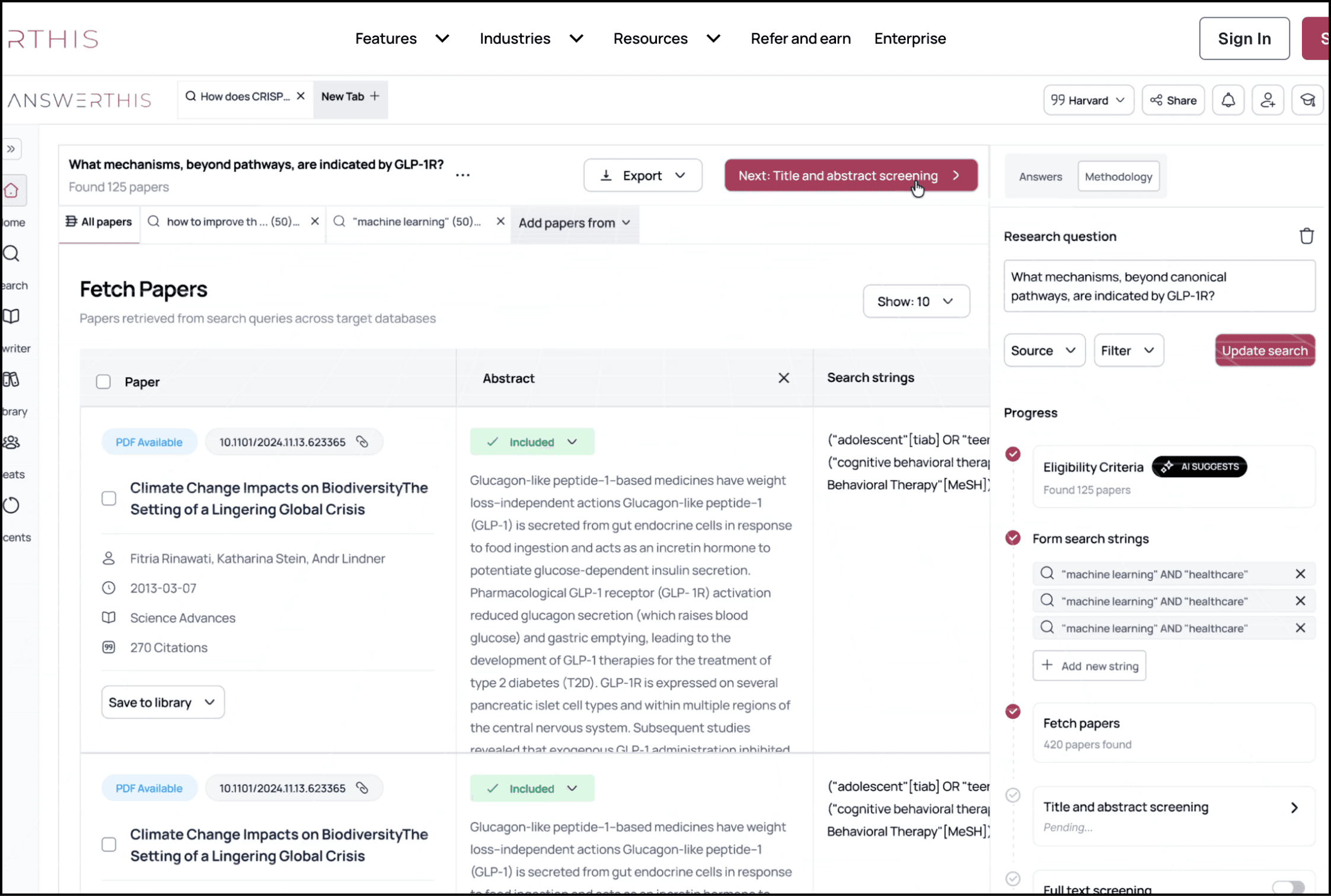
AnswerThis systematic review software supports a faster route through citation-backed answers and generated systematic literature reviews. Its stated scope includes PRISMA/Cochrane-compliant SLRs. Use those outputs within your documented methods, not as a substitute for deciding eligibility or assessing study quality.
AnswerThis is best for researchers who need citation-backed literature synthesis. Its limitation in your workflow is that generated text still requires verification against the cited source. A citation can identify a paper without proving that the sentence accurately represents its methods, results, or population.
Compare each generated claim with the original text. For your 2026 manuscript, verify that a cited finding concerns the population and outcome you are discussing, rather than a superficially similar topic.
Ask focused questions tied to the review protocol.
Open cited sources before accepting substantive claims.
Check population, study design, and outcome alignment.
Distinguish author conclusions from measured results.
Retain conflicting findings rather than smoothing them away.
Keep verified notes separate from unverified draft text.
Screen records with consistent eligibility rules
A spreadsheet is a workable manual starting point for recording eligibility decisions. Use stable record identifiers, a controlled list of exclusion reasons, and separate fields for title-and-abstract screening and full-text assessment. Avoid burying decisions inside free-text comments.
Before screening the full collection, run a pilot batch. As a practical starting exercise, have 2 reviewers independently assess 5 papers, then discuss disagreements. These are suggested calibration quantities, not a universal methodological standard.
Public health eligibility decisions often turn on details that abstracts omit: intervention delivery, population boundaries, outcome definitions, or the difference between a policy description and an evaluation. Check the full text when those details determine inclusion.
The core screening workflow should distinguish identification, screening, extraction, appraisal, and synthesis. Each phase answers a different question; merging them makes errors harder to locate.
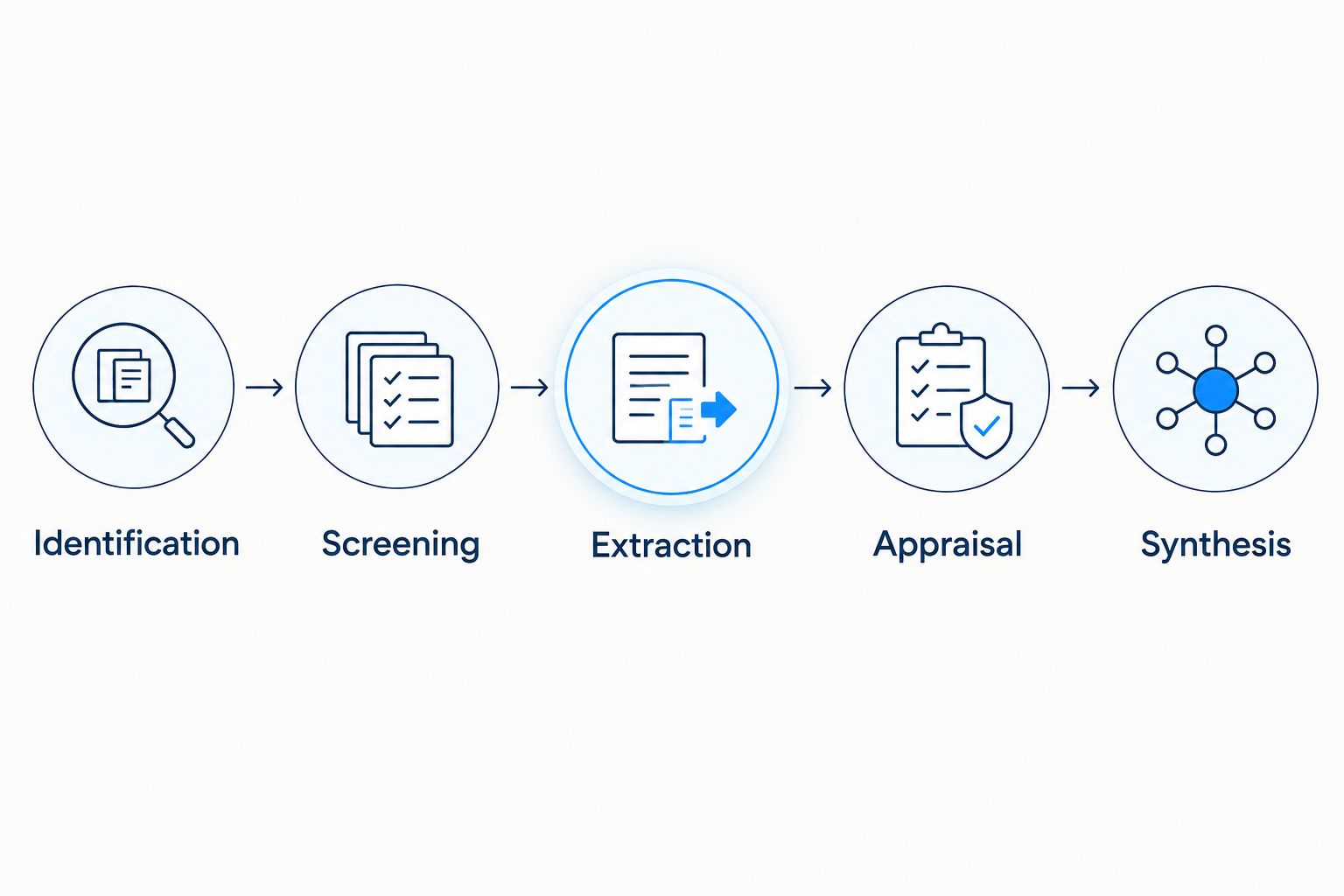
Keep eligibility decisions separate from appraisal and synthesis.
Resolve disagreements through a documented process. Do not silently overwrite the original decision when a reviewer changes their assessment.
Assign a stable identifier to every record.
Separate duplicate removal from eligibility exclusions.
Pilot the criteria before screening the full collection.
Record full-text exclusion reasons consistently.
Preserve reviewer decisions and their resolution.
Reconcile record counts before preparing the flow diagram.
Extract context and assess bias before combining findings
Build an extraction template in a spreadsheet before choosing an automated route. Test it on contrasting study designs so the template captures the differences your review needs to explain. A form designed only for randomized trials will miss relevant features of observational research.
Extract more than the headline result. Public health decisions depend on who received an intervention, where it operated, how it was delivered, and what resources implementation required. Record follow-up periods and outcome definitions as reported, without converting unlike measures into apparently equivalent findings.
Use a critical appraisal approach appropriate to each study design. Risk-of-bias assessment concerns how a study was conducted; applicability concerns whether its evidence fits your question. Keep both visible.
For broader guidance on appraisal and synthesis decisions, refer to the Cochrane Handbook for Systematic Reviews of Interventions and adapt the approach to the designs and questions in your public health review.
For a 2026 evidence review, distinguish publication date from the period when data were collected. Those dates answer different questions about currency and context.
Record population characteristics and recruitment methods.
Capture setting, delivery conditions, and implementation details.
Copy outcome definitions and measurement time points accurately.
Extract effect estimates with their reported uncertainty.
Record study funding and declared conflicts when relevant.
Document bias judgments with supporting passages.
Check extracted values against the source before synthesis.
Synthesize findings and preserve the reporting trail
Start manually by grouping studies according to the review question: intervention, population, setting, outcome, or study design. Write a structured account of agreement and disagreement before deciding whether a pooled estimate is justified.
Do not treat the number of favorable studies as a measure of effect. Studies differ in size, precision, design, and susceptibility to bias. Explain what the evidence supports, which populations it covers, and where uncertainty remains.
PRISMA is a reporting guideline, not a certificate that every methodological decision is correct. A completed checklist cannot repair an incomplete search or unsupported synthesis. Match each reporting item to the underlying record that supports it.
Use the official PRISMA statement and resources to check reporting expectations alongside the underlying methods and decision records.
Keep your 2026 review reproducible by saving the protocol, search logs, screening decisions, extraction files, and appraisal rationale. Follow institutional requirements for storage and access, particularly when uploaded materials contain restricted information.
Group studies using explicit, question-relevant categories.
Explain differences in design, setting, and outcome measurement.
Justify quantitative pooling or narrative synthesis.
Link conclusions to extracted evidence and appraisal findings.
Reconcile the manuscript with the review flow counts.
Preserve dated versions of methods and working files.
Compare options by the work you need to complete
There is no single option that removes every review task. A spreadsheet offers direct control over fields and decisions; a reference manager organizes citations; citation-backed synthesis helps you work through literature. Each has a distinct limitation.
AnswerThis systematic review software is a fit for citation-backed research synthesis, based on its stated capabilities. Before adopting it for a team workflow, check requirements such as reviewer permissions, screening records, export formats, and institutional data handling rather than assuming those functions are included.
If you are comparing dedicated screening and review-management platforms, see the Covidence alternatives comparison and test each option against your protocol and team workflow.
Shared spreadsheet and documented manual review
Best for: Small teams defining a custom extraction or screening process
Main advantage: You control fields, eligibility reasons, and decision records
Key limitation: Consistency depends on careful file management and reviewer discipline
Reference manager with a separate review log
Best for: Researchers organizing citations alongside a documented workflow
Main advantage: Citation organization remains separate from methodological decisions
Key limitation: Citation management alone does not document the full review process
AnswerThis
Best for: Researchers needing citation-backed answers and literature synthesis
Main advantage: Generates answers and systematic literature reviews from over 250 million verified academic papers, trials, and PDFs
Key limitation: Generated claims require source verification; confirm any additional workflow requirements separately
Choose by the task that creates your bottleneck. If reviewers disagree about eligibility, fix the protocol and calibration process. If citation-backed drafting is the bottleneck, evaluate synthesis support. Changing software does not resolve an ambiguous research question.
Common mistakes public health researchers make
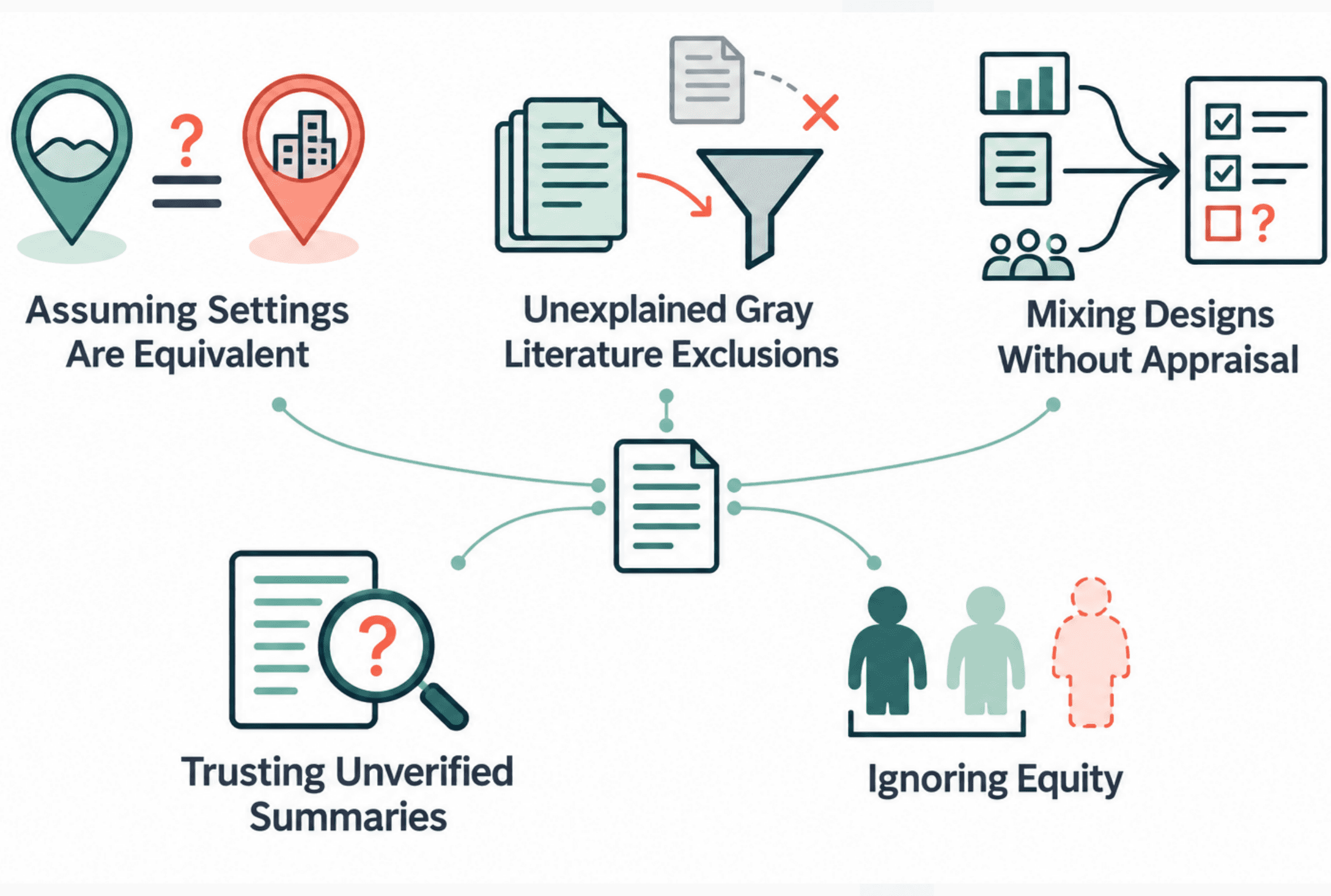
Treating different settings as interchangeable
An intervention’s effect and its transferability are different judgments. Extract implementation conditions and population characteristics so your discussion can distinguish demonstrated effects from assumptions about another setting.
Excluding gray literature without explaining the decision
Public health evidence can include government reports and program evaluations. Decide whether those sources belong in scope, record how you searched them, and explain exclusions rather than allowing software coverage to define the review question.
Mixing study designs without an appraisal plan
Observational associations and randomized intervention effects require different interpretation. Group evidence deliberately, apply suitable appraisal methods, and explain how study design affects the strength of your conclusions.
Treating a cited summary as verified evidence
A citation is a route to a source, not a completed fact check. Confirm the actual outcome, comparison, and study population before using a generated sentence in a manuscript or policy brief.
For a focused final verification step, consult the guide to checking AI citations and retracted papers before incorporating generated summaries into a review manuscript or policy brief.
Ignoring equity during extraction
An overall effect does not describe every population subgroup. Record available subgroup evidence and missing information; do not infer benefits for groups that the included studies did not examine.
FAQs
What should systematic review software support for public health research?
The right software should support the parts of your workflow that need to be documented, such as searching, screening, citation organisation, data extraction, synthesis, and reporting. Choose based on the evidence trail your review must defend, not just the length of a feature list.
Can software complete a systematic review without researcher checks?
Software output does not replace researcher verification of eligibility, extraction, appraisal, and conclusions. Check generated claims against original sources and retain the decision records supporting your review.
Does PRISMA compliance mean a review is methodologically sound?
No. PRISMA supports transparent reporting, but reporting completeness does not establish that the search, appraisal, or synthesis methods were appropriate.
Can I use a spreadsheet for a public health systematic review?
Yes, a spreadsheet can record screening decisions and extracted data. Use stable identifiers, controlled exclusion reasons, version management, and a documented process for resolving reviewer disagreements.
How can AnswerThis support a public health systematic review?
AnswerThis can help researchers develop citation-backed literature synthesis, organise relevant sources, and draft structured summaries. It supports the evidence-review workflow, while the research team remains responsible for the protocol, eligibility decisions, critical appraisal, and final conclusions.
Conclusion
Keep an exclusion example beside every eligibility rule. A rule such as community-based intervention becomes easier to apply when reviewers also see an example that falls outside it. Save those examples with your protocol so a replacement reviewer can understand the boundary without reconstructing earlier discussions.


