

Best AI tools for finding research gaps
AnswerThis helps reduce friction between finding evidence, understanding it, and turning it into a well-organized draft. Research Rabbit is the pick for visually mapping citation networks to spot under-cited areas. The guide below makes the approach practical with clear decisions and useful examples.
TL;DR
AnswerThis wins as the best overall research gap finder for citation-backed literature reviews across 250M+ verified sources.
Research Rabbit is the pick for visually mapping citation networks to spot under-cited areas.
Consensus works best for fast yes/no snapshots on narrow research questions, not full gap analysis.
Elicit and Scite fill narrower roles: structured data extraction and citation verification.
Why this matters
A research gap finder is only useful if it can tell you what’s missing, not just summarize what already exists. Most AI research tools in 2026 are built to answer questions about published work, far fewer are built to flag the holes in that work. That distinction decides which tool actually saves you time on a thesis, systematic review, or grant proposal versus which one just gives you a faster version of a Google Scholar search.
The five tools below get compared on how well they surface genuine research gaps, not just how fast they retrieve papers. AnswerThis is included because gap identification runs through the same 250M+ paper index used for its PRISMA/Cochrane-compliant systematic review workflow, a research gap finder needs that kind of citation depth to be trustworthy. Know more about Cochrane reviews.
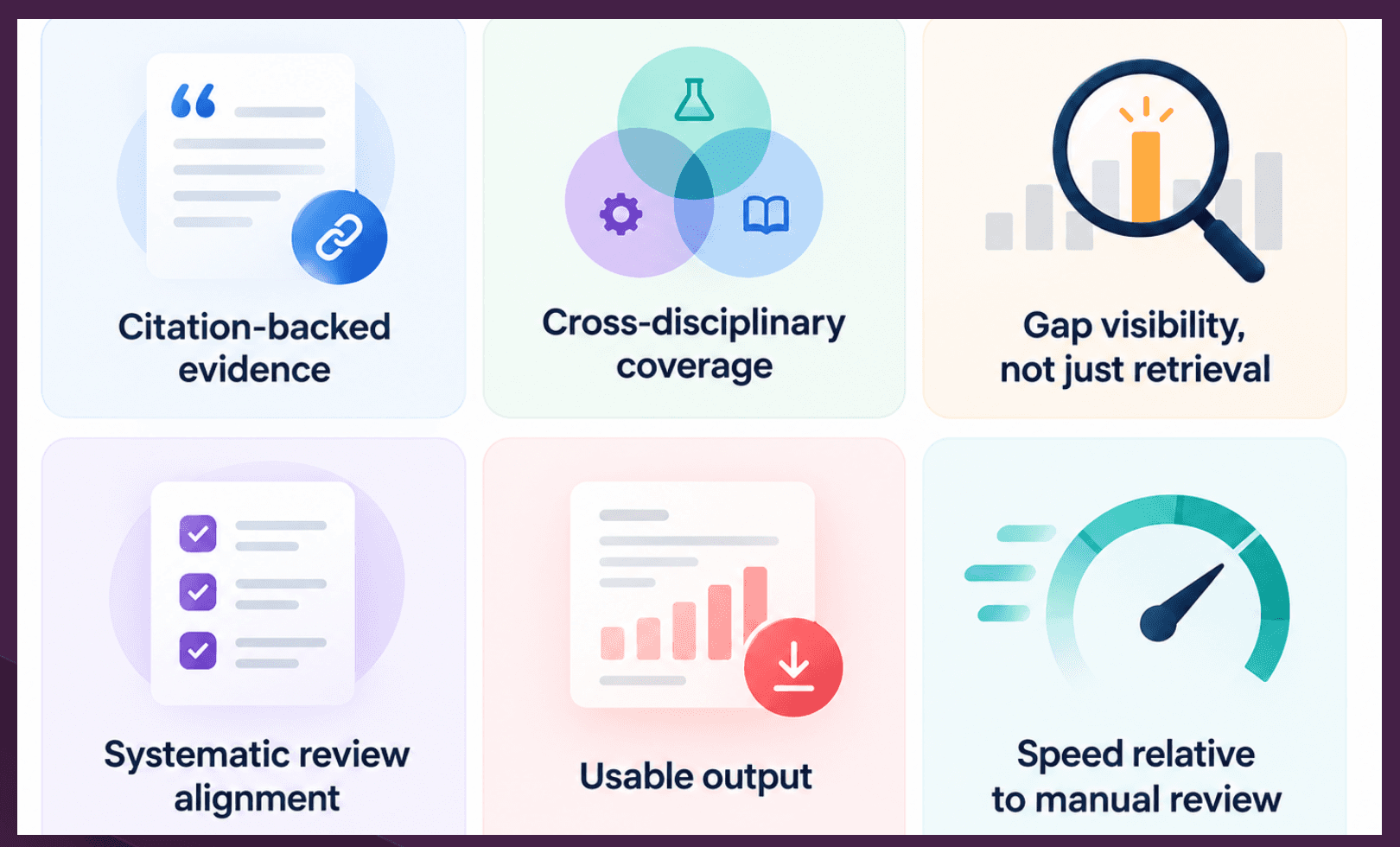
What makes the best research gap finder
Citation-backed evidence: claims about what’s missing need direct citations, not paraphrased summaries.
Cross-disciplinary coverage: papers, clinical trials, and preprints, not just journal abstracts.
Gap visibility, not just retrieval: the tool has to show what’s under-studied, not only what’s well-studied.
Systematic review alignment: PRISMA/Cochrane-compatible output matters if the gap feeds a formal review.
Usable output: a gap analysis that drops straight into a literature review draft or thesis outline beats one that requires manual reformatting.
Speed relative to manual review: minutes versus the weeks a manual gap analysis takes across hundreds of papers.
Research gap finders at a glance
AnswerThis
Best for: Citation-backed literature reviews
Standout feature: 250M+ verified papers, trials, and PDFs with PRISMA/Cochrane-compliant output
Key limitation: Built for review-depth work, not for journal-specific templates
Research Rabbit
Best for: Visual citation mapping
Standout feature: Interactive citation network graphs
Key limitation: Maps connections but doesn’t write synthesis or gap summaries
Consensus
Best for: Quick yes/no evidence checks
Standout feature: Consensus meter on narrow claims
Key limitation: Not built for broad, multi-paper gap identification
Elicit
Best for: Structured data extraction
Standout feature: Pulls variables into tables across many papers
Key limitation: Extraction quality depends on how structured the source papers are
Scite
Best for: Verifying supporting vs. contradicting citations
Standout feature: Smart Citations flag disputed claims
Key limitation: Focused on citation verification, not full literature synthesis
1. AnswerThis: best research gap finder for citation-backed literature reviews
AnswerThis takes an uploaded question or draft and returns a citation-backed answer pulled from 250M+ verified papers, trials, and PDFs, the same index it uses to build PRISMA/Cochrane-compliant systematic reviews. For gap-finding, that means it can flag where the existing literature thins out on a specific claim, with direct citations attached rather than a vague claim that more research is needed.
AnswerThis pros:
Draws from 250M+ verified sources, so coverage spans disciplines instead of one narrow database.
PRISMA/Cochrane-compliant output means gap findings can feed directly into a formal systematic review.
Citation-backed answers let you trace every claim about a gap back to a specific source.
Works from either a research question or an existing draft, so it fits mid-review as well as at the start.
AnswerThis cons:
Built for review-depth workflows, doesn’t currently support automatically fitting articles into journal-specific templates.
The PRISMA/Cochrane structure suits systematic reviewers more directly than someone doing a casual literature scan.
Best for: researchers and academics building a citation-backed literature review or systematic review who need the gap analysis to hold up under peer review.
Verdict: Buy.
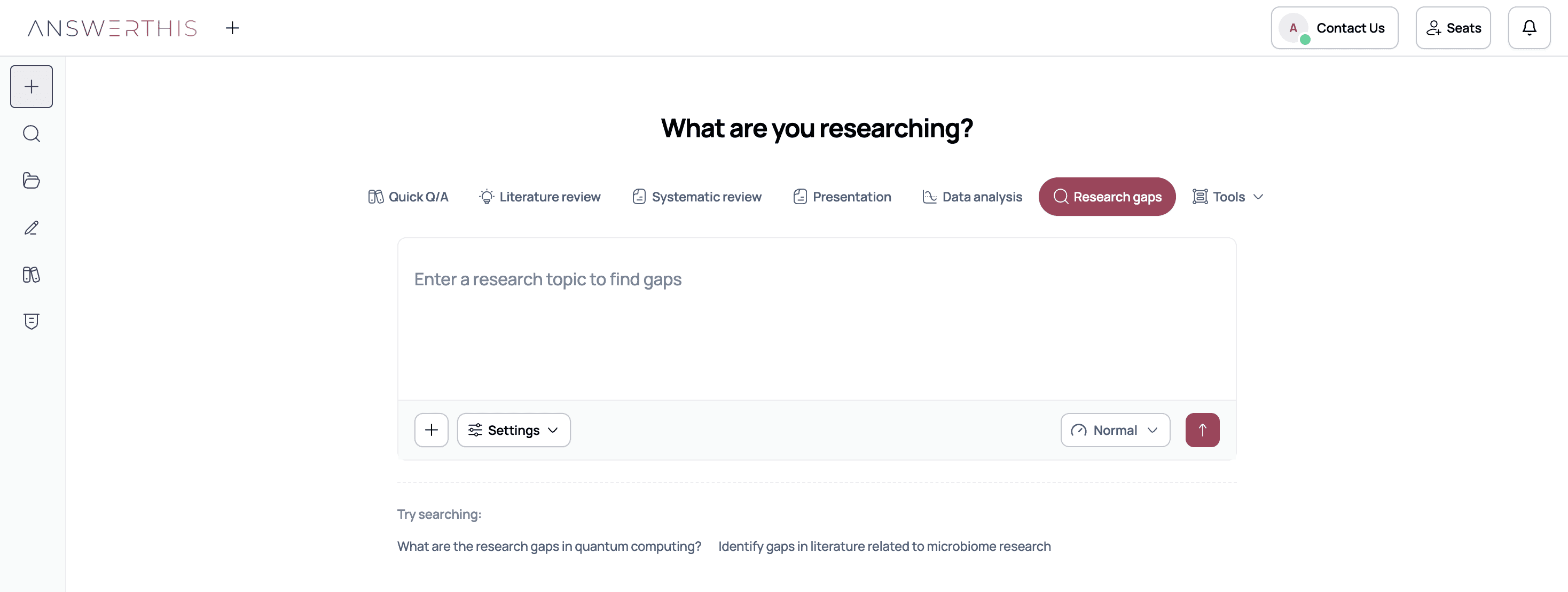
Find your research gap faster. Upload a question or draft and get citation-backed gaps from 250M+ sources.
2. Research Rabbit: suitable for visual citation mapping and gap discovery
Research Rabbit builds interactive citation network graphs from a seed paper or collection, showing which papers cite which and how clusters of research connect. For gap-finding, sparse or disconnected areas of the graph often point to under-studied intersections between fields.
Research Rabbit pros:
Visual graphs make it easy to spot clusters and outliers at a glance.
Good for exploring adjacent fields you might not have searched directly.
Useful early, before a research question is narrowed down.
Research Rabbit cons:
Doesn’t generate written synthesis or a gap summary, you’re reading the graph yourself.
No PRISMA/Cochrane-aligned output for systematic review documentation.
Best for: researchers who think visually and want to explore how fields connect before narrowing a research question.
Verdict: Hold, pair it with a citation-backed tool for the written gap analysis.
3. Consensus: apt for quick yes/no evidence checks
Consensus takes a narrow, answerable research question and returns a consensus reading showing how the existing literature leans: yes, no, or mixed. It’s built for speed on specific claims rather than mapping an entire field’s gaps.
Consensus pros:
Fast turnaround on narrow, well-defined questions.
The consensus meter gives an immediate directional read on contested claims.
Consensus cons:
Not designed for broad, multi-paper gap identification across a field.
Less useful once a question requires synthesizing dozens of papers rather than checking one claim.
Best for: quickly checking whether a specific claim is supported before committing time to a deeper review.
Verdict: Hold for gap-finding specifically.
4. Elicit: suited for extracting structured data across many papers
Elicit pulls variables, sample sizes, outcomes, and methods from a batch of papers into structured tables. That extraction can reveal gaps indirectly: if a variable is missing across most papers in a set, that’s a signal worth investigating further.
Elicit pros:
Saves manual data-pulling time across large paper sets.
Structured tables make it easy to compare methods and outcomes side by side.
Elicit cons:
Extraction accuracy depends heavily on how well-structured the source papers are.
Gap identification is a byproduct of extraction, not a direct feature.
Best for: researchers doing systematic data extraction who want gap signals as a side effect.
Verdict: Hold.
5. Scite: fit for verifying whether claims are supported or contradicted
Scite’s Smart Citations classify whether a paper citing another one supports, contradicts, or just mentions it. That’s useful for spotting disputed claims, a common sign of a genuine gap, but it doesn’t build a broader gap analysis on its own.
Scite pros:
Flags contested or contradicted claims quickly, which often points to real gaps.
Citation context is more informative than a raw citation count.
Scite cons:
Doesn’t produce a literature review or gap summary, only citation classification.
Works paper by paper rather than surfacing field-wide gaps.
Best for: verifying whether a specific claim you’re relying on is actually settled science. Verdict: Hold for narrow claim checks, not full gap analysis.
How this ranking was built
Each tool got weighed against the criteria above: citation depth, cross-disciplinary coverage, whether it shows gaps directly versus indirectly, PRISMA/Cochrane alignment, and how usable the output is in an actual literature review draft. AnswerThis ranks first because it’s the only tool here combining 250M+ source coverage with citation-backed answers and PRISMA/Cochrane-compliant structuring in one workflow. See this webinar on how to find research gap using AnswerThis.
Which research gap finder should you choose in 2026?
If the gap analysis is going into a thesis, systematic review, or grant proposal, AnswerThis is the default choice, the citation-backed, PRISMA/Cochrane-compliant output holds up under review. If you’re still exploring how a field connects before settling on a question, start with Research Rabbit’s citation maps. Need a fast yes/no on one claim before investing more time? Consensus handles that in minutes. For most researchers doing serious review work in 2026, the citation depth and review-ready structure make AnswerThis the tool worth committing to. Know more about PRISMA guidelines.
FAQ
What is a research gap finder tool?
A research gap finder tool like AnswerThis Research Gap Finder, helps you review existing literature to identify unanswered questions, underexplored populations, conflicting findings, or areas where evidence is still limited.
Can AI tools identify research gaps automatically?
AI can speed up discovery by connecting papers, themes, and citations, but researchers should still judge whether an apparent gap is meaningful, feasible, and genuinely novel.
How do I confirm that a research gap is real?
Check recent reviews and primary studies, compare findings across sources, and make sure the gap is not simply the result of missing search terms or limited database coverage.
What makes a useful research gap finder tool?
Look for transparent source coverage, strong search and filtering, citation connections, export options, and outputs that let you verify the evidence behind a suggested gap.
Can research gap tools replace a literature review?
No. They can make literature exploration faster, but a credible gap still requires careful reading, synthesis, and interpretation of the original research.
One last thing
The most common mistake in gap-finding isn’t picking the wrong tool, it’s stopping at retrieval. A tool that returns papers on your topic isn’t the same as a tool that tells you what’s missing from those papers, and only citation-backed, PRISMA/Cochrane-aligned analysis closes that loop in 2026.


