How Much Does a Cochrane Review Cost? Full Breakdown

Dr. Rajni Garg
Executive Lead, Research & Content Strategy
6 min read

A Cochrane review costs in the region of $140,000 to produce, and almost all of that is the author team’s time. The most widely cited estimate puts the salary cost of an average systematic review at $141,194.80, and Cochrane reviews follow some of the most demanding methods in the field. Cochrane does not publish a price of its own, because author time is usually paid for by universities, hospitals and research funders.
The other costs are small by comparison. Cochrane charges $5,100 if you choose immediate gold open access, and nothing if you choose green open access. Review software such as RevMan Web and Covidence is free for registered Cochrane reviews. This guide breaks down each cost, shows how the $141,000 figure was built, and gives you a formula for your own budget.
TL;DR
Team time is the main cost: about $141,195 per review in salary on a 2019 US estimate, based on 1.72 full-time scientist-years.
Publishing in the Cochrane Library is free under green open access. Gold open access costs $5,100 for a review, or $2,550 for an update when the original review’s charge was paid.
RevMan Web and Covidence are free for registered Cochrane reviews. Non-Cochrane teams pay for both.
Database subscriptions, document delivery, translation and statistical support are real costs, often hidden in institutional budgets.
To estimate your own labor cost, multiply total person-hours by your team’s hourly salary cost.
Where does the $141,194 figure come from?
Michelson and Reuter’s paper in Contemporary Clinical Trials Communications built the estimate from three published inputs. They averaged earlier estimates of 6 and 16 months per review to get 11 months of work at about 15 hours a week. With five co-authors working at that pace, a review uses 1.72 full-time scientist-years. Multiplied by the median US scientist salary of $82,090 from the Bureau of Labor Statistics, that gives $141,194.80.

They then scaled it up. The ten most heavily NIH-funded institutions published an average of 132.16 reviews a year, which works out to $18,660,304.77 per institution each year. For the ten largest pharmaceutical companies, after adjusting for reviews that go unpublished, the figure was $16,761,234.71.
Two cautions keep the number honest. It counts salary only, with no overheads, software or fees. And it uses US salaries from 2019, so your figure will differ by country, seniority and year. The method is more useful than the total, because you can rerun it with your own numbers.
The line-by-line cost of a Cochrane review
Cost item | Typical amount | Source |
|---|---|---|
Author team time | About $141,000 on the US 2019 estimate, more or less with your salaries | |
Gold open access charge | $5,100 per review, $2,550 for an update if the review’s charge was paid | |
Green open access | Free, with the full article free to read 12 months after publication | |
RevMan Web | Free for Cochrane reviews. Non-Cochrane individual subscriptions are listed at £80, £100 or £130 a year plus VAT | |
Covidence | Free for registered Cochrane reviews linked to a Cochrane account. Otherwise $339 a year for one review or $907 for up to three | |
Databases such as Embase and CINAHL | Usually covered by an institutional subscription | Your library |
Full texts, interlibrary loans and translations | Varies with the number of included studies | Your library and budget |
Information specialist and statistician time | Part of the team cost, often shared across projects | Your institution |

Cochrane also offers waivers for the open access charge. First authors based in Research4Life Group A or B countries may qualify when their funding does not cover publication charges. The Cochrane Library page asks them to contact their Managing Editor before signing the licence form.
How long does the work take?
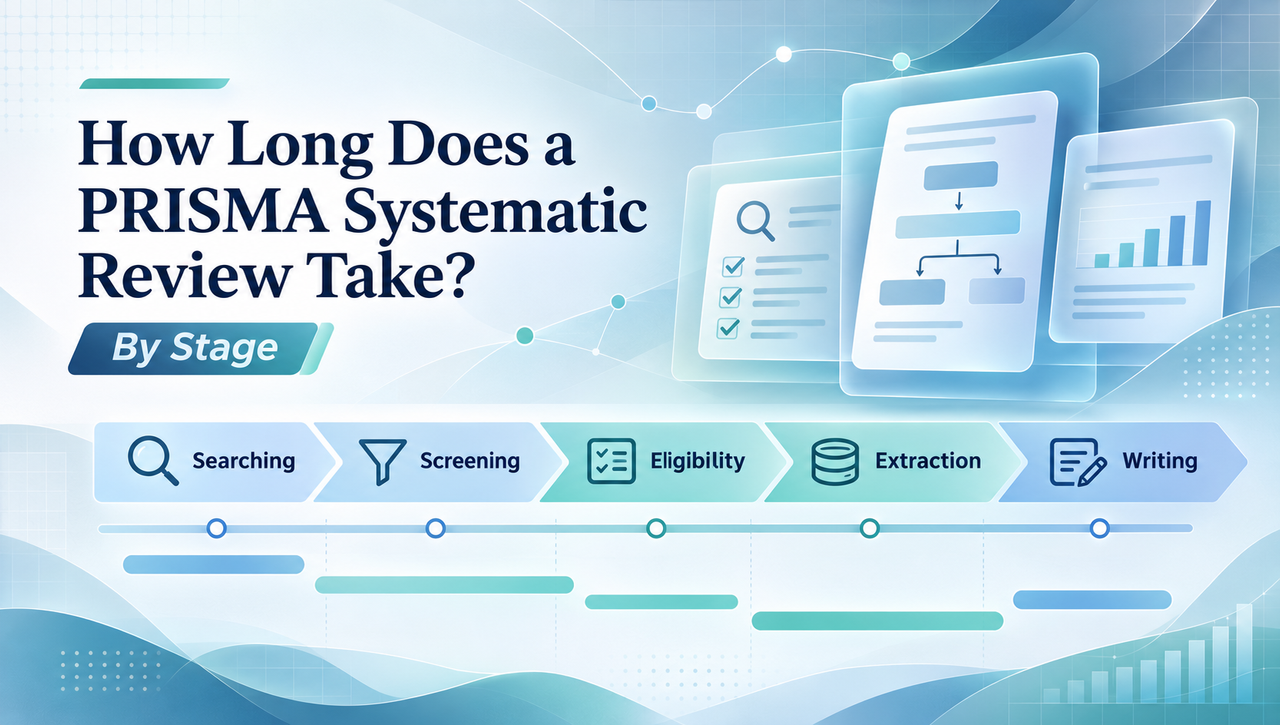
Time drives cost. Reviews registered in PROSPERO took 67.3 weeks on average to reach publication in the analysis by Borah et al. (2017), with five authors on a typical team. That fits the 11 months of active work in Michelson and Reuter’s model once journal review is added.
The fastest documented case is far shorter. An automation-heavy project at Bond University finished a full review in 61 person-hours across 12 calendar days. At the same median salary used above, about $39.50 an hour, that is roughly $2,400 of labor. It shows how much of the usual cost goes on manual, repeatable steps rather than on judgment.
Estimate your own review’s cost
You can adapt the published method in three steps.
Estimate total hours: people × hours per week × weeks. Divide by about 2,080 to convert to full-time years if you like.
Multiply by your team’s hourly salary cost. Use loaded salaries, meaning salary plus benefits and overheads, if your funder asks for full costs.
Add the fixed items: the open access charge if you choose gold, software if you are not a Cochrane team, and any document delivery or translation.
Here is a worked example. Four people giving 10 hours a week for 48 weeks is 480 hours each, or 1,920 hours in total. At the paper’s median salary of about $39.50 an hour, that is roughly $75,800 of labor. Michelson and Reuter’s model, with five people at 15 hours a week for 11 months, comes to about 3,575 hours, nearly twice as much. Hours per week and the number of people are the two levers that move your budget most.

Why Cochrane reviews can cost more than other systematic reviews
Cochrane reviews follow demanding methods, set out in the Cochrane Handbook and the MECIR conduct and reporting standards. These expect a comprehensive search across several databases, independent dual screening and extraction, formal risk of bias assessment and a structured rating of the certainty of evidence. Each adds reviewer hours. Each also adds value, which is why Cochrane reviews carry so much weight in clinical guidelines.
Updates usually cost less than new reviews, because the protocol, search strategy and much of the extraction already exist. Cochrane also halves the open access charge for an update when the original review’s charge was paid.
How teams reduce the cost
Write a tight protocol, so the search returns what you need and not much more. The AnswerThis search string builder gives you an editable first draft of your search for any of 12 databases and search engines.
Test the search against known studies before running it everywhere.
Use the free tools that come with Cochrane registration, such as RevMan Web and Covidence.
Use automation for repeatable steps. Cochrane itself, in a 2025 position statement written with its evidence synthesis partners, accepts AI use when authors can show it does not compromise rigor, provided people oversee it and report it clearly.
Draft risk of bias assessments with AI and have reviewers confirm them. The risk of bias assessment tool prepares a draft appraisal of a single study under RoB 2, ROBINS-I, QUADAS-2, the Newcastle-Ottawa Scale or a JBI checklist.
Choose green open access if there is no publication budget. The review is still published in the Cochrane Library and becomes free to read after 12 months.
For a fuller view of the method behind these costs, see our explainer on systematic reviews and meta-analyses and our step-by-step guide to conducting a systematic literature review.
Where AnswerThis fits
Several of the most time-consuming steps have a free AnswerThis tool behind them. At the analysis stage, the AnswerThis effect size calculator works out Cohen’s d, Hedges’ g, paired effects, odds ratios or Pearson r from your summary statistics. It is free as often as you need it and asks for no account, which makes it an easy way to double-check numbers before they reach your meta-analysis software.
Earlier in the project, the search string builder drafts your search and the risk of bias assessment tool drafts each appraisal for your reviewers to confirm. Together they target the hours that make up most of the budget.

FAQs
Is it free to publish a Cochrane review?
Yes, under green open access, where the full review becomes free to read 12 months after publication. Immediate gold open access costs $5,100 for a review.
Does Cochrane pay authors to write reviews?
Cochrane does not list payments to authors for producing reviews. Author time is usually covered by employers, research grants or the authors themselves, which is why the labor cost often stays invisible.
How much does a non-Cochrane systematic review cost?
The labor cost is similar, since the same methods take similar time. Non-Cochrane teams usually pay for screening and analysis software, such as Covidence at $339 a year for a single review, and publication fees vary by journal.
Why is a systematic review so expensive?
Because it is labor-intensive. Screening thousands of records in duplicate, extracting data and assessing bias all take skilled people many hours, and Borah’s data put the average at more than a year from start to publication.
Can AI make a Cochrane review cheaper?
It can cut the time spent on repeatable steps such as search drafting, screening support and data extraction, which is where most of the hours go. The 2025 position statement still expects people to oversee the AI and to document which tool and version they used and how they validated it.
Budget for people first, then the fixed fees. Start with a tested search from the search string builder and check your pooled numbers with the effect size calculator.