Types of Literature Reviews: Which Review Type Fits Your Question? (2026)

Dr. Rajni Garg
Executive Lead, Research & Content Strategy
8 min read

The main types of literature reviews are narrative reviews, systematic reviews, meta-analyses, scoping reviews, rapid reviews, umbrella reviews, integrative reviews, qualitative evidence syntheses, mapping reviews and realist reviews. Choose by your question: an overview or argument calls for a narrative review, “does it work?” for a systematic review (plus a meta-analysis if the results can be pooled), “what research exists?” for a scoping review or evidence map, and “why” or “for whom” for a qualitative or realist synthesis.
The other types solve practical problems. A rapid review fits a deadline, an umbrella review fits a topic that already has several systematic reviews, and an integrative review fits evidence of very different kinds. These types of reviews in research are not ranked. Each has its own rules and, usually, its own reporting guideline.
TL;DR
Match the type to your question, not to how rigorous it sounds.
Most formal types have their own reporting guideline, from PRISMA 2020 to RAMESES. Narrative reviews have SANRA, a quality scale.
Sourced time figures are scarce. We found them for three types: systematic reviews, Cochrane rapid reviews and Campbell evidence and gap maps.
Used some systematic steps but not all? Call it a systematized review.
Decision table: which review type fits your question?
Find the row closest to your question. Times appear only where we found a published source.
Your question or goal | Review type | Reporting guideline or quality tool | Typical time |
|---|---|---|---|
Give an expert overview of a broad topic, or argue a position | Narrative review | None. SANRA (6 items, scored 0 to 12) rates quality | No reliable figure |
Test whether an intervention works, using every eligible study | Systematic review | PRISMA 2020 (27 items) | Mean of 67.3 weeks to complete and publish (Borah et al. 2017) |
Pool comparable numeric results into one estimate | Meta-analysis, usually inside a systematic review | PRISMA 2020, within the systematic review | No separate figure |
Map what research exists on a broad topic, and the gaps | Scoping review | PRISMA-ScR (20 essential and 2 optional items) | No reliable figure |
Answer a decision-maker’s question on a deadline | Rapid review | Cochrane rapid review guidance; PRISMA 2020 plus interim items until PRISMA-RR is out | Six months at most for Cochrane rapid reviews (Garritty et al. 2024) |
Pull together existing systematic reviews | Umbrella review (overview of reviews) | PRIOR (27 items) | No reliable figure |
Combine experimental, non-experimental and theoretical sources | Integrative review | None of its own; method from Whittemore and Knafl (2005) | No reliable figure |
Understand experiences, views or acceptability | Qualitative evidence synthesis (meta-synthesis, meta-ethnography) | ENTREQ (21 items); eMERGe (19 criteria) for meta-ethnography | No reliable figure |
Show where evidence is dense or missing | Systematic map or evidence and gap map | ROSES; Campbell map guidance and checklist | 6 to 12 months for a Campbell map (White et al. 2020) |
Explain why a complex program works for some, not others | Realist review | RAMESES (19 items) | No reliable figure |
Use some systematic steps, but not the full method | Systematized review | None | No reliable figure |
Each guideline links to its paper: PRISMA 2020, PRISMA-ScR, PRIOR, ENTREQ, eMERGe, ROSES, RAMESES and SANRA. The systematic review time comes from Borah and colleagues’ study of 195 PROSPERO-registered reviews. The type names follow two typologies, by Grant and Booth (2009) and Sutton et al. (2019), both in the Health Information and Libraries Journal.

The ten review types, one at a time
Narrative review
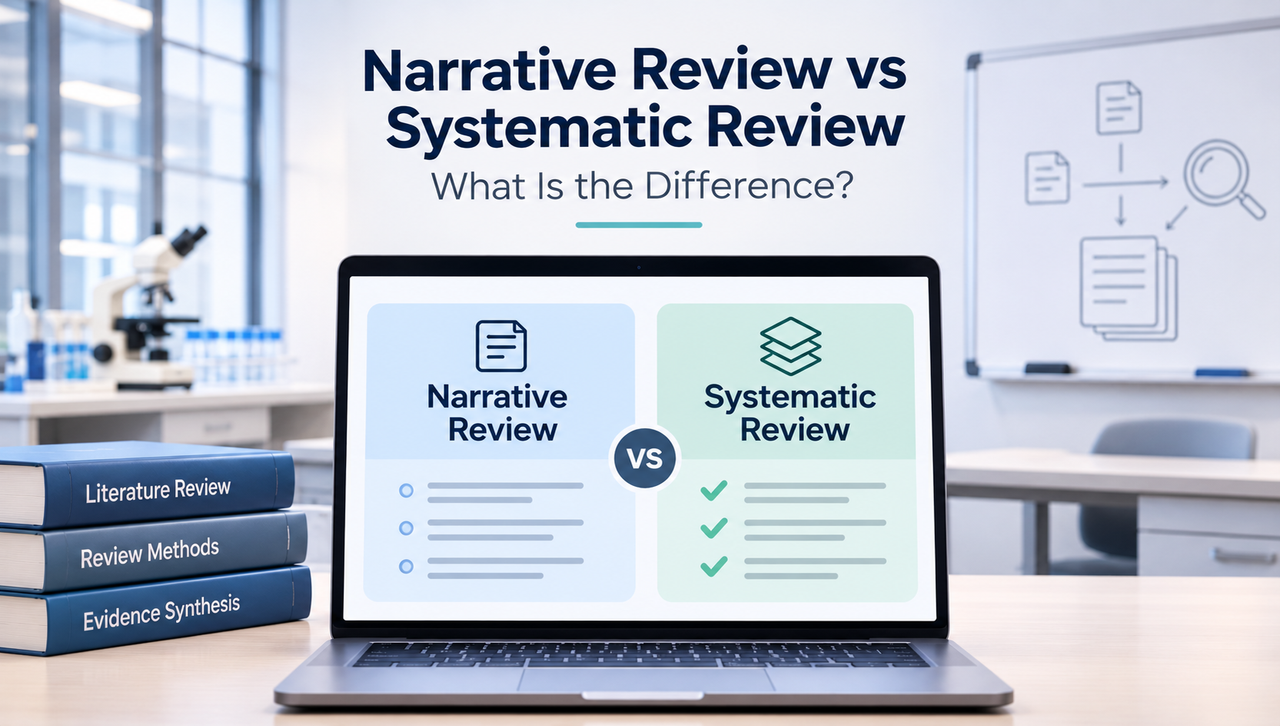
A narrative review is an expert’s reading of a field. You choose the sources, interpret them and argue a case, without claiming to have found everything. See narrative review vs systematic review for when that freedom helps and how SANRA scores it.
Systematic review
A systematic review answers one focused question from all the eligible studies. It runs on a protocol fixed in advance, a search designed to miss nothing, two people screening independently and a risk of bias check for each study. Our systematic review explainer sets out the method.
Meta-analysis
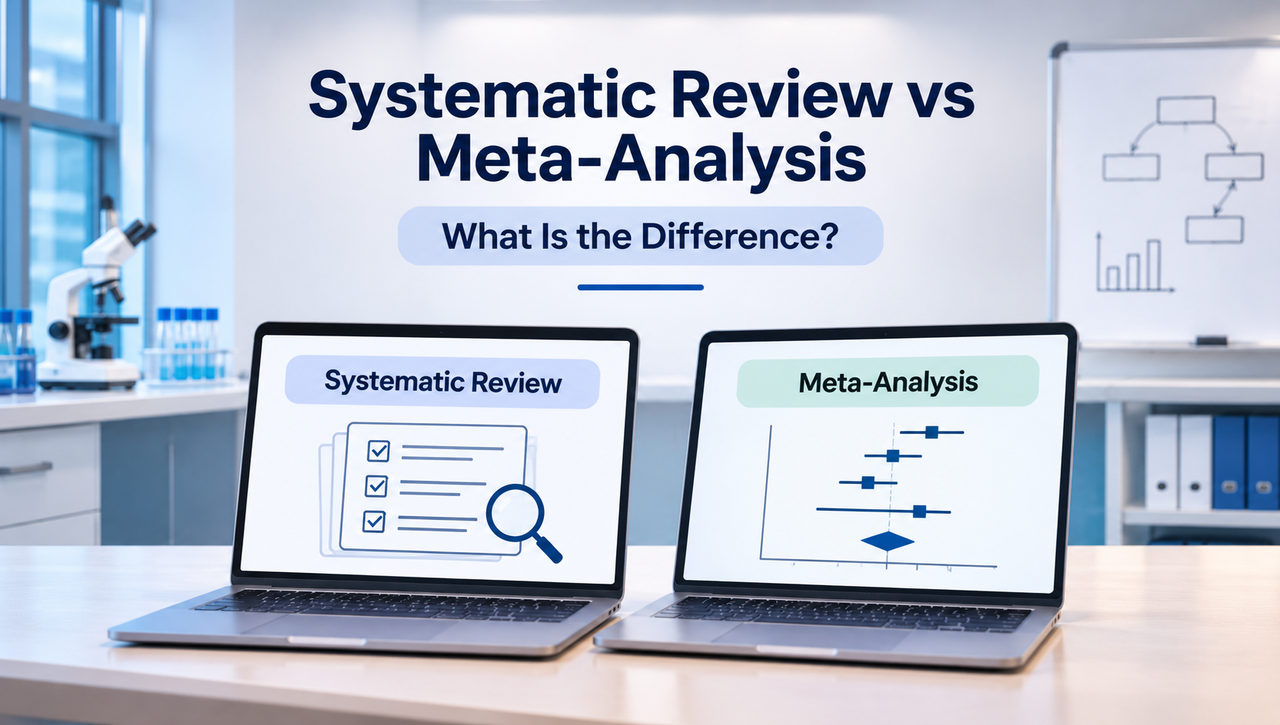
A meta-analysis is a statistical step more than a review type. It pools comparable results from two or more studies into one estimate, usually inside a systematic review. Read systematic review vs meta-analysis to see when pooling is sound.
Scoping review
A scoping review charts what has been studied on a broad topic, and how, instead of asking whether something works. It needs a protocol and reports with PRISMA-ScR, but appraising each source is usually optional. For the steps, read what is a scoping review.
Rapid review
A rapid review is a systematic review with some steps simplified or dropped, so the answer arrives in time for a decision. The Cochrane Rapid Reviews Methods Group’s updated guidance (Garritty et al. 2024) makes 24 recommendations and says Cochrane rapid reviews should take six months at most. Its shortcuts include:
Searching a small number of bibliographic databases, but at least two.
One person extracting data and judging risk of bias, with a second person verifying.
Date limits only with a stated reason, and any English-language limit applied at study selection, not in the search.
It also asks you to involve the review’s users in setting the question. A PRISMA extension for rapid reviews, PRISMA-RR, is still in development, so the group’s interim reporting guidance (Stevens et al. 2024) says to build on PRISMA 2020. Report every shortcut, because readers need to know what the speed cost.
Umbrella review (overview of reviews)
An umbrella review collects systematic reviews instead of primary studies. Chapter V of the Cochrane Handbook calls these overviews, notes they also go by umbrella reviews, reviews of reviews or meta-reviews, and makes the review your unit of search, inclusion and analysis. Because the reviews already exist, an overview can save time. JBI’s manual gives umbrella reviews a chapter of their own.
The catch is overlap. When one trial sits in three of your reviews, counting it each time inflates its weight. Cochrane suggests a citation matrix showing which studies appear in which reviews, and a “corrected covered area” score to measure the overlap. You also appraise each review, with a tool such as AMSTAR 2 or ROBIS, and report with PRIOR.

Integrative review
An integrative review puts experimental and non-experimental studies, and even theoretical papers, in one review. Whittemore and Knafl (2005), writing in the Journal of Advanced Nursing, set out five stages: problem identification, literature search, data evaluation, data analysis and presentation. The analysis borrows from qualitative research. You reduce the data, display it, compare it, then draw and verify conclusions.
That breadth is also the risk. The authors warn that combining diverse methods can lead to a lack of rigor, inaccuracy and bias, so record how you judged each kind of source. No reporting guideline was built for this type, so ask your journal or supervisor which checklist to use.
Qualitative evidence synthesis (meta-synthesis and meta-ethnography)
A qualitative evidence synthesis, or meta-synthesis, pulls together studies built on interviews, focus groups and other qualitative methods. It answers questions about experience, such as how patients live with a condition or what makes an intervention acceptable. The Cochrane-Campbell Handbook for Qualitative Evidence Synthesis gives chapters to framework synthesis, thematic synthesis and meta-ethnography, and introduces meta-aggregation.
Meta-ethnography, developed by Noblit and Hare, has seven phases and builds a new interpretation across studies. The Handbook also covers GRADE-CERQual, which rates how much confidence readers can place in each finding. Report with ENTREQ’s 21 items, or with eMERGe’s 19 criteria for a meta-ethnography.
Mapping reviews: systematic maps and evidence and gap maps
Mapping reviews show where research exists, not what it found. Grant and Booth describe them as a way to categorise a literature and decide where further reviews or primary research should go. Two formal versions are common.
A systematic map, from environmental science, “collates, describes and catalogues available evidence” on a topic. As James, Randall and Haddaway (2016) note, it does not try to answer a specific question the way a systematic review does. Report it with ROSES.
An evidence and gap map (EGM) is the Campbell Collaboration’s version. Its guidance for EGMs (White et al. 2020) describes a matrix with intervention categories as rows and outcomes as columns, so empty cells mark the gaps. Maps “usually show what evidence is there, not what the evidence says.” Appraisal is recommended but not required, and a map may take 6 to 12 months.

Realist review
A realist review asks a sharper question than “does it work?” Pawson and colleagues (2005) put it as “what works for whom, in what circumstances, in what respects and how.” It suits complex programs that succeed in one setting and stall in another, such as a community health worker scheme.
You start by writing down the program theory, your account of how the program is meant to work. Then you test and refine it against the evidence, asking how context triggers mechanisms that produce outcomes. The output is an explanation, not a pooled effect. Report with RAMESES: 19 items agreed by a 37-member Delphi panel.
Systematized reviews: what many student “systematic reviews” really are
Grant and Booth (2009) use the term systematized review for work that borrows some systematic steps, such as a documented search, without the full method, and they link it to postgraduate assignments. If one person screened alone or nobody appraised the studies, that is the accurate label. Our post on systematic review vs literature review shows where the line falls.
Where an AI tool fits
AI is most useful at the first-draft stage. The AnswerThis AI literature review generator suits the start of a narrative, integrative or systematized review. Tell it the topic, the population and the relationship you want to explore (up to 16,000 characters). It retrieves scholarly records, works from their abstracts, and returns an outline, one opening paragraph with citations, linked sources and the search scope, in Standard or Concise wording. Each browser gets three successful free runs, and failed requests do not count.
Use the outline as a starting structure, then add the protocol, screening and appraisal your review type calls for. For the drafting itself, see how to write a literature review.

FAQs
How many types of literature reviews are there?
It depends on who is counting. Grant and Booth (2009) described 14 types. A decade later, Sutton and colleagues (2019) found 48 and grouped them into seven families: traditional, systematic, review of reviews, rapid, qualitative, mixed methods and purpose-specific. This page covers the ten you are most likely to meet.
What is the difference between an umbrella review and a systematic review?
What they include. A systematic review gathers primary studies, such as trials. An umbrella review gathers systematic reviews, so it is only as sound as they are. Each reports with its own checklist: PRISMA 2020 for one, PRIOR for the other.
Should I choose an integrative review or a systematic review?
Choose a systematic review when the question is narrow and the studies are similar enough to judge together, such as trials of one intervention. Choose an integrative review when the answer needs mixed designs, or theory alongside research. Sutton and colleagues place integrative reviews in the traditional family, beside narrative and critical reviews.
Can one review combine two types?
Yes. Sutton and colleagues list the rapid realist review, for example, and the Cochrane-Campbell Handbook has a chapter on integrating qualitative and quantitative evidence. Name both parts in your title and methods, and follow the reporting guidance for each.
Which review types appraise the quality of their sources?
Systematic and rapid reviews assess each study’s risk of bias. Umbrella reviews appraise their included reviews, and qualitative syntheses assess each study’s methodological strengths and limitations. Integrative reviews have a data evaluation stage. Scoping reviews usually skip appraisal, and Campbell recommends it for evidence and gap maps without requiring it.
Matched your question to a type? Get a first outline from the AI literature review generator, then build the method your review type requires.