

Choose a narrative, scoping, or systematic approach before you search. Researchers can use AnswerThis to keep source work, evidence review, and structured writing connected throughout the process. Use the guidance below to translate this starting point into a practical workflow.
TL;DR
A literature review analyses and connects existing studies. It is not an annotated list of summaries.
Choose a narrative, scoping or systematic approach before you search.
Organise the body thematically, chronologically or methodologically, according to the question.
Record methods, samples, findings and limitations in a synthesis matrix before drafting.

What is a literature review, and what is it not?
A literature review is a critical synthesis of published research on a defined topic or question. It establishes what is known, compares theories and methods, explains disagreements, evaluates the strength of the evidence, and identifies gaps that justify further work. It can stand alone as a paper or form part of a thesis, dissertation, research proposal, or journal article.
A literature review is a reasoned account of a field, not a stack of article summaries. It combines evidence from several sources to explain patterns, disagreements, limitations, and unanswered questions. The writer’s contribution is the structure and interpretation: showing how individual studies connect, how much confidence their methods deserve, and what the combined evidence means for the research question.
An annotated bibliography treats sources one at a time. A literature review puts them in conversation. Instead of writing “Smith found X, Jones found Y, and Patel found Z,” ask why the findings differ. The explanation may lie in the sample, setting, measurement, theoretical framework, or period studied.
A strong review does five jobs:
Places a research question within the current scholarly conversation.
Shows areas of agreement, debate, and change.
Evaluates the credibility and relevance of the evidence.
Prevents unnecessary duplication of earlier work.
Identifies a defensible gap or direction for further research.

Which type should you use: narrative, scoping, or systematic?
The right type depends on the question and the standard of reproducibility your project requires. A broad interpretive question may suit a narrative review. A field that has not yet been clearly mapped may need a scoping review. A narrow question about effects, associations or interventions may require a systematic review.
Review type | Best for | Search and selection | Typical output | Main limitation |
|---|---|---|---|---|
Narrative | Explaining concepts, theories and debates | Purposeful and transparent, but not always protocol-led | Interpretive synthesis organised around an argument | Selection can be harder to reproduce |
Scoping | Mapping a broad or emerging field | Broad search with explicit inclusion criteria | Map of themes, evidence types and gaps | Usually does not estimate one combined effect |
Systematic | Answering a tightly defined question | Predefined protocol, documented search and screening | Reproducible synthesis, sometimes with meta-analysis | Time-intensive and narrow by design |
A thematic, chronological or methodological review is an organisational choice, not necessarily a separate review type. For a formal protocol, screening flow and reporting standards, use the guide to conducting a systematic literature review.

How should you structure a literature review?
Most literature reviews contain an introduction, a synthesised body and a conclusion. The introduction defines the question, scope, inclusion boundaries and organising logic. The body compares evidence. The conclusion states what the literature supports, where uncertainty remains, and how the gap relates to the next study.
Thematic structure
Group studies around recurring ideas, outcomes or debates. This is usually the strongest choice when the field contains several connected explanations. A review of social media and adolescent mental health, for example, might use themes such as sleep disruption, social comparison, cyberbullying and supportive communities. Within each theme, compare methods and findings rather than describing papers one by one.
Chronological structure
Trace how knowledge changed over time. Use it when turning points matter, such as the arrival of a new theory, technology, dataset, or policy. Do not merely sort citations by year. Explain what changed, why later work challenged earlier assumptions, and which questions persisted.
Methodological structure
Group research by design, such as experiments, surveys, interviews, cohort studies or computational analyses. This works when different methods produce different answers. It lets you show that an apparent disagreement may reflect how a concept was measured rather than a genuine conflict.
You can combine approaches. A review may use themes as the main H2 sections, then trace developments chronologically inside each theme. The key test is simple: the structure should help answer the research question, not merely store information.
How do you write a literature review step by step?

1. Define the question and scope
Write one answerable question. Set boundaries for population, concept, context, dates, languages, and source types. A topic such as “social media and mental health” is too broad. “How does passive social media use relate to depressive symptoms among adolescents?” gives the search and synthesis a clear centre.
Decide what the review must accomplish. Are you mapping a field, testing whether findings are consistent, comparing methods, building a theoretical model, or identifying a gap? This decision controls what evidence belongs.
2. Build and document the search
Break the question into concepts and list synonyms for each. Combine synonyms with OR, then connect concepts with AND. Search databases that fit the discipline and record the database, date, exact query, and filters. Follow reference lists and papers that cite key studies, but apply the same eligibility rules to every candidate.
A useful search is iterative. A first pass reveals recurring terminology, authors, and subject headings. Add those terms, rerun the search, and stop expanding only when new searches mostly repeat material already found.
3. Screen and evaluate sources
Remove duplicates, screen titles and abstracts, then assess full texts against the inclusion criteria. Keep a reason for each exclusion if the review needs a transparent record. Evaluate relevance and quality separately: a paper can be closely related to the topic yet provide weak evidence.
Check the research design, sample, measures, analysis, conflicts of interest, and whether the conclusion matches the results. Give greater weight to evidence with methods suited to the question. Do not treat publication in a journal as proof that every claim is sound.
4. Extract comparable evidence
Keep only enough structured information to retrieve and compare each source: the question, method, sample or context, main finding, limitation, and exact evidence location. Use those notes to test patterns rather than reproduce a spreadsheet in the review itself.
Look across rows for agreements, contradictions and blind spots. Ask whether findings change with age, location, measurement, study design or follow-up period. A table of notes becomes synthesis only when you explain these relationships.
Need a working template?
Use our literature review matrix, synthesis matrix, and downloadable outline.

5. Synthesise, draft and revise
Create a claim for each section before drafting it. Then choose several sources that support, qualify or challenge that claim. A strong paragraph usually opens with the point, compares evidence, evaluates the comparison, and closes by explaining its significance.
Revise at three levels. First, check the argument: does every section answer the question? Second, check synthesis: are studies connected rather than listed? Third, check accuracy: does every citation support the exact sentence attached to it? Remove repetition, unsupported generalisations, and detail that does not change the conclusion.
Turn summaries into synthesis
Lead with a cross-study claim, compare the evidence that supports or qualifies it, explain meaningful differences in method or context, and end with a bounded conclusion.
Want to see what strong synthesis looks like?
See our annotated literature review examples.
How can you use AI without creating fake citations?
Use AI to accelerate bounded tasks, not to replace source checking or scholarly judgement. It can help refine a question, propose search terms, organise notes, compare extracted fields and improve a draft’s clarity. It should not be trusted to invent a bibliography, quote a paper it cannot access, or decide that a gap exists without checking recent research.
Follow four safeguards:
Work from identifiable papers and open the original source behind every important claim.
Confirm authors, title, year, journal, DOI, and quotation wording before citing.
Separate extracted evidence from your interpretation in your notes.
Keep your search record and inclusion decisions so another reader can understand how the evidence was chosen.
Doing this with AnswerThis
Open the AnswerThis literature review tool and enter a focused research question. Select the databases and date range that fit the project, then review the generated answer beside its cited sources. Open the relevant papers, compare methods and findings in the source table, save useful evidence to your working notes, and verify each claim before moving it into your draft.
After mapping the recent literature, use the research gap finder to generate candidate gaps. Test each candidate against the newest relevant papers before treating it as a defensible research gap.
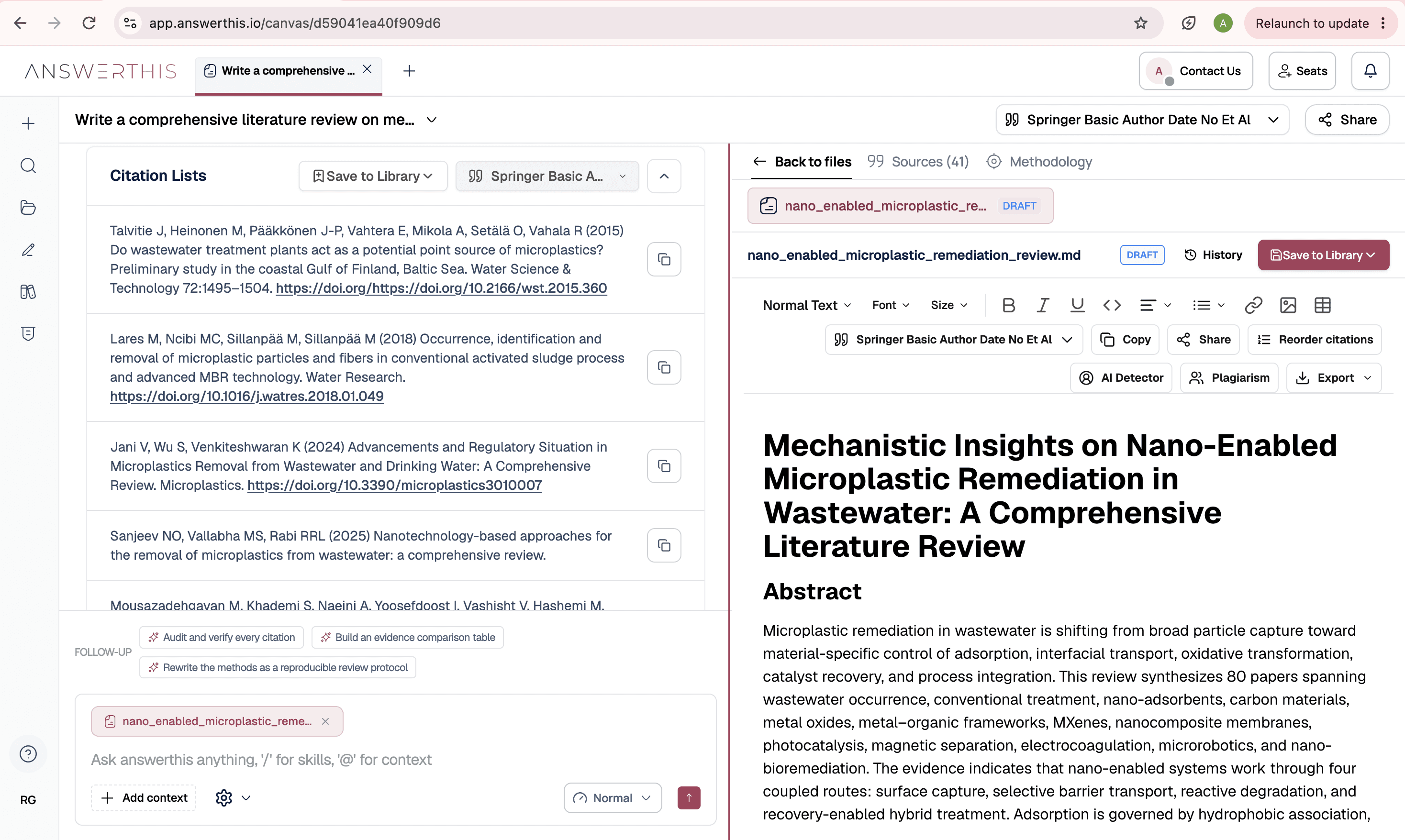
AI output is a starting point for analysis. Your review still needs your inclusion logic, evaluation of methods, interpretation of disagreements, and academic voice.
FAQs
What is the purpose of a literature review?
A literature review shows what is already known about a topic, compares relevant research, identifies patterns or gaps, and explains how your own work fits into the wider field.
How do I start a literature review?
Begin with a focused research question, define your search terms and inclusion criteria, then collect and organize credible sources before trying to write a synthesis.
How can AnswerThis help with a literature review?
AnswerThis can help you explore a research question, discover relevant sources, compare findings, and develop a structured, citation-backed starting point that you should still verify and refine.
How do I organize sources for a literature review?
Group sources by themes, methods, findings, or debates instead of summarizing them one by one. Keep notes on how each source contributes to your argument.
What is the difference between a literature review and an annotated bibliography?
An annotated bibliography describes sources individually, while a literature review synthesizes them to explain relationships, trends, disagreements, and unanswered questions across the field.


