
A scoping review systematically maps the extent, characteristics and concepts of evidence on a defined topic. Unlike a systematic review designed to answer a focused clinical question, it usually asks what evidence exists and how it has been studied, rather than estimating a treatment effect or supporting a clinical recommendation.
For clinicians and postgraduate researchers, the distinction starts with the decision the review must inform. Mapping how remote rehabilitation has been delivered is different from determining whether one rehabilitation intervention improves a specified outcome. Both require explicit methods, documented searches and defensible selection decisions. AnswerThis helps present the selection process by turning your review counts into a flow diagram; its scoping option adapts the PRISMA 2020 layout for scoping reviews.
TL;DR
Choose a scoping review to map concepts, evidence types and research coverage, not as a shortcut to clinical recommendations.
Use Population, Concept and Context to align the question, eligibility criteria and charting fields.
Plan the work in a protocol, screen transparently and report with PRISMA-ScR.
AnswerThis’s scoping flow-diagram option adapts the PRISMA 2020 layout for scoping reviews.
Scoping review vs systematic review
Choose the review type for its purpose, not its apparent difficulty. The guide to what is a systematic review explains the focused-question approach. Systematic reviews can address effectiveness, experiences, diagnosis and other questions, so PICO is not appropriate for every systematic review.
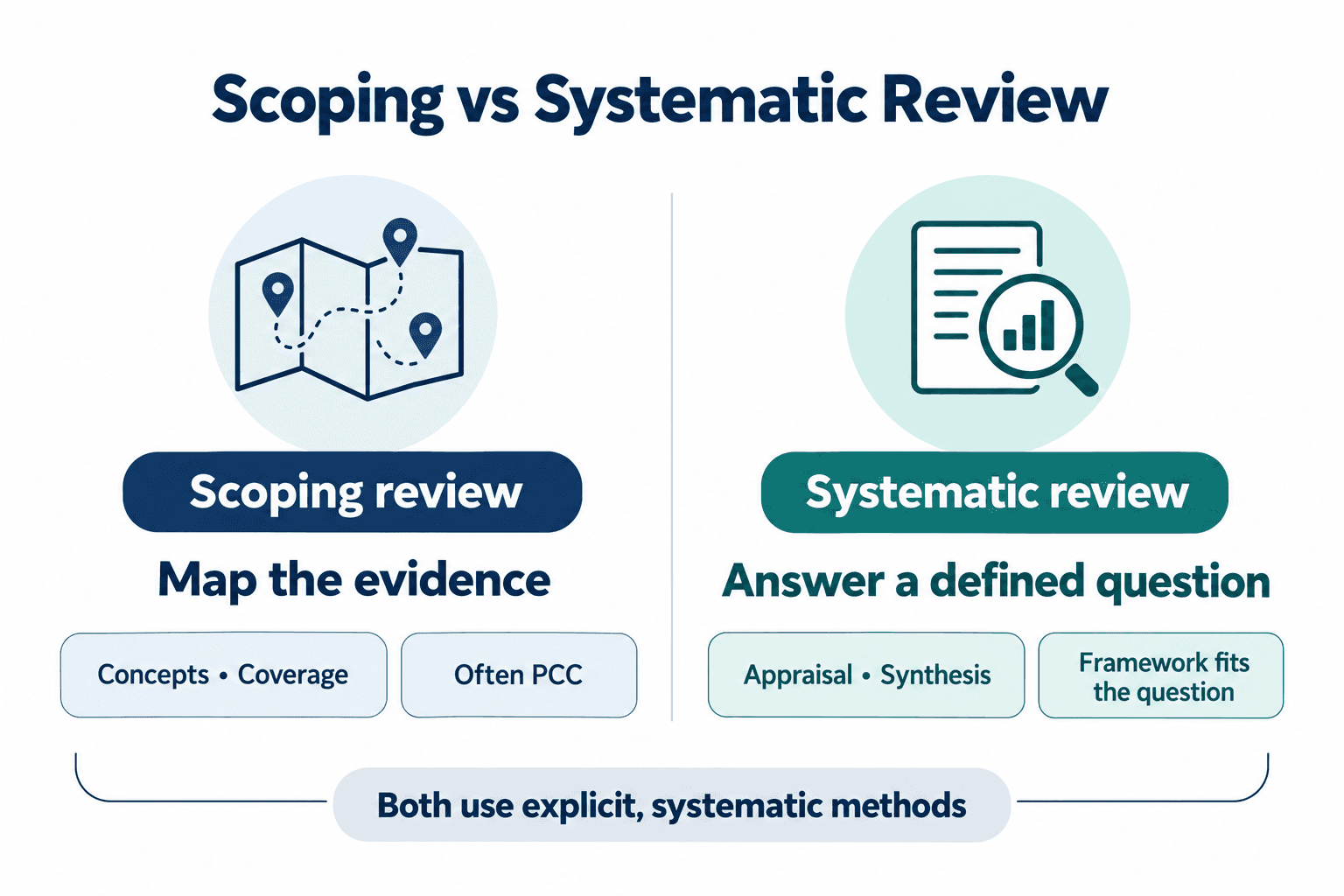
Purpose
Scoping review: Map concepts, evidence characteristics, methods and coverage.
Systematic review: Answer a defined question through an appropriate synthesis and assessment of evidence.
Question framework
Scoping review: Often PCC: Population, Concept, Context.
Systematic review: PICO for intervention questions; other frameworks suit other questions.
Critical appraisal
Scoping review: Not routinely required; justify any appraisal against the objective.
Systematic review: Normally integral, using methods suited to the included evidence.
Synthesis
Scoping review: Descriptive counts, categories, evidence maps and structured narrative summaries.
Systematic review: Question-specific synthesis; meta-analysis only where appropriate.
Reporting guideline
Scoping review: PRISMA-ScR.
Systematic review: PRISMA 2020 and applicable extensions.
Time and resources
Scoping review: Broad coverage can create substantial screening and charting work.
Systematic review: Workload depends on question, evidence volume, appraisal and synthesis.
Neither label guarantees a particular completion time. A broad scoping question can produce more records and more varied material than a narrowly specified systematic review. A scoping review also does not become a systematic review simply because its authors appraise some sources.
The JBI Manual for Evidence Synthesis, scoping-review chapter provides methodological guidance. PRISMA-ScR addresses reporting: it helps readers see what was done, but does not establish that the chosen methods were appropriate.
When should you choose a scoping review?
Choose this approach when the intended output is a map of a field. You might investigate how researchers define continuity of care, which outcomes digital rehabilitation studies measure, or which populations and settings appear in service-access research. The output should clarify the evidence landscape rather than rank treatments.
A scoping review can also identify whether a more focused synthesis would be useful and practicable. However, finding few papers in a category does not automatically establish a clinically important gap. Search limitations, terminology and eligibility decisions can all influence apparent coverage.
If the question is whether an intervention works well enough to change care, plan an appropriate systematic review rather than using a scoping label to bypass appraisal. Broad variation in the evidence does not itself prevent a systematic review; it can instead affect how its results are synthesized.
How to conduct a scoping review
Arksey and O’Malley’s 2005 paper, Scoping studies: towards a methodological framework, set out five core stages: identify the question, identify relevant studies, select studies, chart data, and collate, summarize and report results. They also described consultation as an optional additional stage.
Levac, Colquhoun and O’Brien’s 2010 methodological paper refined this approach, emphasizing an explicit purpose, iterative teamwork and interpretation beyond a list of papers. They argued for consultation as an essential component. Distinguish that recommendation from the optional status in the original framework, and explain the role stakeholders will actually have in your review.
Use those contributions alongside current JBI guidance rather than treating five stage labels as a complete protocol. The practical sequence below adds the planning and reporting decisions needed to carry them out.
1. Define a PCC question and its boundaries
PCC stands for Population, Concept and Context. It helps turn a broad interest into eligibility decisions without forcing every review into an intervention comparison.

Consider this illustrative planning question, not a completed study: What approaches to remote rehabilitation have been described for adults after stroke receiving care at home?
Population
Working definition: Adults after stroke.
Eligibility decision to resolve: How will mixed-diagnosis samples be handled?
Concept
Working definition: Remotely delivered rehabilitation approaches.
Eligibility decision to resolve: Does telephone advice qualify, or must structured rehabilitation be delivered?
Context
Working definition: Rehabilitation received at home.
Eligibility decision to resolve: Are hybrid home-and-clinic programs eligible?
Specify eligible source types, dates and languages, with reasons for restrictions. A scoping review can include diverse research designs and nonresearch documents, but does not have to include every type of publication. Define what each source can contribute to the question.
2. Write a protocol and register it appropriately
Before formal selection, document the objective, PCC definitions, eligibility criteria, sources, search plan, screening process, charting fields and planned presentation. Specify reviewer roles, disagreement resolution and whether critical appraisal serves the review’s purpose. Record amendments with dates and reasons instead of silently changing rules as attractive results appear.
The Medical University of South Carolina’s protocol guidance explains using the Open Science Framework’s Generalized Systematic Review Registration template for scoping reviews. Identify the project as a scoping review and explain fields that are not applicable. Creating an editable OSF project is not the same as submitting a dated registration of the protocol.
PROSPERO does not accept scoping reviews under its published eligibility rules. Its official registration guidance explicitly excludes them. Use a suitable alternative such as OSF rather than relabeling the project to fit a registry.
3. Search for the full range of eligible evidence
Develop the search with an information specialist where possible. An initial limited search can help identify terminology and indexing; adapt the developed strategy to relevant databases and supplement it through reference checking and other justified sources. Preserve the exact strategy, platform, date, limits and result count for each search.
For the stroke example, clinical, allied-health and technology databases might contribute different evidence. Decide whether registers, service reports or other grey literature are relevant to the stated purpose. Searching broadly does not mean searching indiscriminately: each source and restriction needs a rationale.
Save original exports before deduplication. Search updates and alternative discovery routes must remain identifiable so the final selection counts can be reconciled.
4. Screen records and full reports consistently
Pilot the eligibility rules on a shared set of records, resolve ambiguous definitions and then apply the agreed process. Use independent reviewers for title-and-abstract and full-text selection, with a documented route for resolving disagreements. An AI recommendation does not count as an independent human reviewer.
Keep full-text exclusion reasons. Separate reports that could not be retrieved from those assessed and excluded, and distinguish duplicate search records from separate reports describing the same investigation.
In the worked planning example, a virtual-rehabilitation paper might be excluded because the program was tested only in a clinic. That decision should follow the context rule, not whether its findings look useful. Iteration can clarify the protocol, but amendments must remain visible and consistent across records.
5. Chart the data needed to answer the question
Data charting means extracting and organizing the information relevant to the map. Pilot the form on several sources, compare interpretations and revise definitions before completing the full set. Revisit earlier sources whenever a revision changes what must be collected.
Source identity
What to record: Citation, identifier and related reports.
Why it matters: Keeps the evidence traceable without double-counting an investigation.
Population and setting
What to record: Diagnosis, eligibility and actual delivery setting.
Why it matters: Shows who and where the evidence concerns.
Concept definition
What to record: How the source defines remote rehabilitation.
Why it matters: Reveals inconsistent use of terminology.
Delivery approach
What to record: Technology, professional involvement and program components.
Why it matters: Supports a meaningful description of service models.
Design and measures
What to record: Study design, outcomes and measurement times.
Why it matters: Maps how approaches have been evaluated.
Supporting location
What to record: Page, table or passage for each consequential item.
Why it matters: Allows verification of the charted information.
Use “not reported” rather than guessing. Separate what the authors state from your coding interpretation, especially when categorizing complex interventions.
Critical appraisal is not routinely required for the mapping purpose. Current JBI guidance allows justified exceptions, such as a question explicitly describing evidence quality, but a quality description should not be used to convert a map into clinical-effectiveness recommendations. If you appraise, specify the tool, process and role of the judgments.
6. Collate and interpret the map
Group the evidence according to the question: populations, service models, definitions, designs or outcomes. Combine descriptive tables with a narrative explaining the patterns. A paper-by-paper catalogue does not show how the evidence relates across sources.
State the unit behind each count. The number of publications is not necessarily the number of studies, patients or distinct programs. Categories can overlap, so explain when their totals are not intended to add to the included-source count.
For the stroke example, mapping which approaches were evaluated at home could inform a subsequent research agenda. It would not establish that the most frequently described approach is the most effective or suitable for every patient.
7. Report with PRISMA-ScR and reconcile the flow
The official PRISMA-ScR guidance, published by Tricco and colleagues in 2018, contains 20 essential and 2 optional reporting items. The optional items concern critical appraisal methods and results. Report the objective, protocol, eligibility, sources, search, selection, charting, synthesis and limitations, including what was actually done when it differed from the plan.
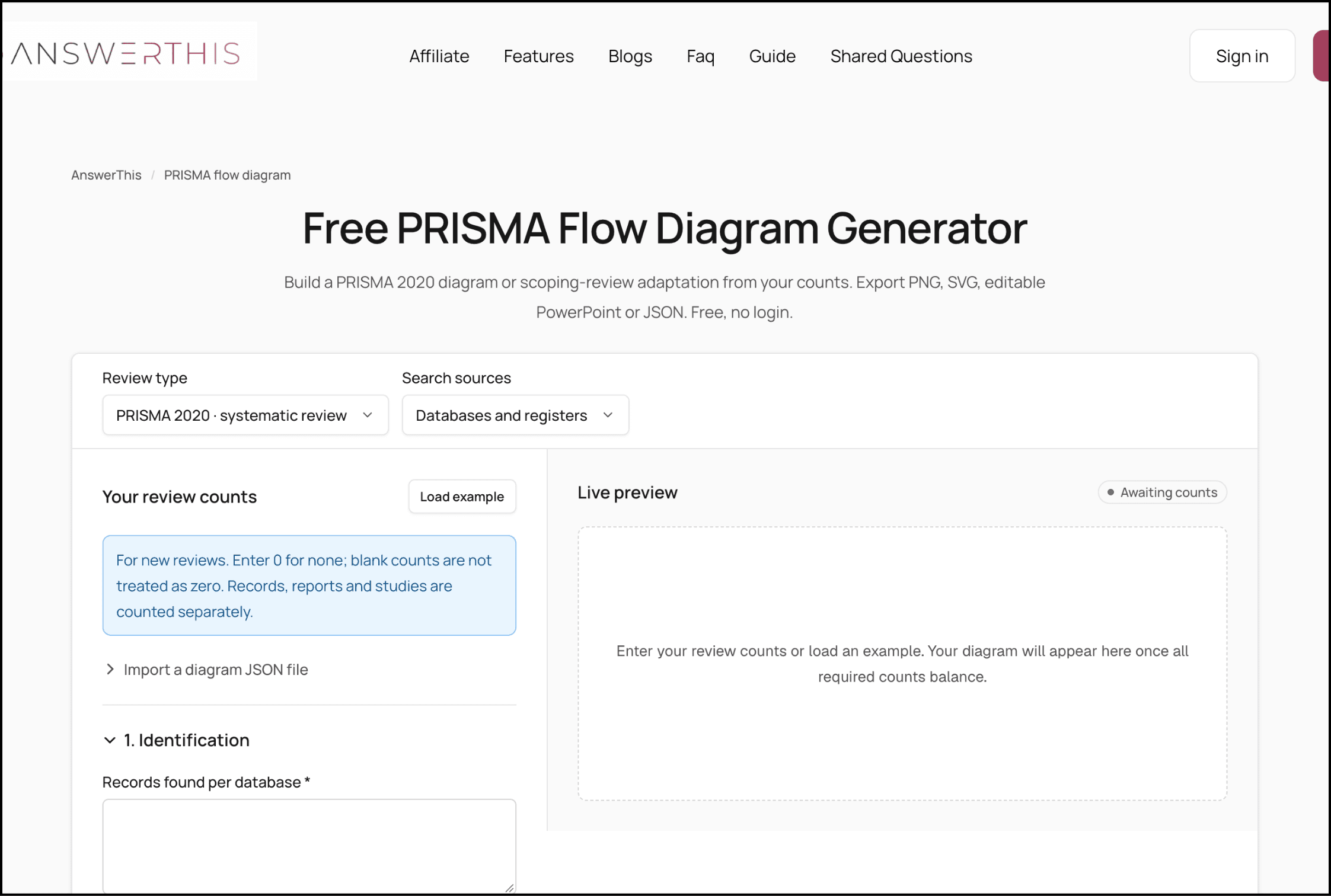
A selection diagram is one part of that account. AnswerThis’s free PRISMA flow diagram generator accepts your review counts and exports PNG, SVG and editable PowerPoint files. Its scoping option is a PRISMA 2020 layout adapted for scoping reviews, not a separate official PRISMA-ScR template. The tool checks arithmetic and draws the diagram; it does not search, deduplicate or screen evidence.
Reconcile the diagram against the logs before exporting. Keep records, reports and investigations distinct, and document overlaps between search routes. A visually complete flow does not establish checklist adherence or sound review methods.
A published scoping review example, walked through
Abedi, Colella, Pakosh and Khan’s Artificial intelligence-driven virtual rehabilitation for people living in the community: A scoping review appeared in npj Digital Medicine in 2024. It examined applications of AI in home-based rehabilitation, making it useful for seeing how a broad clinical-technology concept becomes concrete eligibility rules.
The authors included studies evaluating AI-driven rehabilitation with adult patients at home, including hybrid programs. They excluded systems evaluated only on healthy volunteers or only outside patients’ homes. The key lesson is that the presence of “AI” and “rehabilitation” in a title was not enough: the actual population and deployment context determined eligibility.
Search coverage
What the published paper reports: Four bibliographic databases searched through June 2022; a Google Scholar search covered June 2022 to June 2023.
Lesson for your review: Report dates by source rather than presenting every source as equally current.
Selection
What the published paper reports: 2,172 unique records screened; 51 full texts assessed; 13 studies included.
Lesson for your review: Preserve the selection trail instead of reporting only the final total.
Charting
What the published paper reports: Study and participant characteristics, aims and findings, rehabilitation programs, and AI applications.
Lesson for your review: Build fields around what the question needs to map.
Presentation
What the published paper reports: Descriptive analysis and narrative tables; no meta-analysis because populations, measures and timings differed.
Lesson for your review: Explain the chosen synthesis rather than equating synthesis with pooling.
The paper used the Arksey and O’Malley framework and reported against PRISMA-ScR. Its authors also discussed effectiveness, but its map of varied applications should not be read as a pooled estimate of clinical benefit. A useful review example can illustrate transparent decisions without becoming a template to copy unchanged.
Using AI for screening and data charting
AI can assist with proposed eligibility labels, locating passages and drafting chart entries, but each use needs a defined checking process. Evaluate the tool on material representative of your review, including ambiguous exclusions, and preserve enough information to inspect how decisions were made. Do not assume that a fluent explanation accurately represents the source.
Suggested screening decision
Appropriate human check: Apply the written criteria independently; investigate disagreements and potential false exclusions.
Draft chart entry
Appropriate human check: Verify population, setting, intervention and measures against the full report.
Suggested category
Appropriate human check: Check that the category is defined and consistently applied across sources.
Summary of the map
Appropriate human check: Trace claims to charted evidence and distinguish missing reporting from absence of research.
Record the tool and version, dates, task, relevant instructions and verification procedure so readers can understand its influence. Follow institutional rules for uploading copyrighted or sensitive material. Automated suggestions do not replace the review team’s responsibility for selection, charting and interpretation.
If the objective changes from mapping evidence to answering a focused synthesis question, reconsider the design rather than changing only the manuscript label. The guide to how to conduct a systematic literature review provides an adjacent workflow, but the final protocol should follow the methodology appropriate to the question.
Common scoping review mistakes
Choosing the label to avoid appraisal. Select the approach for a mapping purpose. If the intended conclusion is an effectiveness recommendation, reconsider the review design.
Leaving the concept undefined. Translate broad terminology into inclusion rules and pilot them before formal screening. Record later clarifications and apply them consistently.
Assuming a broad search is an adequate search. Preserve reproducible strategies and justify coverage. Listing database names alone does not show what was searched.
Charting everything available. Keep fields connected to the question. Unused detail increases workload without improving the map.
Calling every sparse category a research gap. Consider search limits, missing reporting and the importance of the uncertainty before recommending more studies.
Treating PRISMA-ScR as a methods certificate. Use methodological guidance to conduct the review and the reporting checklist to explain it. A diagram cannot substitute for either.
FAQ
What is a scoping review in simple terms?
A scoping review is a systematic way to map what evidence exists on a topic, how it is defined and which populations, settings or methods it covers. It uses explicit eligibility, search and selection procedures. Its usual purpose is to describe the evidence landscape rather than determine which treatment should be used.
Does a scoping review need critical appraisal?
Not routinely. Whether appraisal is useful depends on the objective and the methodology being followed. Explain any decision to appraise and how the judgments will be used. A map without appraisal cannot establish the trustworthiness of intervention effects, while adding appraisal alone does not turn a scoping review into a clinical recommendation.
Is a scoping review quicker than a systematic review?
Not necessarily. Broad questions can generate substantial screening and diverse charting work. Estimate resources from the expected evidence volume, access needs, reviewer arrangements and analysis plan. A small team or short deadline is a reason to adjust a defensible scope, not to assume that a scoping label permits undocumented shortcuts.
Can I register a scoping review on PROSPERO?
No, scoping reviews are excluded by PROSPERO’s published eligibility rules. OSF is an alternative for registering a scoping-review protocol. Describe the review accurately and preserve a dated plan before formal selection. Registration records the plan; it does not certify that the methods are appropriate or that the completed review followed them.
Can a scoping review include qualitative studies and grey literature?
Yes, when those sources address the question and meet the protocol’s criteria. A map of service delivery may benefit from qualitative research or organizational reports alongside trials. Define eligible source types, plan how to find them and chart their contributions appropriately instead of treating every source as equivalent evidence of clinical effectiveness.
Start by writing the PCC question and the intended output of your map. Then draft eligibility rules and a charting form that would let another reviewer understand how each included source contributes.