Narrative Review vs Systematic Review: What Is the Difference? (2026)

Dr. Rajni Garg
Executive Lead, Research & Content Strategy
7 min read

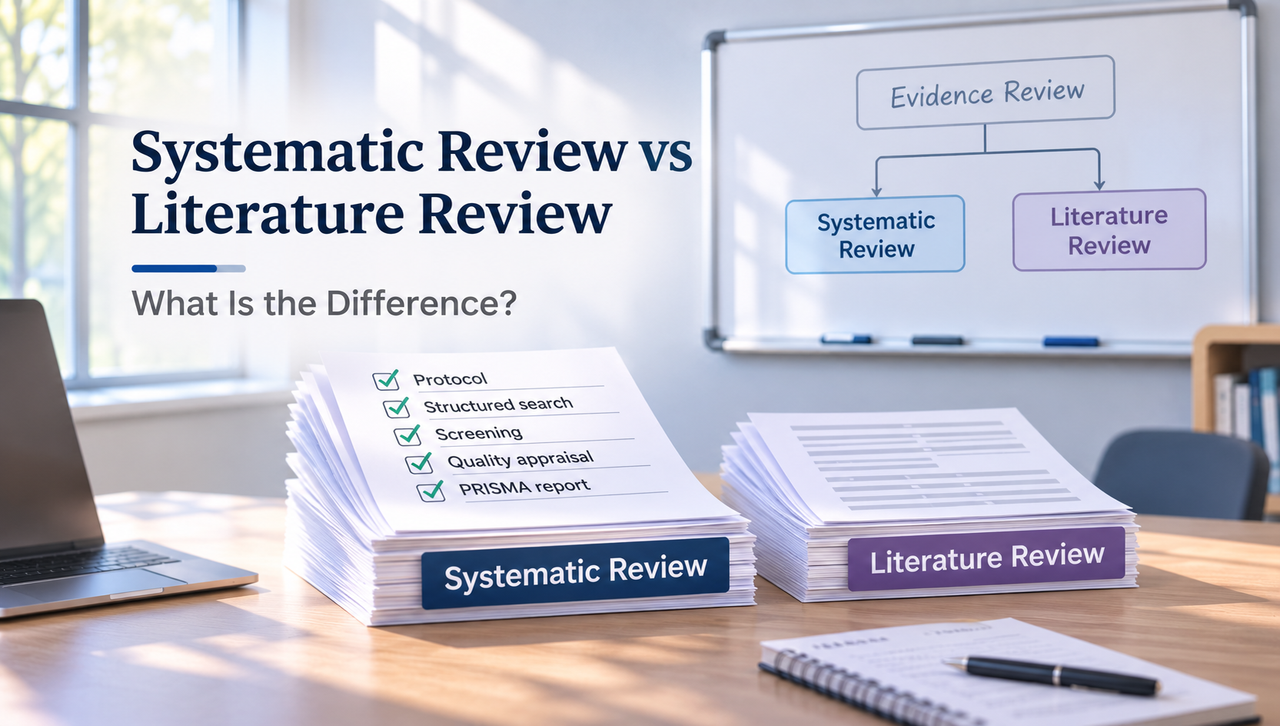
A systematic review follows a protocol written before the search starts and tries to find every study that meets set criteria for one narrow question, then checks those studies for bias. A narrative review takes a wider view of a topic, chooses and interprets its sources through the author’s expertise, critiques the field and does not claim to include everything.
Neither type is better in general. They answer different questions. This page compares them in one table, then covers rigor, when each one fits, how to score a narrative review with the SANRA scale, and how it differs from a scoping review.
TL;DR
Systematic review: a fixed protocol, a narrow question, a search built to find all eligible studies and a formal check for bias.
Narrative review: a broad topic, sources picked and weighed by the author, an interpretive argument and no claim of full coverage.
A good narrative review is open about its scope, search and perspective. SANRA scores that on six items, from 0 to 12.
A scoping review is broad like a narrative review, but it is planned in a protocol and built to map the evidence, not to interpret it.
Narrative review vs systematic review: key differences
The table draws on three sources: the Cochrane Handbook for systematic reviews, Sukhera’s (2022) Narrative Reviews: Flexible, Rigorous, and Practical and Baethge et al.’s (2019) SANRA—a scale for the quality assessment of narrative review articles.
Feature | Narrative review | Systematic review |
|---|---|---|
Main job | Interpret, connect and critique a body of work | Answer one specific question from all the eligible evidence |
Question | Broad, and it can be refined as you read | Narrow and fixed before the search |
Protocol | Not required, but the scope and approach are explained | Written in advance, with any later changes declared |
Search | Described (which databases and terms, and why) but not exhaustive | Built to find all relevant research |
Choosing studies | The author’s judgment, explained to the reader | Pre-specified eligibility criteria |
Study quality | Weighed and critiqued in the text | Assessed formally, so bias in the included studies is accounted for |
Author perspective | Stated openly, because it shapes the reading | Kept in check by explicit methods chosen to minimize bias |
Repeatability | Another expert could tell a different story from the same field | Structured, transparent and reproducible by design |
Best for | Overviews, teaching, theory and debate | Specific questions, such as whether an intervention works |
Quality check | SANRA (six items, scored 0 to 12) | Tools such as AMSTAR 2 |
Two short phrases capture the split. Cochrane counts “making every effort to find all relevant research” among the core features of a systematic review. Sukhera says a narrative review “can include a wide variety of studies and provide an overall summary, with interpretation and critique.”

Is a narrative review less rigorous?
It is less reproducible. That is not the same as less careful. Systematic reviews sit higher on the usual evidence hierarchy, and the SANRA authors admit that narrative reviews “have been widely criticized as unreliable.” The worry is selection. When you choose the studies, you can choose the ones that agree with you, and readers cannot see what you left out.
Rigor in a narrative review comes from a different place: transparency. Sukhera notes that these reviews “will not provide an exhaustive, comprehensive review of the literature,” which is fine as long as they do not pretend to. In place of full coverage, he asks authors to:
State a clear research question and the audience it is for.
Mark the boundaries of the topic and define key terms.
Explain which databases and search terms they used, and why.
Name the factors that may have shaped their interpretation.
Describe how the analysis was done and justify the approach.
What a narrative review cannot do well is settle a narrow question. The SANRA paper puts it plainly: systematic reviews are “superior to narrative reviews in answering specific questions,” while narrative reviews are “better suited to addressing a topic in wider ways.” So the useful question is not which type is more rigorous. It is which type matches what you need to know.
When is a narrative review the right choice?
Pick a narrative review when your reader needs understanding more than a verdict. Sukhera describes narrative reviews as often helpful for teaching or learning about a topic, because they give a general overview, and as a way to bring several points of view together. They fit well when:
You are introducing a field to people new to it, such as trainees or the readers of a thesis background chapter.
The relevant work spans very different sources, from trials to qualitative studies to theory.
You want to trace how an idea has changed, or make a case for seeing a problem in a new way.
The question is still too loose to turn into fixed eligibility criteria.
Pick a systematic review when someone will act on the answer: whether a treatment works, how accurate a test is, or what a guideline should say. Those questions need a protocol, a search designed to catch all eligible studies and a formal bias assessment. Our systematic review post walks through those steps.
Here is one topic split both ways. Say you care about burnout in resident physicians. A narrative review might ask how burnout has been defined and argued about in medical education, and what that means for training programs. A systematic review might ask whether one kind of wellness program, compared with none, changes a validated burnout score in residents. The first question invites interpretation. The second needs every eligible study.
How do you judge a narrative review? Use SANRA
SANRA is a short scale for the quality assessment of narrative review articles. Three journal editors, Christopher Baethge, Sandra Goldbeck-Wood and Stephan Mertens, published it in 2019 in Research Integrity and Peer Review. It has six items. Each is scored from 0 (low standard) to 2 (high standard), so a review can score anywhere from 0 to 12.
Justification of the article’s importance for the readership. Does the review say why readers should care?
Statement of concrete aims or formulation of questions. Are there specific aims or questions, not just a topic?
Description of the literature search. Top marks go to a search described in detail, with search terms and inclusion criteria.
Referencing. Are the key statements backed by references?
Scientific reasoning. Does the argument rest on evidence suited to the field, such as randomized trials for clinical treatment questions?
Appropriate presentation of data. Are outcome data shown in a suitable form, for example absolute as well as relative risks?
Read the validation results with care. The authors tested SANRA on 30 narrative review manuscripts from a general medical journal and report an intraclass correlation of 0.77 and a Cronbach’s alpha of 0.68. They judge that adequate for a six-item scale and call for more validity testing. The raters were the scale’s own authors. The average score in that sample was 6 out of 12, so plenty of reviews had room to improve.
You can also run SANRA on your own draft. If you would give yourself a 0 or 1 on the search item, add a short paragraph on where and how you searched. When you start writing, our guide to writing a literature review covers structure and synthesis, and SANRA works as a last check before you submit.

Narrative review vs scoping review
A scoping review can look like a narrative review, since both take on broad topics. The difference is purpose and method. The JBI Manual for Evidence Synthesis describes scoping reviews as a type of evidence synthesis that aims to “systematically identify and map the breadth of evidence” on a topic, and says they can clarify key concepts and definitions. JBI requires an a priori protocol for its scoping reviews. Its appraisal guidance does not generally advocate judging each source for quality or bias, because a map is not meant to drive practice or policy recommendations.
Purpose: a scoping review maps what has been studied, by whom and how. A narrative review interprets what that work means.
Method: a scoping review runs on a protocol with a systematic search and selection. A narrative review explains its scope and search but needs no protocol.
Critique: a scoping review usually describes sources without appraising them. A narrative review weighs and challenges the work it discusses.
A quick test: if your main output is a chart of who studied what, where and how, you are scoping. If it is an argument about what a field gets right and wrong, you are writing a narrative review.

Can AI help you draft a narrative review?
It can help you start one. AnswerThis literature review generator produces a literature review outline and one cited opening paragraph from retrieved scholarly abstracts. You name the topic, population and relationship you care about, in up to 16,000 characters. It returns an outline, the opening paragraph, linked sources and the search scope it used, in Standard or Concise wording, which you can copy or download. The page allows three successful free runs in each browser, and requests that fail are not counted. It works from abstracts, and its page describes the outline as a starting structure for your review. Check each source for relevance and quality, then do the reading, critique and interpretation that make a narrative review worth publishing.

FAQs
Can a narrative review be published in a peer-reviewed journal?
Yes. Many journals publish them, and SANRA itself was built by journal editors and tested on narrative review manuscripts from a general medical journal. Check your target journal’s author instructions, because what they expect in a methods section varies.
Does a narrative review need a search strategy?
It does not need a protocol-driven search, but it should say how you found your sources. Sukhera asks authors to explain which databases and search terms they used and why, and SANRA gives top marks when the search is described in detail.
Can a narrative review mix different kinds of studies?
Yes. Sukhera points out that a narrative review can include a wide variety of studies and bring several points of view together. Tell the reader why each kind of source is there and how much weight you give it.
Can I turn my narrative review into a systematic review later?
Not by renaming it. The Cochrane Handbook describes a protocol written without knowledge of the available studies, and a finished narrative review means you already know them. Use what you learned to sharpen a question, then plan a new systematic review from the protocol up.
Is SANRA a reporting checklist?
No. Its authors call it a critical appraisal tool and not a reporting guideline. Use it to judge how well a narrative review is done, and follow your target journal’s instructions on what to report.
Planning a narrative review? Get a first outline from the literature review generator, then score your draft against SANRA before you submit.