
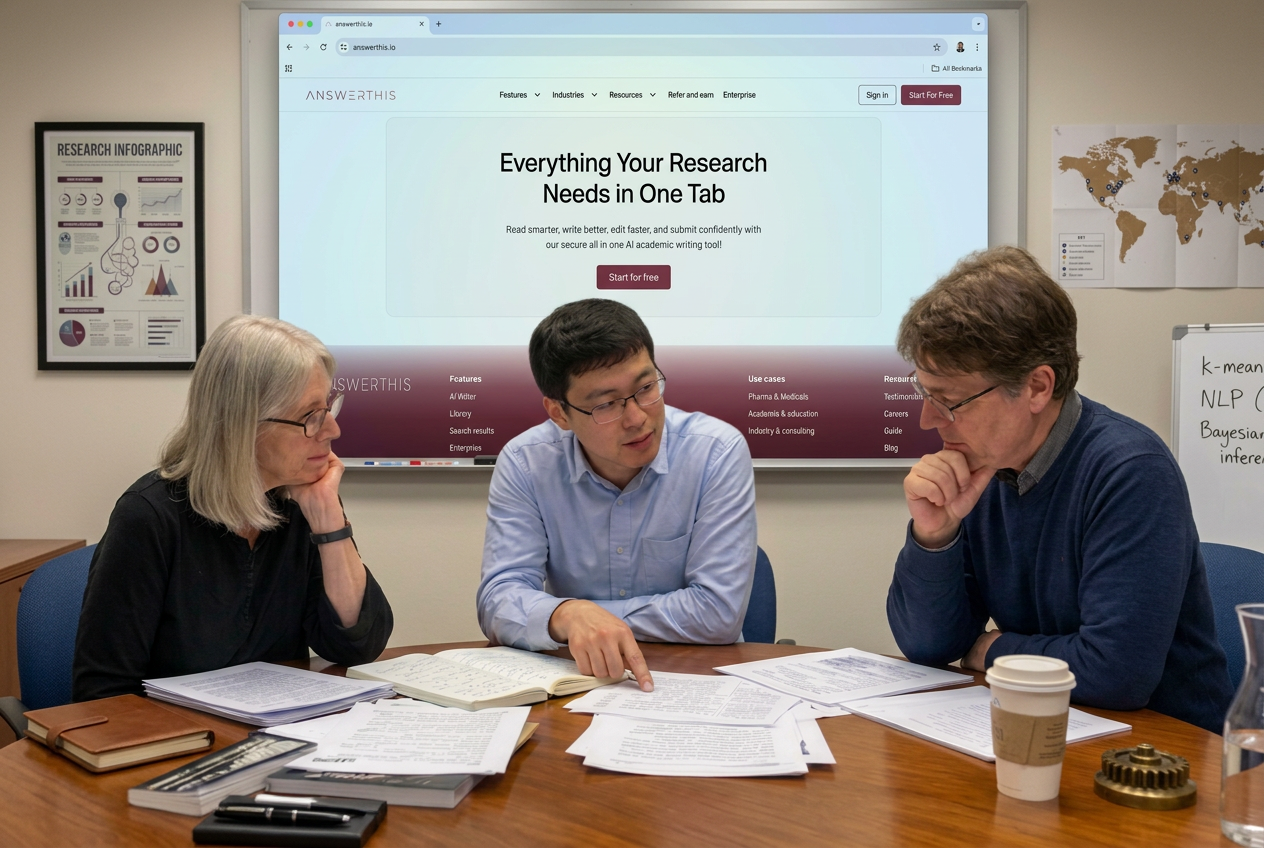
Use specific questions instead of asking whether a manuscript is simply good. AnswerThis lets researchers bring discovery, synthesis, and writing into a single, connected workflow. What follows explains the trade-offs, techniques, and next steps in more detail.
TL;DR
An AI peer review tool adds a structured review layer before journal submission.
Use specific questions instead of asking whether a manuscript is simply good.
Check the research gap, evidence, section alignment, citations, tables, and journal requirements.
Verify every suggested change against original sources, study data, and disciplinary standards.
What is AI-assisted pre-submission review?
Pre-submission review sits between completing a full draft and entering formal peer review. It should examine more than grammar and formatting. A useful review considers the manuscript’s research problem, evidence, argument, organization, conclusions, references, figures, tables, terminology, word limit, and compliance with the target journal’s instructions.
This stage is valuable because authors become familiar with their own manuscripts. After months of working on a study, a connection that seems obvious to the author may not be clear to a first-time reader. A structured review creates an opportunity to step back and assess the manuscript from the reader’s perspective.
Before a paper reaches an editor or peer reviewer, ask:
Is the research gap clearly established?
Does the literature review represent relevant scholarship and competing findings?
Do the research questions, methods, results, discussion, and conclusions align?
Are the tables, figures, terminology, references, and formatting consistent?
Does the manuscript meet the target journal’s submission requirements?
AI adds another review layer during this stage. Its role is not to replace scholarly judgment, but to help authors inspect a manuscript systematically, identify issues that deserve attention, and revise while there is still time to improve the paper.
How to use an AI peer review tool in 6 steps
Instead of asking whether the paper is simply “good,” frame specific questions about its argument, literature coverage, evidence, structure, clarity, or potential weaknesses. The following workflow moves the practical steps earlier so you can begin with the manuscript rather than a long definition.
1. Prepare the full manuscript
Use a complete working draft so the review can compare the introduction, research questions, methods, results, discussion, and conclusions. Remove private or restricted information that you are not permitted to upload.
Before starting, gather:
The current manuscript
The target journal’s author guidelines
The reference list
Any tables, figures, appendices, or supplementary material
The research questions or hypotheses in their final wording
2. Open AnswerThis and define the review task
Sign in to AnswerThis and open Quick Q/A. State what type of manuscript you are reviewing, the target journal or discipline when relevant, and the exact issue you want examined.
A focused request produces more useful feedback than a general quality check. Ask for one review dimension at a time, such as argument clarity, literature coverage, evidence, structure, potential gaps, or terminology consistency.

3. Ask targeted pre-submission questions
Use questions that point to a decision you can make during revision. Examples include:
Where is the research gap stated, and is it supported by the literature review?
Which major claims appear to need stronger evidence or clearer qualification?
Do the research questions align with the methods, results, and conclusions?
Are competing findings or alternative interpretations represented fairly?
Does the discussion make claims that extend beyond the reported results?
Are key terms, sample sizes, tables, figures, and citations consistent across sections?
These questions make each response easier to verify. They also produce self-contained answers that can be reviewed section by section in 2026 rather than one broad assessment that mixes evidence, style, and formatting.
4. Evaluate the feedback
Treat each observation as a prompt for further checking, not as evidence that the manuscript is scientifically correct. Compare suggested changes with the study data, original sources, disciplinary conventions, and the target journal’s instructions.
Separate the feedback into three groups:
Changes supported by the manuscript or source material
Points that need manual verification
Suggestions that do not fit the research context

5. Revise the manuscript
Strengthen the literature review, clarify the research gap, reorganize sections, or improve the connection between evidence and conclusions where the review identifies a genuine weakness. Keep disciplinary terminology, interpretation, nuance, and argumentation under the author’s control.
Editing should clarify the author’s ideas, not replace them with generic machine-generated prose. This matters especially in specialized fields, where a minor terminology change can alter the meaning of a technical statement.
6. Complete the final checks
Polish the language, verify references against original sources, compare tables and figures with the surrounding text, and review the target journal’s author guidelines. Confirm that every accepted change preserves the intended scientific meaning.
The 2026 workflow is straightforward: complete the draft, run an AI-assisted pre-submission review, revise the manuscript, submit it to the journal, and proceed to formal peer review. An AI-assisted review prepares a manuscript for peer review; it does not replace review by qualified academic experts.
How AI can strengthen a manuscript review
Traditional proofreading tools are useful for spelling, grammar, and style. AI-assisted systems like AnswerThis can also help authors inspect the manuscript’s organization and reasoning. They can flag repetitive sections, unclear transitions, claims that appear to need stronger support, or weak connections between research questions and conclusions.
These observations are prompts for further checking, not proof that the manuscript is publication-ready. Editors and reviewers must be able to understand, assess, and engage with the research.
Strengthen the literature review
A literature review must do more than list prior studies. It should establish the context of the research question, show what previous work has found, acknowledge competing findings, and explain how the manuscript contributes to existing scholarship. Keeping track of relevant work becomes more difficult as a field grows.
AI research tools can accelerate literature discovery and evidence exploration. AnswerThis helps researchers investigate academic questions against a large research corpus and explore relevant research before submission.
Discovery must be followed by scholarly verification. Authors should read important original sources, assess their relevance, and decide how they genuinely relate to the manuscript. AI-generated results should not be treated as authoritative without checking the underlying evidence.
Find weaknesses before reviewers do
Pre-submission review is an opportunity to test the relationship between claims, evidence, and conclusions. A manuscript may make a broad claim while citing limited evidence, describe a research gap without showing what earlier studies established, or interpret results more broadly than the study supports.
Use AnswerThis to ask:
Is each major argument supported by appropriate evidence?
Are relevant alternative perspectives represented?
Do the conclusions accurately reflect the findings?
Does the discussion introduce interpretations that the results cannot support?
The purpose is not to outsource critical reading. It is to create another opportunity for it before journal submission in 2026.
Check the manuscript’s internal logic
A well-structured paper should have a clear progression. The introduction establishes the problem and gap; the research questions or hypotheses define what the study investigates; the methodology explains how it was conducted; the results present the findings; and the discussion interprets their significance in relation to the research question and existing literature.
A manuscript can contain all the expected sections and still have structural weaknesses. The research question may not align with the conclusions, or the discussion may introduce ideas that were not established earlier. AnswerThis-assisted review can flag these potential problems so the author can revisit the relevant passages.
Detect inconsistencies before submission
Long and collaborative manuscripts can accumulate small discrepancies. A sample size may be reported differently in two sections. A key term may be defined in more than one way. A table may not match the surrounding text. A reference may appear in the bibliography without being cited, or a cited source may be missing from the reference list.
AnswerThis can assist by comparing information across the manuscript and highlighting apparent inconsistencies. Authors must verify each observation against the data, source material, and study documentation; AI should flag potential problems rather than make unverified corrections.
Improve clarity without losing the author’s voice
Language affects how easily research can be understood. AnswerThis-assisted editing can identify unnecessarily complex sentences, unclear phrasing, repetition, weak transitions, and grammatical problems while preserving an academic tone.
The author should retain control over disciplinary terminology, interpretation, nuance, and argumentation. Editing should clarify the author’s ideas, not replace them with generic machine-generated prose.
What an AI peer review tool cannot replace
AI cannot take responsibility for the scientific integrity of a manuscript. Researchers must decide whether the evidence is credible, the methodology is appropriate, the interpretations are justified, and the conclusions accurately reflect the study. They must also verify citations and follow the policies of their institution, funder, publisher, and target journal.
AI-generated information should never be accepted merely because it sounds convincing. References, factual claims, interpretations, and suggested revisions should be checked against reliable sources and the original research. The final manuscript remains the authors’ responsibility in 2026.
AnswerThis can also support the revision stage through its Smart Google Docs workspace. Researchers can iterate on their work, run AI-detection and plagiarism checks, and share a working document with peers while keeping the final decisions with the author.
A more thoughtful final step before submission
AnswerThis-assisted review is most useful as part of an iterative process. It can help authors identify a weakly justified research gap, an unclear section, an unsupported claim, or an inconsistency early enough to correct it.
The technology provides another perspective and identifies what needs attention. The researcher decides what deserves revision and what the evidence can support. Used in that way, pre-submission review becomes more than a final checklist: it becomes a structured opportunity to send a clearer, better-supported manuscript to the journal.
FAQs
What is an AI-assisted pre-submission review?
It is a structured review of a manuscript before submission in which AI helps identify unclear claims, inconsistent terminology, missing connections between evidence and conclusions, and sections that may need revision. The author remains responsible for evaluating every suggestion.
What should I ask an AI peer review tool to check?
Ask it to review the manuscript’s internal logic, alignment between research question and conclusion, clarity of the literature review, consistency of terminology, and places where a claim needs stronger evidence or qualification.
Can AI replace journal peer review?
No. AI can support a pre-submission review, but it cannot replace specialist judgment, independent reviewer expertise, editorial decisions, or the formal peer-review process used by journals.
How can I use AI feedback without losing my voice?
Use feedback to identify a specific issue, then revise the passage in your own words. Keep the paper’s terminology, argument, and evidence under your control rather than accepting broad rewrites without checking them.
How can AnswerThis help before manuscript submission?
AnswerThis can help researchers review a draft for logical gaps, unclear sections, and evidence-to-claim alignment. Use its feedback as a revision aid, then verify changes against the manuscript and original sources before submission.
One last thing
The most useful pre-submission question is not “Is this manuscript good?” Ask where the argument, evidence, or section alignment breaks, then verify the answer against the paper and its sources.


