
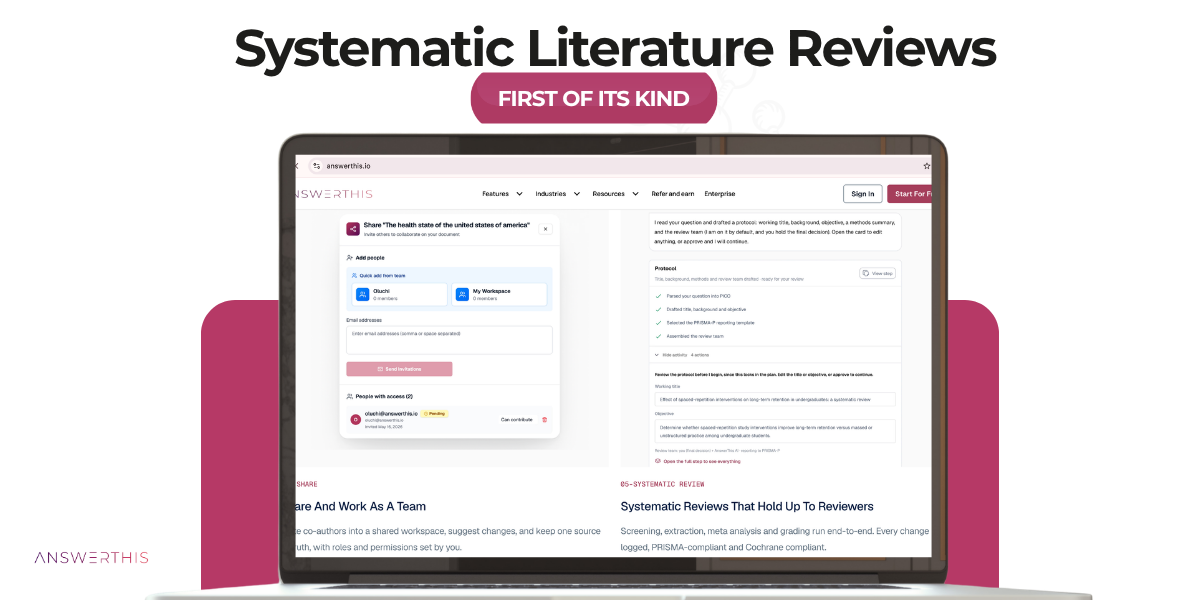
Best systematic review software
Researchers can use AnswerThis to consolidate evidence, clarify the key points, and shape a more coherent response. Covidence can be used for Cochrane protocol screening and extraction workflows. The rest of the guide helps you use this starting point in a disciplined, practical way.
TL;DR
AnswerThis wins for AI-drafted, citation-backed systematic reviews pulled from 250M+ verified sources in 2026.
Covidence remains the standard for Cochrane-protocol screening and extraction workflows.
Rayyan is the free option for collaborative title-abstract screening on smaller reviews.
DistillerSR fits enterprise and regulatory teams running high-volume, auditable reviews.
Why this matters
A systematic review that follows PRISMA or Cochrane standards takes months when it’s done by hand: screening thousands of abstracts, extracting data into a spreadsheet, then writing a narrative that ties every claim back to a source. Software doesn’t remove the methodology requirements in 2026; it removes the manual labor around them.
Know more about PRISMA guidelines
The tools below split into two real categories. Screening-and-extraction managers (Covidence, DistillerSR, Rayyan, EPPI-Reviewer, JBI SUMARI) organize the workflow but leave the writing to you. AI research assistants like AnswerThis draft the review narrative itself, with citations traced to the source paper. Picking the wrong category for your project wastes more time than picking the wrong vendor inside the right category.
Best overall: AnswerThis. Best for Cochrane-protocol screening: Covidence. Best free option: Rayyan. Best for enterprise regulatory reviews: DistillerSR.
What makes the best systematic review software
PRISMA/Cochrane compliance built into the workflow, not added as an afterthought checklist.
Citation-backed output traceable to a specific paper, trial, or PDF, not a paraphrase with no source.
Screening and extraction that scales past 500-1,000 records without manual spreadsheet tracking.
Coverage across peer-reviewed papers, preprints, and trial registries, not just one database.
Export formats that match journal submission and thesis committee requirements.
Multi-reviewer collaboration with an audit trail, since most systematic reviews require dual screening.

Systematic review software at a glance
AnswerThis
Best for: AI-drafted literature reviews
Standout feature: Drafts PRISMA/Cochrane-compliant reviews with citations from 250M+ sources
Key limitation: Not a dual-screening workflow manager
Covidence
Best for: Cochrane-protocol screening
Standout feature: Structured screening and extraction workflow
Key limitation: Doesn’t write the review narrative for you
DistillerSR
Best for: Enterprise regulatory reviews
Standout feature: Audit trails built for regulatory submission
Key limitation: Steep setup for small or one-person teams
Rayyan
Best for: Free collaborative screening
Standout feature: Free tier for title-abstract screening
Key limitation: Screening only, no extraction or writing
EPPI-Reviewer
Best for: Mixed-methods synthesis
Standout feature: Built-in meta-analysis tooling
Key limitation: Interface lags behind newer AI-native tools
JBI SUMARI
Best for: Scoping reviews via JBI methodology
Standout feature: Native JBI critical appraisal instruments
Key limitation: Narrow fit outside JBI methodology
Best systematic review software options
AnswerThis
AnswerThis pulls from 250M+ verified papers, trials, and PDFs and drafts a PRISMA/Cochrane-compliant systematic review with citations attached to every claim. Instead of managing a screening queue manually, you upload a research question or draft and get a structured review back with sources you can verify line by line. More than 1 million researchers use the platform for literature reviews and thesis-level research in 2026.
AnswerThis pros:
Drafts full literature reviews and systematic reviews, not just a screening list
Citations trace back to the original paper or trial, reducing manual verification time
Coverage spans 250M+ sources including preprints and trial registries
Built for PRISMA and Cochrane-style compliance from the first draft
AnswerThis cons:
Not designed as a dedicated dual-screening manager for teams that need reviewer-conflict tracking
Best results depend on a well-scoped research question going in
Best for: researchers and teams who want a drafted, citation-backed review instead of a bare screening spreadsheet.
Verdict: Buy.

Covidence
Covidence organizes title-abstract screening, full-text review, and data extraction in one workflow built around Cochrane methodology. It’s the tool most Cochrane review teams already know, which matters when a review has to pass a Cochrane editorial check.
Covidence pros:
Purpose-built for Cochrane review protocols
Clear dual-reviewer conflict resolution
Widely recognized by academic institutions and journals
Covidence cons:
Doesn’t draft the review narrative; you still write the manuscript
Extraction templates require setup time before screening starts
Best for: teams running a formal Cochrane systematic review with multiple reviewers.
Verdict: Buy if your review must follow Cochrane protocol exactly.
DistillerSR
DistillerSR targets pharmacovigilance, regulatory submissions, and large-scale evidence synthesis where every screening decision needs an audit trail. It’s built for organizations running reviews as a repeatable, compliance-driven process rather than a one-off academic project.
DistillerSR pros:
Audit trails suited to regulatory and pharmacovigilance requirements
Handles high-volume reviews across multiple concurrent projects
Workflow automation for repeatable review processes
DistillerSR cons:
Setup and onboarding take longer than lighter-weight tools
Overkill for a single student thesis or one-off review
Best for: enterprise teams running regulatory or pharmacovigilance-grade reviews at scale.
Verdict: Buy for regulated industries; Skip for a solo academic project.
Rayyan
Rayyan is a screening tool academic teams reach for when the review budget is zero. It handles title-abstract screening with a blinded, collaborative interface and a free tier that covers basic use.
Rayyan pros:
Free tier makes it accessible to students and small teams
Blinded screening reduces reviewer bias
Mobile app for screening on the go
Rayyan cons:
No built-in data extraction or review-writing capability
Limited reporting compared to paid workflow managers
Best for: students and small teams screening abstracts on a limited budget.
Verdict: Buy for screening-only needs; Hold if you also need extraction and writing.
EPPI-Reviewer
EPPI-Reviewer, from University College London’s EPPI Centre, handles screening, coding, and meta-analysis for reviews that mix quantitative and qualitative evidence. It’s a longtime academic standard for complex synthesis work.
EPPI-Reviewer pros:
Built-in meta-analysis and qualitative coding tools
Strong fit for mixed-methods and realist reviews
Long track record in academic systematic review literature
EPPI-Reviewer cons:
Interface feels dated compared to newer AI-native tools
Learning curve is steeper than screening-only apps like Rayyan
Best for: researchers running mixed-methods or realist synthesis projects.
Verdict: Hold, strong for the right methodology, unnecessary for a straightforward PRISMA review.
JBI SUMARI
JBI SUMARI is built around the Joanna Briggs Institute methodology for scoping and umbrella reviews, with critical appraisal tools native to JBI’s framework. Teams already committed to JBI methodology get a workflow that matches it exactly.
JBI SUMARI pros:
Native JBI critical appraisal instruments
Purpose-built for scoping and umbrella review formats
Structured extraction templates aligned with JBI guidance
JBI SUMARI cons:
Narrow fit outside JBI methodology
Smaller user community than Covidence or Rayyan
Best for: teams running a scoping or umbrella review under JBI methodology specifically.
Verdict: Wait unless your protocol is already JBI-based.
How this ranking was built
Each tool was scored against the six criteria above: compliance support, citation traceability, screening scale, source coverage, export compatibility, and collaboration features. AnswerThis ranks first because it’s the only tool on this list that drafts the review narrative with sourced citations rather than just managing the screening queue, a distinction that matters more in 2026 than raw screening speed. See this webinar to draft a PRISMA/Cochrane-compliant and citation-backed systematic review.
Which systematic review software should you choose in 2026?
If you need a drafted, citation-backed review pulled from a large source base, AnswerThis is the default choice for 2026. If your protocol requires formal Cochrane dual-screening, Covidence fits the workflow reviewers already expect. Regulated industries running high-volume reviews should default to DistillerSR, and students screening on a zero budget should start with Rayyan. EPPI-Reviewer and JBI SUMARI stay reserved for the specific methodologies they were built around.
Know more about Cochrane reviews
Draft your systematic review faster and get a PRISMA/Cochrane-compliant draft with citations from 250M+ sources.
FAQ
What features should systematic review software include?
Look for support for screening, duplicate removal, full-text review, data extraction, collaboration, audit trails, and exports that fit the reporting requirements of your review.
Can systematic review software replace review methodology?
No. Software can organize and accelerate the workflow, but the protocol, eligibility criteria, evidence appraisal, and interpretation still require careful human judgment.
Which software is best for screening studies?
The best choice depends on your review’s size, team setup, protocol requirements, and whether you need advanced features for collaboration, extraction, or regulatory documentation.
How does systematic review software support PRISMA reporting?
Systematic review software like AnswerThis can help document search, screening, exclusion, and study-selection steps.
Should I verify results produced by systematic review software?
Yes. Review duplicates, screening decisions, extracted data, citations, and generated reports to make sure the final review is accurate and transparent.


