
Finding a research gap starts with a broad area and a comparison of what papers answer and leave unresolved. Read limitations and future-research sections, then map the populations, settings, methods and time periods covered. Treat each apparent omission as a candidate to investigate, not proof that nobody has studied it. AnswerThis supports this stage through Research gaps, where you enter an area and inspect a possible gap alongside its cited papers.
TL;DR
Finding a research gap means documenting an unresolved question, not collecting few search results.
Read limitations and future-research sections, then compare coverage across papers.
AnswerThis Research gaps offers possible directions to check against sources and broader searches.
Take your evidence and candidate question to a supervisor before committing.
Where should you start if you do not have a research topic?
Start with an area you want to understand, then narrow it through reading. You need a direction for your search, not a polished question or a claim of novelty.
A broad area might be dementia prevention, informal learning in clinical placements or communication with patients after discharge. Choose something connected to your interests and the evidence you could realistically work with. These examples are starting areas, not claims that a gap exists in them.
Read a relevant recent review and a small set of papers it discusses. Record the review's search date and scope so that you know what its conclusions cover. A recently published review can still be based on an earlier search.
Keep a working note with three fields: what the evidence addresses, what remains uncertain and where you found that uncertainty. If you need help reading across studies rather than summarising papers separately, see What a good literature review actually looks like.
Where do research gaps hide in papers?
Look in two places: what authors explicitly say remains unresolved, and what the studies actually cover. Neither route establishes a gap until you check other relevant research.

Read limitations and future-research sections in context
A limitation describes a constraint on what a study can establish. A future-research recommendation proposes work that might address an uncertainty. Read both alongside the methods and results, rather than copying the last paragraph of a discussion into your proposal.
For each promising statement, ask what prevented the study from answering the question. Was the relevant group outside its scope? Was follow-up unsuitable for the outcome? Did its measures answer a related but different question?
Brown and colleagues' BMJ paper on formulating research recommendations proposes EPICOT: Evidence, Population, Intervention, Comparison, Outcome and Time stamp. Read future-research recommendations as structured statements about evidence and a proposed question, not proof that the proposed work remains undone. The time stamp is the date of the recommendation, not the length of follow-up.
Then look for later studies. A reasonable recommendation can have been addressed since the authors made it, even if the same sentence still appears in older reviews.
Map populations, settings, methods and time periods
Compare the questions that papers actually investigated. Similar titles do not mean identical participants, measures or follow-up.
AHRQ's framework for determining research gaps during systematic reviews classifies why gaps exist and characterises them using PICOS elements: population, intervention, comparison, outcome and setting. That framework is written for systematic reviewers. For a student project, use the underlying discipline of describing precisely where the evidence falls short, while recording design and timing separately.
The table below is a reading template, not a report of actual research findings.
Population
What to record: Who was included and excluded
What to investigate: Whether the question remains unresolved for a relevant group
Setting
What to record: Where and under what conditions the study took place
What to investigate: Whether different conditions could change the interpretation
Methods
What to record: Design, measures and comparison group
What to investigate: Which conclusions the approach can and cannot support
Time
What to record: Data-collection period and follow-up
What to investigate: Whether the timing answers the question you want to ask
An empty cell is a prompt to check, not evidence of absence. Keep “not reported in the abstract” separate from “explicitly not studied.” A detail missing from an abstract may be present in the full paper.
For the fuller method, the guide on how to identify a research gap covers reading recommendations, mapping coverage, investigating disagreements and checking AI-suggested candidates.
How do you turn an observation into a research gap statement?
Write the known evidence and the unresolved question in the same sentence. A useful research gap statement makes both parts specific enough to challenge.
Use this template:
“While prior research shows X, it remains unclear whether Y.”
X should describe what the sources support. Y should name the uncertainty, not simply add a different location or population without explaining why the difference matters.
Consider this explicitly fictional example. Suppose Study A examines how students describe feedback during hospital placements, while Study B examines feedback during classroom teaching. If neither addresses community placements, a provisional sentence could be:
“While prior research describes students' experiences of feedback in hospital placements and classrooms, it remains unclear how students experience feedback during community placements.”
That is a candidate, not an established gap. Search for community-placement studies and alternative terminology before keeping it. If you find a paper that answers the question, revise or discard the statement.
After checking the uncertainty, turn it into a question your proposed method could answer. The research question generator turns a topic into ten candidate questions, with qualitative, quantitative or mixed-methods options. It does not search papers, so its wording does not establish novelty.
How to explore possible research gaps with AnswerThis
Use Research gaps to enter a broad area, inspect the proposed direction and open the cited evidence. The walkthrough below uses “GLP-1 receptor agonists and dementia prevention” as an example topic, not as an established clinical gap.
Open Research gaps and type your broad area, not a finished question.
From the home screen, choose Research gaps beneath the search box. The search box then shows Enter a research topic to find gaps. Enter “GLP-1 receptor agonists and dementia prevention” or an area relevant to your work.

Send it and read the gap it proposes.
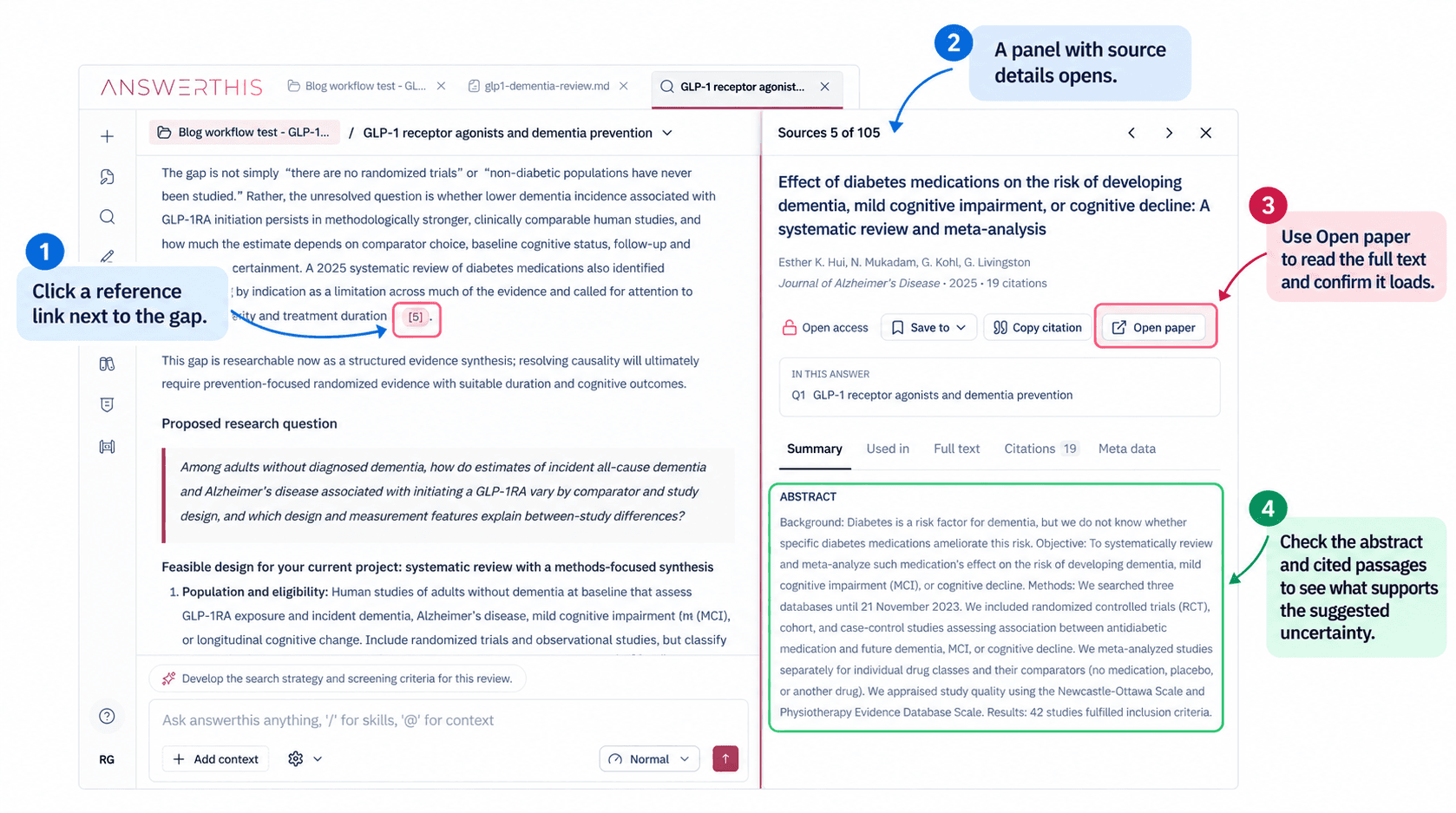
Read the answer and identify its proposed uncertainty, then inspect the papers attached to the explanation. For this example, the answer proposed one focused direction under Research gap, concerning differences in study methods and comparisons. Treat that as a suggested line of investigation, not a verified clinical conclusion.
If you run the search inside an existing project, the answer can draw on that project's context.

Pick one gap and open a paper behind it.
In this example, clicking [5] beside the gap opens source details for Effect of diabetes medications on the risk of developing dementia, mild cognitive impairment, or cognitive decline: A systematic review and meta-analysis. The panel shows publication details, an ABSTRACT and CITED PASSAGES.
Read the displayed material to check what supports the suggested uncertainty. Then get the full paper, through your library if needed, and read its methods and discussion before relying on it.
These are possible gaps to check, not guaranteed ones. Read the underlying papers, search beyond the returned evidence and take the surviving question to your supervisor. Your supervisor gets the final word on the project's suitability.
For a no-signup starting point, try the free research gap finder. This separate tool suggests one to three candidate gaps from a bounded search of retrieved abstracts, with source links, and allows three free runs per browser. It does not read full papers or establish novelty. Do not confuse its stated limits with the in-app walkthrough above.
How do you check whether a possible gap is still open?
Try to find the research that would make your gap statement wrong. A candidate that survives this check is more defensible than one built only from supporting examples.
Search alternative terms for the population, setting and outcome. Inspect recent reviews, follow relevant references backwards and look for later papers citing the key studies. Keep the wording and scope of each search in your notes.
Use this verification checklist before writing “no research exists”:
Read the relevant full papers, not only abstracts.
Check for subgroup analyses and supplementary material.
Search terms used by neighbouring disciplines.
Look for studies published after the review's search date.
Record evidence that challenges the candidate, not only evidence supporting it.
When your search is limited, keep your statement limited too. “The papers reviewed did not resolve this question” says what you established. “Nobody has studied this” makes a much broader claim.
What should you take to your supervisor?
Take a candidate question with its evidence, a short search record and a realistic plan. A supervisor can assess a specific uncertainty more usefully than a broad topic described as unexplored.
Prepare a short note that states what is known, what remains uncertain, why answering it matters and what evidence you could obtain. Include the papers that support and challenge your interpretation, plus access or methodological constraints.
For a dissertation or medical-school project, discuss whether the question fits the available time, skills, data and supervision. For a case series or audit, discuss the project's purpose before presenting it as a test of a causal explanation. A local audit question can concern practice against an agreed standard without claiming a globally novel research gap.
Ask your supervisor whether the uncertainty is still open, whether your proposed approach could answer it and whether a smaller question would be more useful. Treat that conversation as part of choosing the project, not a final formality after committing to it.
FAQs
Does every dissertation need a completely untouched topic?
Do not assume that a dissertation needs a topic nobody has ever considered. A contribution can concern a specific uncertainty, a justified replication or a different interpretation of existing evidence. Ask your supervisor what contribution your programme expects, then explain how the proposed work meets that expectation without overstating novelty.
What if another paper already answers my proposed question?
Revise or discard the candidate rather than ignoring the paper. Read its scope, methods and limitations to see whether a meaningful uncertainty remains. A related question may still be useful, but changing the population or location alone does not establish its importance. Take the revised rationale to your supervisor.
Can a negative or inconclusive result help me choose a project?
A negative or inconclusive result can prompt a useful question, but it does not automatically identify a gap. Check what the study estimated, how uncertain the result was and which conclusions its design supports. Distinguish evidence against an effect from evidence too limited to resolve the question before proposing follow-up work.
What if I cannot obtain the full text of a relevant paper?
Do not describe the full paper as checked if you have read only its abstract. Seek access through your library or ask your supervisor for help. Record the access limitation and avoid claiming that a method or subgroup was absent merely because the abstract does not mention it.
Should I choose the most original-looking gap or the most feasible one?
Choose a question with a defensible rationale that you can realistically investigate, rather than the most original-sounding wording. Novelty alone does not supply participants, usable data, suitable methods or supervision. Discuss the trade-off with your supervisor and narrow the question until its evidence needs match the resources you can access.
Explore AnswerThis to investigate a broad area and inspect the papers behind a possible gap. Bring the candidate, your source checks and your proposed question to your supervisor before choosing the project.