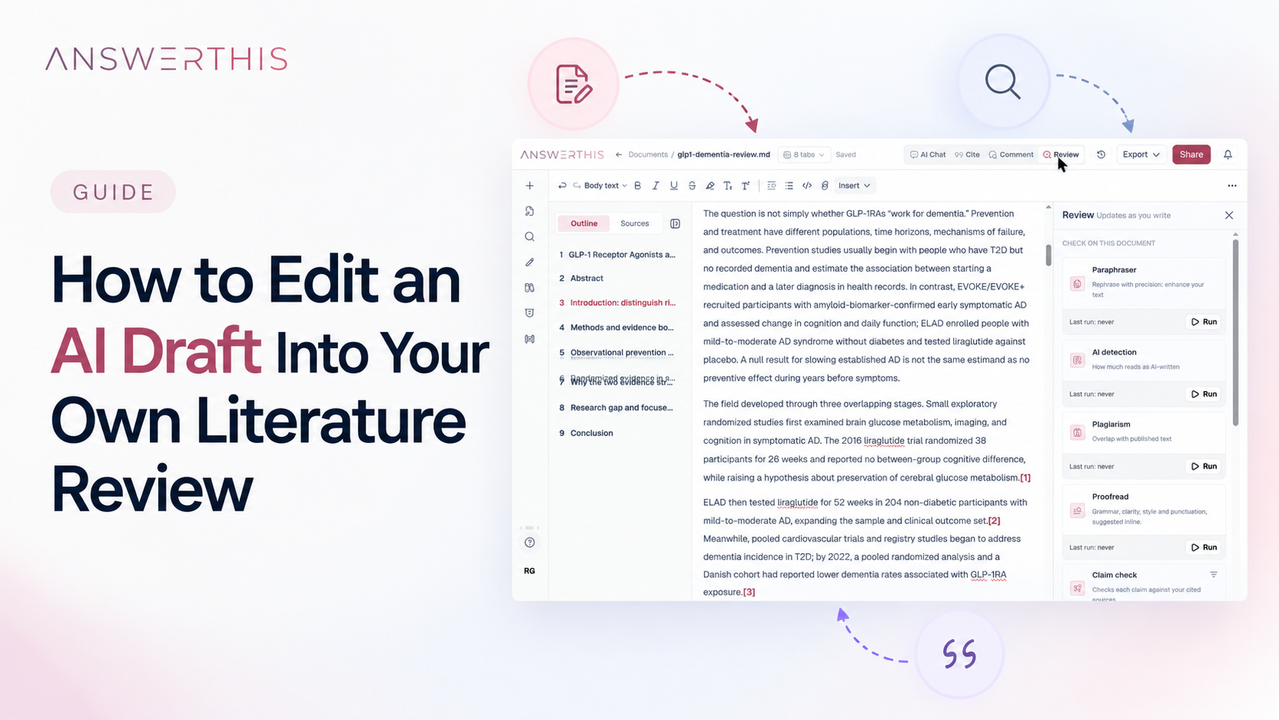

A good literature review explains what researchers know, where their findings agree or disagree, and what remains unresolved. It is organized by theme, not by author, and its unresolved questions set up the research question you are about to ask. AnswerThis can generate a cited first draft of a review from a typed research question, which gives you a starting synthesis to check and refine rather than a finished analysis.
TL;DR
Organize your review by theme rather than summarizing each author separately.
Compare study populations, designs, outcomes and limitations to explain apparent disagreement.
Use AnswerThis’s cited draft as a starting point, then verify claims against original papers.
Confirm a candidate gap with recent papers and registered trials before turning it into a research question.
Why a List of Summaries Is Not a Literature Review
A review that only restates “Smith found this, then Jones found that” has not yet done that work. This distinction matters whether you are writing a thesis chapter, a medical school research project, or the background of a case report. Readers need to see how the evidence fits together, not simply that you read it.
A list of summaries describes each study in isolation. A literature review uses critical synthesis to connect findings across sources and explain what the comparison shows. For more detail on this distinction and on choosing a narrative, scoping or systematic approach, see how to write a literature review.
The difference is structural. A summary-style paragraph says Study A found a result and Study B found a different result. A thematic paragraph asks why they differ: different populations, different comparison groups, different outcome measures, or different study designs.
Readers of a thesis or research proposal are trying to answer one question: does the author understand how this evidence fits together? A sequence of isolated summaries answers a different question, namely whether the author read the papers. Both matter, but only the first demonstrates the analytical work a review is supposed to do.
How Do You Organize a Literature Review by Theme?
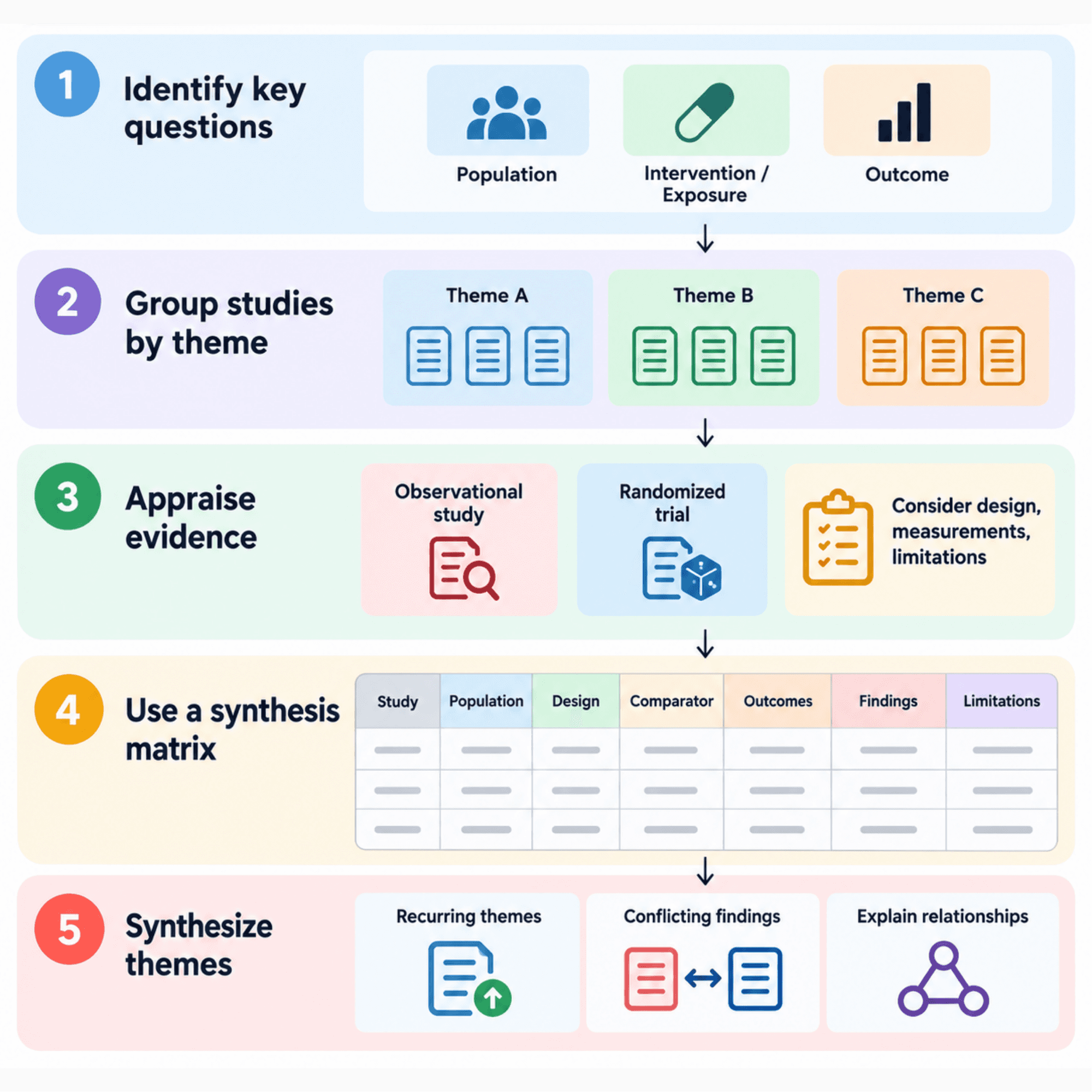
You organize a literature review by theme by grouping studies around the questions they jointly answer, such as a shared population, intervention, or outcome, rather than around the order you found them.
Start by listing the questions your field is actually debating. For a clinical topic, that might be a population (older adults with a chronic condition), an exposure or intervention (a medication class), and an outcome (a measured risk or symptom change). Group your sources under those questions instead of under their publication dates.
Within each theme, note what kind of evidence each study provides. An association found in routine clinical records answers a different kind of question than a result from a randomized trial. This critical appraisal means examining how the study design, measurements, and limitations affect the conclusions you can draw.
A synthesis matrix can help you organize the comparison before writing. Record each study’s population, design, comparator, outcomes, findings, limitations, and supporting passage. Read across the entries to identify recurring themes and conflicting findings. The table supports evidence synthesis, but your explanation of those relationships is what turns the notes into a literature review.
A Worked Comparison
Consider two illustrative sources on the same general subject.
Study A is a large observational cohort. It tracks patients over several years using health records and reports that people taking a certain medication had a lower rate of a later diagnosis. It cannot assign treatment at random, so people who received the medication may differ from those who did not in ways the analysis cannot fully capture.
Study B is a randomized controlled trial. It assigns a comparable group of patients to the medication or a placebo, measures a defined clinical outcome over a fixed period, and finds no significant difference between the groups. It controls for unmeasured differences between groups through randomization, but its result applies to the specific population and outcome it tested.
A thematic literature review states what each design can and cannot show, and explains why their conclusions do not automatically transfer to each other. A summary-style review would just report that one study found a benefit and the other did not.
How Do You Explain Disagreement Between Studies?
You explain disagreement by identifying what differs between the studies methodologically, not by counting how many reported a positive result.
Ask whether the studies examined the same population, the same comparison group, and the same outcome at the same point in a disease or process. Two studies that appear to conflict may actually be answering different questions.
For example, a study measuring whether a treatment prevents a new diagnosis in people who do not yet have a condition is not directly comparable to a trial measuring whether the same treatment slows progression in people who already have it. Both are legitimate questions. Treating their results as interchangeable produces a false sense of conflict.
How to Write a Literature Review With AnswerThis
AnswerThis can generate a cited first-draft synthesis from a specific research question, which you then review and refine using your own judgment of the evidence.
From the home screen, select New, then choose Literature review.
Type your research question, specifying the population, intervention or exposure, outcome, and any comparison you want addressed, and submit it.
Review the generated document’s thematic sections and inline citations.
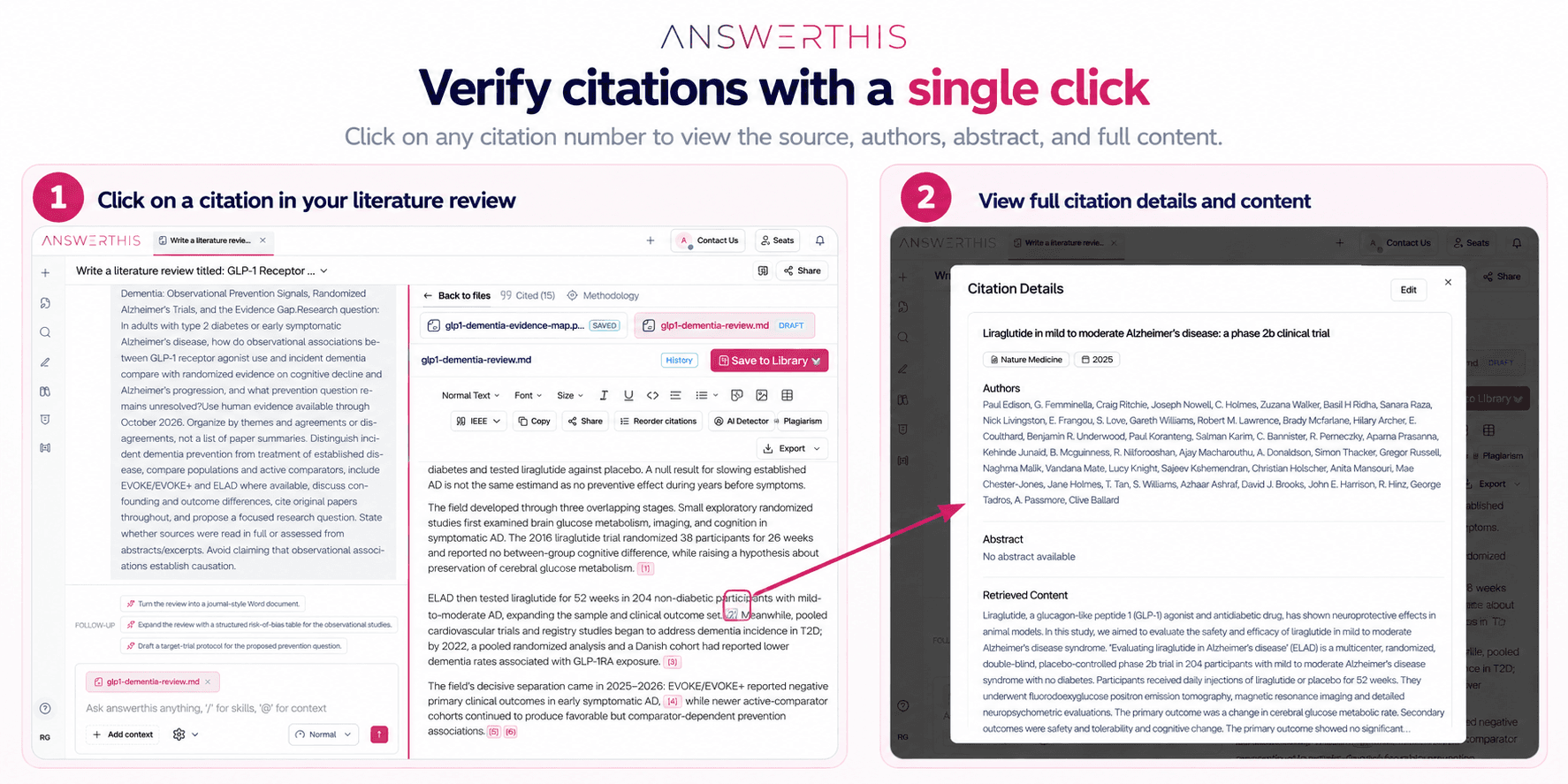
Click an individual citation to see its retrieved source detail, then compare that passage against the original paper before relying on it.
AnswerThis produces a cited draft to work from. Deciding which themes actually hold together, verifying the evidence behind each claim, and defining the research gap remain tasks for you to complete.
A Real Worked Example: Checking One Citation Against Its Source
To show this process concretely, a literature review was generated in AnswerThis using the following question, typed directly into the Literature review screen from the home screen:
“In adults with type 2 diabetes or early symptomatic Alzheimer’s disease, how do observational associations between GLP-1 receptor agonist use and incident dementia compare with randomized evidence on cognitive decline and Alzheimer’s progression, and what prevention question remains unresolved?”

The generated review separated its evidence into themes: observational signals in people with type 2 diabetes, randomized trial evidence in people with symptomatic Alzheimer’s disease, and the reasons those two evidence streams are not directly comparable.
One cited source was a phase 2b randomized trial of liraglutide in people with mild to moderate Alzheimer’s disease. Clicking its citation in AnswerThis opened the paper’s retrieved detail, including its primary-outcome description. Checking that passage against the published trial report confirmed that the primary outcome, a measure of brain glucose metabolism, showed no significant difference between treatment and placebo groups, while a secondary cognitive measure favored treatment and the authors described that secondary result as exploratory and not adjusted for multiple comparisons.
That distinction matters for how you would write about the study. Describing it only as a trial that “improved cognition” would omit the qualification the authors themselves applied to their own secondary finding.
A separate randomized trial of oral semaglutide in early symptomatic Alzheimer’s disease, reported in The Lancet, did not find a significant difference in clinical progression between treatment and placebo groups. Comparing it with the liraglutide trial shows two randomized studies testing related medicines in overlapping but not identical populations, with different outcome measures and different results. A thematic review states that comparison directly instead of implying the field has reached one settled answer.
How Do You Turn a Research Gap Into a Question?
You turn a research gap into a question by naming the specific population, comparison, and outcome that existing studies have not yet tested together. For a fuller treatment of this step, including methods for checking a candidate gap, see how to identify a research gap.
“More research is needed” does not tell a reader what a new study would contribute. A research gap statement names the unresolved issue and explains which limitations in the existing evidence prevent an answer. A usable research question then specifies who would be studied, what would be compared, and what would be measured.
In the worked example above, the observational studies addressed people who did not yet have dementia, while the randomized trials addressed people who already had symptomatic Alzheimer’s disease. The unresolved question sits between those two groups: whether starting treatment in people with no cognitive impairment changes their later risk of decline. That gap, not a vague call for more study, is what should lead into a thesis proposal or project background.
Before treating a proposed gap as genuinely open, check recent publications and registered trials in the area. A generated review can surface a candidate gap, but confirming it is still open is your responsibility. Once the gap is confirmed, see research question examples for guidance on turning it into a focused, answerable question.
Frequently Asked Questions
What makes a literature review different from an annotated bibliography?
An annotated bibliography describes each source individually, typically in its own entry. A literature review instead organizes sources around shared themes and explains how they relate to each other, including where they agree, disagree, or leave a question unanswered. The review’s goal is synthesis across sources, not separate description of each one.
How long should a literature review be?
Length depends on your assignment, journal, or thesis requirements rather than a fixed rule. A thesis chapter is usually longer and more comprehensive than the background section of a case report or short research proposal. Check your program, journal, or supervisor’s specific requirements before setting a target length.
Should a literature review include studies that disagree with each other?
Yes. Including studies with different findings, and explaining what methodological differences might account for the disagreement, is part of demonstrating synthesis. Omitting conflicting studies to present a single uniform conclusion misrepresents the evidence and weakens the credibility of your review.
Can I rely on an AI-generated literature review as my final submission?
An AI-generated review can provide a cited starting draft that identifies relevant sources and candidate themes. You still need to verify each citation against its original source, judge whether the thematic groupings are accurate, and confirm that any proposed research gap is genuinely unresolved before submitting the work as your own.
What is a research gap in a literature review?
A research gap is a specific, unanswered question that existing studies have not yet addressed together, such as an untested population, comparison, or outcome. A strong research gap names these elements directly rather than stating generally that “more research is needed.”
Ready to turn a research question into a cited first draft you can check and build on? Explore AnswerThis.