
A good research question identifies a focused problem that you can investigate using available evidence and an appropriate method. These research question examples show how to turn a broad interest into a clear inquiry without assuming the answer. AnswerThis’s research question generator can draft ten candidate questions from your topic, selected method and optional population. Then run an AnswerThis literature search to confirm each one is new.
TL;DR
Compare 40 research question examples across eight fields to see what each revision improves.
Match the question’s purpose to evidence you can access, not simply a preferred method.
Use FINER to assess feasibility, interest, novelty, ethics and relevance in your discipline.
Keep research questions, hypotheses and thesis statements distinct.
Research question examples by field
All 40 pairs below are original illustrative examples, not questions taken from published studies, and require adaptation to your evidence, access and assignment.
Each revision clarifies the inquiry; suitability still depends on the evidence and proposed design.
Education
These revisions separate learning outcomes, participation and students’ accounts of their experiences.
1. Written feedback
Weak question: How do students use feedback?
Stronger question: How do first-year history students use written tutor feedback when revising an essay?
Why it is stronger: Identifies the feedback source, learning task and process to investigate.
2. Retrieval practice
Weak question: Does retrieval practice help learning?
Stronger question: What effect does weekly retrieval practice, compared with weekly rereading, have on delayed vocabulary recall in a randomized classroom study?
Why it is stronger: Names an intervention, comparison and outcome, with a design cue for causal inference.
3. Attendance
Weak question: Why is attendance low?
Stronger question: What reasons do commuting undergraduates give for missing scheduled morning lectures?
Why it is stronger: Explores participants’ explanations without assuming laziness or a single cause.
4. Online discussion
Weak question: Are online discussions better?
Stronger question: How does the distribution of student contributions differ between live and asynchronous discussions in an undergraduate seminar?
Why it is stronger: Replaces an undefined judgment of quality with a comparable participation pattern.
5. Academic belonging
Weak question: Does belonging affect persistence?
Stronger question: What is the association between reported academic belonging and intention to continue among part-time master’s students?
Why it is stronger: Uses association language and distinguishes intention from actual continuation.
Psychology
Here, the challenge is to distinguish measured associations from experimental effects and participants’ interpretations.
6. Bedtime phone use
Weak question: Do phones cause poor sleep?
Stronger question: What is the association between phone use before bedtime and sleep-onset latency among postgraduate students?
Why it is stronger: Narrows phone use and sleep while avoiding an unsupported causal claim.
7. Attention
Weak question: Does noise affect concentration?
Stronger question: How does background speech, compared with silence, affect sustained-attention task accuracy in a randomized laboratory experiment?
Why it is stronger: Defines the exposure, comparison and observable performance outcome.
8. Loneliness
Weak question: Why are students lonely?
Stronger question: How do students living alone describe experiences of connection and disconnection during their first semester?
Why it is stronger: Leaves room for varied experiences rather than assigning loneliness to everyone.
9. Stress measurement
Weak question: Do stress measures agree?
Stronger question: How closely do daily stress diaries and end-of-week stress ratings agree among doctoral researchers?
Why it is stronger: Specifies the measurement approaches and the agreement being assessed.
10. Help-seeking
Weak question: Why do people avoid therapy?
Stronger question: How do adults who considered but did not begin therapy describe their decision-making?
Why it is stronger: Defines a relevant group without presuming avoidance or its reasons.
Business and management
These examples replace broad claims about organizational success with defined outcomes and decision processes.
11. Remote work
Weak question: Is remote work productive?
Stronger question: How does self-reported task completion differ between fully remote and hybrid customer-support employees within one organization?
Why it is stronger: Specifies the comparison and indicator without equating self-report with objective productivity.
12. Leadership
Weak question: Does leadership improve retention?
Stronger question: What is the association between perceived supervisor support and voluntary departure among graduate recruits during their first year?
Why it is stronger: Identifies a leadership-related construct, outcome and period without claiming causation.
13. Pricing
Weak question: Do discounts increase sales?
Stronger question: What effect does offering a checkout discount, compared with no discount, have on purchase completion in a randomized online experiment?
Why it is stronger: Defines the offer, control condition and conversion outcome.
14. Organizational change
Weak question: Why do employees resist change?
Stronger question: How do employees interpret the introduction of automated scheduling in a retail workplace?
Why it is stronger: Allows acceptance, ambivalence and opposition instead of presuming resistance.
15. Supplier trust
Weak question: How do buyers trust suppliers?
Stronger question: What practices do small manufacturers describe using to assess a supplier’s reliability before their first contract?
Why it is stronger: Locates trust formation in a specific decision and organizational setting.
Public health and healthcare
The questions distinguish access barriers, service outcomes and understanding of health information.
16. Vaccination access
Weak question: Why do people miss vaccinations?
Stronger question: What barriers do parents whose children missed a scheduled routine vaccination describe when arranging appointments through a community clinic?
Why it is stronger: Retains the missed-vaccination problem and identifies whose accounts can illuminate appointment barriers.
17. Appointment reminders
Weak question: Do reminders improve attendance?
Stronger question: What effect do text reminders, compared with usual scheduling information, have on missed outpatient appointments in a randomized trial?
Why it is stronger: States the intervention, comparison and service outcome without predicting benefit.
18. Medication information
Weak question: Is medication advice clear?
Stronger question: How do adults starting an inhaled medicine explain the instructions in its patient information leaflet?
Why it is stronger: Examines understanding through participants’ explanations rather than an undefined clarity score.
19. Neighborhood access
Weak question: Do neighborhoods affect healthcare?
Stronger question: How is travel time to primary care associated with reported unmet appointment needs among rural adults?
Why it is stronger: Connects a defined access measure with a defined reported outcome.
20. Discharge communication
Weak question: Is discharge communication different?
Stronger question: How does documentation of medication changes differ between weekday and weekend hospital discharge summaries?
Why it is stronger: Makes the comparison about recorded information, not unmeasured patient understanding.
Sociology and social policy
These revisions make social concepts investigable without building a contested explanation into the question.
21. Housing insecurity
Weak question: How do renters experience insecurity?
Stronger question: How do private renters facing lease renewal describe uncertainty about remaining in their homes?
Why it is stronger: Grounds an abstract concept in a recognizable housing transition.
22. Welfare services
Weak question: Why is applying for benefits difficult?
Stronger question: What administrative tasks do first-time applicants describe when seeking disability-related benefits?
Why it is stronger: Examines the process without presuming that every applicant experiences difficulty.
23. Social mobility
Weak question: Does parents’ education shape their children’s careers?
Stronger question: How is parental educational attainment associated with adult occupational position among people entering employment in the same period?
Why it is stronger: Separates association from causation and introduces cohort comparability.
24. Public consultation
Weak question: Do consultations represent residents?
Stronger question: How does the age distribution of participants in a municipal transport consultation compare with that of the municipality’s adult population?
Why it is stronger: Gives representation a defined dimension and an explicit reference population.
25. Care work
Weak question: Why is unpaid care invisible?
Stronger question: How do unpaid carers describe recognition of their work in interactions with local support services?
Why it is stronger: Investigates recognition without treating invisibility as an established finding.
Environmental science
Comparable conditions and defined environmental measures help separate description, association and experimental effects.
26. River litter
Weak question: How polluted is the river?
Stronger question: What types of visible litter occur along urban riverbank segments surveyed after rainfall?
Why it is stronger: Defines the pollutant category and observation conditions without claiming to measure all pollution.
27. Urban shade
Weak question: Do trees reduce heat?
Stronger question: How does afternoon surface temperature differ between shaded and unshaded pavements of the same material on the same survey days?
Why it is stronger: Improves comparability while remaining an observational comparison.
28. Fertilizer runoff
Weak question: Does fertilizer pollute water?
Stronger question: What effect does fertilizer application, compared with no application, have on nitrate concentration in runoff from randomized soil plots?
Why it is stronger: Specifies a testable intervention and chemical outcome under controlled comparison.
29. Biodiversity
Weak question: Does land use affect birds?
Stronger question: What is the relationship between surrounding impervious-surface cover and recorded bird-species richness at urban survey sites?
Why it is stronger: Defines the land-use indicator and biodiversity measure without asserting an effect.
30. Conservation decisions
Weak question: Why do farmers reject conservation?
Stronger question: How do tenant farmers describe decisions about joining a voluntary hedgerow conservation scheme?
Why it is stronger: Allows participation and nonparticipation to emerge from accounts of decision-making.
Computer science and engineering
These questions bound system performance and usability problems through specified tasks, conditions and evaluation criteria.
31. Classification
Weak question: Which classifier is best?
Stronger question: How do two document classifiers compare in precision and recall on the same held-out collection of labeled support tickets?
Why it is stronger: Defines the task, shared evaluation material and complementary performance criteria.
32. Cooling design
Weak question: Do cooling fins work better?
Stronger question: How does wider, compared with narrower, fin spacing affect steady-state component temperature under fixed heat input and airflow in a randomized bench experiment?
Why it is stronger: Defines a manipulated design feature, outcome and controlled test conditions.
33. Password recovery
Weak question: Why do users fail password recovery?
Stronger question: How do users who cannot complete password recovery interpret the identity-verification instructions during a moderated usability session?
Why it is stronger: Retains unsuccessful recovery as the problem while examining instructions rather than blaming users.
34. Network demand
Weak question: Does traffic slow networks?
Stronger question: How is concurrent connection count associated with request latency on a server processing a fixed mix of request types?
Why it is stronger: Identifies demand and latency measures while limiting the system context.
35. Software review
Weak question: What happens in code review?
Stronger question: What categories of concern appear in review comments on documentation-only changes in an open-source project?
Why it is stronger: Defines the artifact, change type and descriptive classification task.
Humanities
A defined text, historical debate or concept anchors interpretation without forcing it into an experimental format.
36. Literary memory
Weak question: How does fiction portray memory?
Stronger question: How does the narrator’s treatment of remembered conversations shape responsibility in Kazuo Ishiguro’s The Remains of the Day?
Why it is stronger: Identifies a text, formal feature and interpretive issue without settling the reading.
37. Historical citizenship
Weak question: What did citizenship mean?
Stronger question: How did arguments about property ownership frame citizenship in British parliamentary reform debates of 1831–1832?
Why it is stronger: Bounds the concept through a defined debate and period.
38. Translation
Weak question: How do translations differ?
Stronger question: How do two English translations of Antigone render the conflict between kinship obligations and civic authority?
Why it is stronger: Gives comparison a conceptual focus rather than listing every textual difference.
39. Museum interpretation
Weak question: Are museum labels biased?
Stronger question: How do labels in a museum’s colonial-history gallery attribute agency to colonized people and colonial officials?
Why it is stronger: Replaces an undefined verdict with an analyzable feature of the displays.
40. Political philosophy
Weak question: Can consent create political obligations?
Stronger question: Under what conditions, if any, can tacit consent justify political obligation in Locke’s Second Treatise?
Why it is stronger: Locates a conceptual inquiry in a specific argument while keeping the conclusion open.
What makes a good research question?
Good research questions make the intended inquiry clear without deciding its answer. Focus establishes what belongs in the project. Clarity establishes what its terms mean. Answerability connects the inquiry to evidence, while significance explains why an answer matters beyond completing the assignment.

George Mason University’s guidance on writing a research question emphasizes clarity, focus and disciplinary fit. Apply those principles to your task: an interpretive argument needs evidence and analysis, while a descriptive study can legitimately estimate a defined quantity. Not every valuable question must contain a disputed proposition.
FINER offers another check. The UCSF inquiry curriculum uses the criteria Feasible, Interesting, Novel, Ethical and Relevant. It is a useful framework, not a universal scoring system, and its application depends on the discipline.
Feasible
Practical check: Can you obtain suitable evidence, skills, time, equipment and permissions?
Interesting
Practical check: Does the question sustain your attention and engage a relevant scholarly audience?
Novel
Practical check: What justified contribution could it make relative to existing work?
Ethical
Practical check: Can the investigation meet consent, privacy, welfare and integrity requirements?
Relevant
Practical check: Which scholarly, practical or interpretive uncertainty would an answer address?
Novelty need not mean investigating something nobody has mentioned. Depending on disciplinary expectations, a contribution can involve justified replication, an extension, a consequential context or an unresolved interpretation. Adding a location does not automatically establish a research gap. Likewise, a narrower question is not necessarily feasible if its evidence remains inaccessible.
Types of research questions
A question’s purpose and its methodology are related but different. A comparative question identifies a contrast, but that contrast might be examined through interviews, documents or numerical observations. The categories below overlap rather than divide research into exclusive boxes.
Descriptive
What it asks: What occurs, how often or in what forms?
Suitable evidence or approach: Defined observations, records, surveys or systematic document coding.
Comparative
What it asks: How do specified groups, cases or materials differ?
Suitable evidence or approach: Comparable measurements, case analysis or close textual comparison.
Relationship
What it asks: How are concepts or variables associated?
Suitable evidence or approach: Observational data with appropriate definitions and analysis.
Causal
What it asks: What changes because of an intervention or exposure?
Suitable evidence or approach: Randomized designs or justified causal approaches with explicit assumptions.
Qualitative exploratory
What it asks: How do people experience, interpret or organize something?
Suitable evidence or approach: Interviews, observation and suitable qualitative analysis.
Interpretive
What it asks: How should a text, practice, event or concept be understood?
Suitable evidence or approach: Close reading, archival sources, contextual analysis or philosophical argument.
Do not select a method simply because a question begins with “how.” The decisive issue is what would count as a supported answer. For causal questions, naming a comparison is only a starting point: allocation, confounding, measurement and other design assumptions still require attention.
How to write a research question in five steps
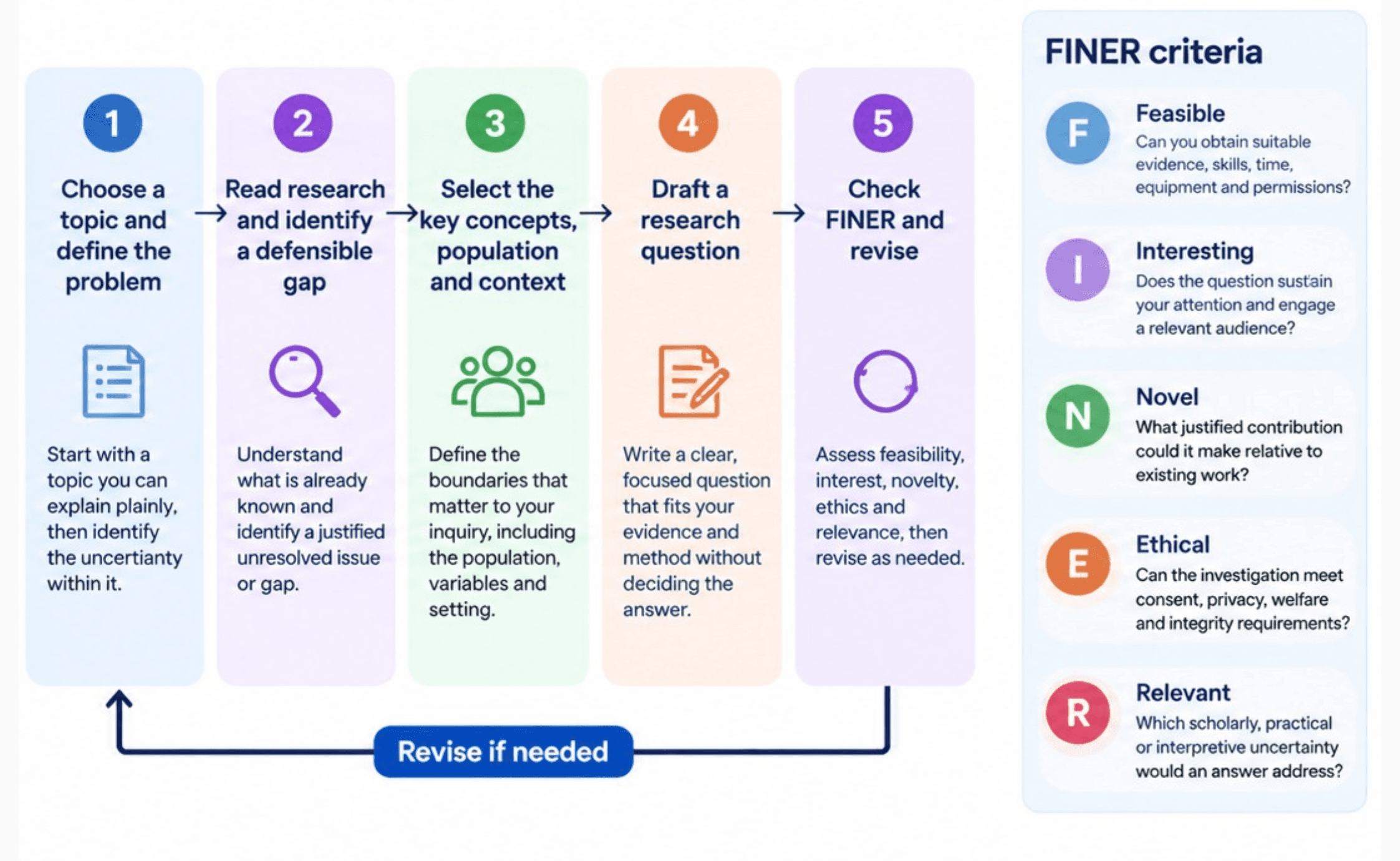
1. Choose a topic and define the problem
Begin with a topic you can explain plainly, then identify the uncertainty within it. For the continuing example, the topic is written tutor feedback in undergraduate history. The problem concerns what students do with comments when revising an essay, rather than whether feedback is universally “good.”
2. Read relevant research and identify a defensible gap or unresolved issue
Read how researchers define feedback use and what evidence supports their conclusions. Record findings that challenge your rationale, including work that might already answer your question.
In the example, examine whether prior work addresses reported reactions, actual revisions or both. Do not claim that revision practices are understudied unless the search supports it. The guide to types of research gaps can help name the uncertainty after you establish its evidence base.
3. Select the central concepts, population or material, and context
Choose the boundaries that matter to the inquiry. Here, focus on first-year history students, written tutor comments and essay revision. These choices make it possible to distinguish tutor feedback from peer discussion and revision from students’ general satisfaction.
Check consent to examine drafts and comments, particularly where tutors have assessment authority. If access or participant protection is unresolved, revise the plan.
4. Draft a question that fits the evidence and method
The working question becomes: “How do first-year history students use written tutor feedback when revising an essay?” Interviews could explore how students interpret comments, while consented drafts could show changes in the text. Neither source alone establishes that feedback caused better writing.
A reusable pattern is: “How does a defined group experience a specified process in a relevant context?” This is a qualitative drafting aid, not a universal formula. Adapt the structure to the inquiry.
At this stage, AnswerThis’s free research question generator can draft ten candidates from a topic, method and optional population. Compare the candidates with your evidence plan and select the wording that best expresses your central inquiry.
5. Check scope, feasibility, ethics and significance, then revise
Apply FINER to the feedback project: confirm access, an analysis plan and a rationale. Check that your inquiry allows different answers, including little visible use of comments.
Revise whichever element fails the check. If only interviews are available, specify that you will investigate students’ accounts rather than directly observe revisions. Discuss the question and its evidence requirements with your supervisor before committing to recruitment or collection.
Research question vs hypothesis vs thesis statement
A research question directs investigation, a hypothesis proposes a testable relationship or explanation, and a thesis statement presents an argument. These examples share the feedback topic, but the hypothesis and thesis are illustrative formulations, not findings.
Research question
Purpose: Specifies what the study investigates.
Example: How do first-year history students use written tutor feedback when revising an essay?
Hypothesis
Purpose: States a testable proposed relationship or explanation.
Example: Among first-year history students, reported clarity of written tutor feedback is positively associated with the proportion of comments addressed in essay revisions.
Thesis statement
Purpose: States a central argumentative claim requiring support.
Example: Evaluating written tutor feedback solely by student satisfaction overlooks the distinction between understanding a comment and applying it during revision.
The hypothesis would need definitions of clarity and comments addressed, plus evidence suitable for estimating that relationship. It is not mandatory for the exploratory question. A thesis statement develops an argument and should not be treated as a predicted statistical result.
If your design does require testable statements, AnswerThis’s hypothesis generator drafts three candidate null-and-alternative pairs with variables, a population and suggested measurements. Check that the chosen pair matches your variables and planned comparison.
Common research question mistakes
Scope exceeds the project. Remove dimensions that do not serve the central inquiry. Check the reading, collection and analysis workload, not just the number of words in the question.
Concepts remain vague. Define terms such as success, engagement or quality through an appropriate conceptual or operational account. Choose definitions relevant to the field rather than whatever is easiest to count.
Wording assumes the answer. Replace language that presumes harm, improvement or resistance with an inquiry open to competing answers. Neutral wording still allows a clear theoretical position.
Causal language exceeds the design. Use association, difference or reported experience when those match the evidence. Retaining causal language requires a design and assumptions that justify the intended inference.
Disconnected aims accumulate. Separate the central question from subsidiary questions. Keep a subsidiary inquiry only if answering it contributes to the same project rather than starting another one.
Access or ethics are treated as details. Check permissions, participant burden, sensitive information and evidence availability before finalizing the question. A project depending on unavailable records needs redesign, not more polished phrasing.
FAQs
What is an example of a good research question?
A useful example is: ‘How do first-year history students use written tutor feedback when revising an essay?’ It identifies a population, feedback source and process without predicting the answer. Whether it is suitable for your project depends on access to evidence, ethical arrangements and a justified reason for investigating it.
How do I turn a topic into a research question?
Identify an uncertainty within the topic, read relevant research, then specify what evidence could resolve it. Select the concepts and boundaries that matter and draft one central inquiry. Finally, check whether you can obtain and analyze the evidence within your project’s resources, ethical requirements and disciplinary expectations.
Can a research question start with ‘how’ or ‘why’?
Yes. ‘How’ and ‘why’ can support inquiries into processes, experiences, explanations and interpretation. Their value depends on the rest of the question, not the opening word. Avoid formulations that assume an outcome or explanation, and check whether your proposed evidence can address the kind of answer the wording requests.
Does every research question need a hypothesis?
No. Exploratory qualitative work, interpretive scholarship and some descriptive studies can proceed with research questions rather than formal hypotheses. A hypothesis is useful when a proposed relationship or explanation can be evaluated through an appropriate design. Do not add one merely to make a project look more scientific or decide its answer in advance.
How narrow should a PhD research question be?
It should be bounded enough to support a coherent, achievable investigation while sustaining a contribution appropriate to the discipline. A doctorate can organize related studies around an overarching question. Assess the evidence required, analytical depth and connection between subsidiary inquiries with your supervisor, rather than applying a fixed limit on populations or variables.
One last thing
Draft your own question, then write a separate sentence naming the evidence needed to answer it. If those two statements do not align, revise the question or the evidence plan. Bring both to your next supervision meeting so the discussion concerns a researchable project, not wording alone.