

Types of Research Gaps
Understanding the different types of research gaps is essential for writing a strong literature review and producing meaningful academic work. For a smoother research process, AnswerThis connects source exploration, analysis, and structured writing support. The remaining sections show how to apply this principle to real research work.
TL;DR
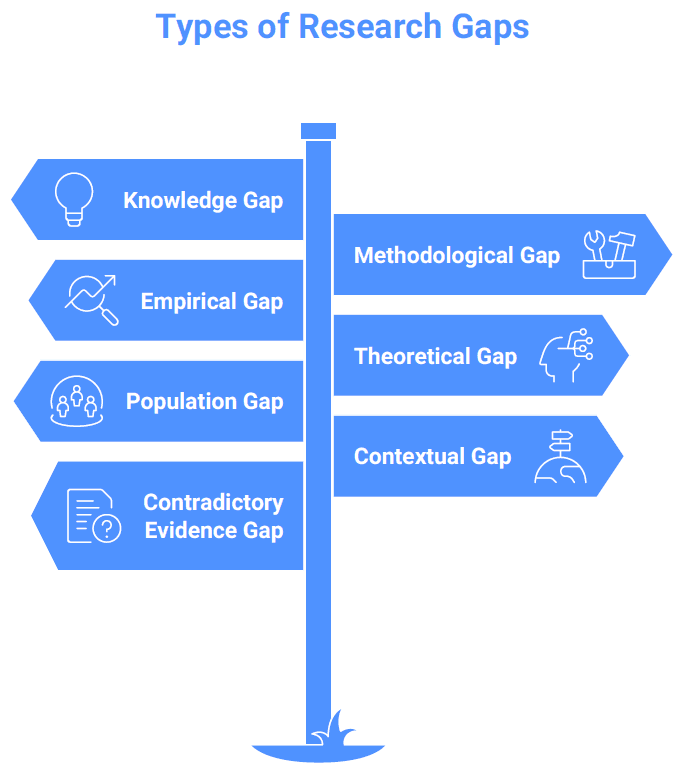
This guide explains 7 Types of Research Gaps (With Examples).
Understanding the different types of research gaps is essential for writing a strong literature review and producing meaningful academic work.
This guide explains knowledge gaps, methodological gaps, empirical gaps, and more, with clear examples and practical ways researchers can identify gaps faster using modern research tools.
Use the sections below for practical steps, examples, and next actions.
Determining your research gap may present a challenge to students and some experienced researchers alike. In numerous examples of literature reviewed, even though there are hundreds of other researchers reviewing the same literature, there remains the. “I don’t know what is missing,” many researchers feel while trying to determine if they have sufficient evidence to fill in a research gap.
In the following sections of this blog, we shall outline some of the main types of research gaps, define them in sample language, and provide you with ideas on how you can find and define your research gap more effectively by using modern tools like AnswerThis.
What is a research gap?
Research gaps are aspects of a study that require additional exploration and follow-up. These could include missing data, questions that can’t be answered yet, outdated research results, and conflicting results with one another.
Think of research as a big puzzle. Many pieces are in place, but there is a missing piece; hence, an open space is created (the research gap).

1. Knowledge Gap
A knowledge gap can occur when you have very little or no research available, which is an easy example of a knowledge gap. For example, if an emerging technology (artificial intelligence) has recently appeared in a particular area, there may not be enough research available to determine how it will affect that specific area. This would again translate into a clear area of research opportunity. Knowledge gaps in this area will become increasingly rare in established fields as research is undertaken, but the true skill lies in determining what exactly is missing from the research that has been performed.
Tools such as AnswerThis allow researchers to quickly search and identify large amounts of information, allowing them to see where studies conducted on similar topics are lacking or missing completely. This saves the researcher weeks of searching manually through an enormous volume of material.
2. Methodological Gap
A methodological gap occurs when past research has used untested methods or poor research designs. For instance, (i) only qualitative studies have been published, but no quantitative validations have been performed; (ii) Low sample sizes were used; (iii) there were few experimental or longitudinal studies conducted.
If any of these apply to current research, then using a more rigorous or distinct methodology can help fill the methodological gap. Methodological gaps are frequent throughout the social sciences and emerging interdisciplinary areas. AnswerThis can help to identify common patterns of methodology in different articles by examining several study papers together; thus, identifying areas of concern across studies will be simplified.

3. Empirical Gap
An empirical gap is when there is a lack of evidence or data available. Theories can sometimes exist without being tested in the real world. Evidence can also come from small sample sizes and from old datasets that are no longer relevant. Examples include: (i) A theory that exists but has no proof in the real world (ii) Data exists from only one country rather than having been collected from around the world (iii) Old datasets are being used and not the current. Research can help fill empirical gaps by providing new data through experimentation and/or case studies.
AnswerThis can show you what empirical gaps you may have missed by showing you multiple research studies from different data sources. This allows for quick reference to see where gaps exist.
4. Theoretical Gap
A theoretical gap arises when existing theory does not satisfactorily describe a phenomenon.
The following are examples of circumstances that can create theoretical gaps: (i) The emergence of new technologies/trends (ii) A lack of consistency between the current theory and the new context in which it is being used (iii) The emergence of new models that challenge traditional paradigms of thought. For example, traditional business models may not be adequate in explaining platform economies, such as Uber or Airbnb. As researchers fill these theoretical gaps, they typically do one of the following (i) create a new model, (ii) extend or refine an existing model, (iii) combine various models.
With AnswerThis, researchers can compare how other scholars have approached the same theoretical gaps and analyze how authors use different theories to illustrate their problems in academic or professional contexts.

5. Population Gap
A population gap happens when someone studies one group but fails to research any other groups. For example: (i) Successful research intended for use by adults may not be useful for children, both in development and current use; (ii) Research completed solely within Western society and not considering developing areas; (iii) Data collected only from a particular industry or segment of the economy. Population gaps are important because they limit the researcher’s ability to generalize their findings to different types of populations outside of what was studied. Your research may help fill this gap by completing the data on populations that have not been well-studied or not previously studied at all.
AnswerThis provides information about the populations used for the various types of research conducted so that you can quickly reference what has been done previously and what has not.
6. Contextual Gap
When research evidence is restricted to some or all of a given place’s space, a contextual gap exists in that particular place being studied. For instance, in the following examples: (i) Findings from one country may not apply to another country; (ii) One kind of industry will not always apply to another industry; (iii) Findings obtained from experimental or controlled conditions will not always apply in actual or real-life settings. This type of gap would be very significant in the fields of education, business, or healthcare. Filling this gap requires the application of existing research results and/or theories in new environments and/or locations.

7. Contradictory Evidence Gap
At times, research is available, but the conclusions vary. Take, for example: (i) One study may indicate a method is effective; (ii) another study may find it ineffective; (iii) this leads to confusion about what remains to be investigated. You can then conduct your research to: (i) Compare inconsistent studies (ii) Identify causal factors for the differences (iii) Reach sounder conclusions about the two research projects. You can also compare results from multiple articles, which aids in determining differences across studies.
How to identify research gaps faster
Historically, the process of identifying research gaps involved reading through dozens/hundreds of papers by hand, and this was time-consuming and often tedious. Once the analysis is complete, some researchers convert their final summary from PDF to flipbook before sharing it with their department, making a dense document easier to page through than a plain file.
Now, technologies like AnswerThis, allow users to do the following:
Find papers easily, quickly, and efficiently
Extract critical information from papers
Correlate findings from studies
Identify missing elements of research/ discrepancies
Instead of spending weeks identifying gaps, users can now find gaps in hours or even minutes, concentrating rather on doing research.

Final thoughts
Academic researchers must develop the skill of finding and identifying gaps within their topic area; this is a major component of turning a broad abstract concept into a full-scale publishable journal article. Some gaps represent missing knowledge, while others represent studies that used substandard methodology, sample size, or external factors. By more clearly defining your gap within the literature, you will be in a stronger position to conduct your research. However, researchers no longer must do this alone! Research tools such as AnswerThis allow researchers to quickly identify research gaps, clear up any confusion, write literature reviews that are clearly defined, and solidify their research argument with confidence.
If you are looking for key takeaways on identifying gaps that researchers are coming up with, or seeking further research opportunities, consider exploring recent articles and utilizing tools like AnswerThis to ensure further research is needed and that you have a clear summary of the essential concepts discussed. Explore this webinar to facilitate your research workflow.
FAQs
What is the goal of finding Research Gaps?
The goal is to make the research process more systematic, transparent, and useful by connecting a focused question with credible evidence.
Who can benefit from this approach?
Students, researchers, and teams preparing evidence-based reports can use the process to work through a larger body of literature with more clarity.
What is the best first step?
Start with a focused research question, define what counts as relevant evidence, and choose a clear method for organizing the sources you find.
How do I check the quality of the results?
Review the source selection, look for gaps or bias, verify citations, and make sure each conclusion can be traced back to the underlying evidence.
When should I use a more formal review process?
Use a formal process when the work will inform an academic paper, a major decision, or a review that needs to be transparent and reproducible.


.png)
