
An AI writing self-check means verifying the sources behind your claims, examining text matches and reviewing how you used AI before submitting. Detector scores are estimates, not authorship verdicts. Correct unsupported claims and borrowed wording, keep earlier drafts, and follow the disclosure rules for your course or journal.
You can use this process on a literature review, a dissertation chapter or a manuscript without having followed the rest of this series. The aim is to submit work you understand and can support, not to make a score change. AnswerThis supports the process through AI detection and plagiarism checks in AI Writer, while interpretation and responsibility stay with you.
TL;DR
An AI writing self-check starts with source verification, not a detector score.
AnswerThis checks flag what to review before you submit, so you can confirm authorship and originality with confidence.
Correct attribution and evidence problems, not writing patterns merely to change a score.
Keep earlier drafts and follow your university's or journal's AI disclosure rules.
What should an AI writing self-check cover?
Check evidence, attribution and disclosure separately. A result from one check does not answer the questions covered by another.
An AI flag is a detector's estimate about writing patterns. A similarity match is reported overlap between text and material included in a comparison. Plagiarism concerns how you use and attribute someone else's work, not simply whether a tool reports matching words.

Source verification
Question to investigate: Does the paper support this specific claim?
What the result cannot establish: Whether your AI use follows submission rules
AI detection
Question to investigate: Which passages does the detector flag for review?
What the result cannot establish: Who wrote the document or whether misconduct occurred
Similarity review
Question to investigate: What wording overlaps with the compared material?
What the result cannot establish: Whether every idea is original or properly attributed
Disclosure review
Question to investigate: Have you accurately described permitted AI use?
What the result cannot establish: Whether the manuscript's claims are correct
Start with your current draft and preserve a copy before editing. Keep the sources you relied on accessible, together with the submission instructions. You need those materials to make decisions that a score cannot make for you.
Open the sources behind your key claims
Read the source passage behind each central claim and compare it with your final wording. A citation that opens the intended paper is a starting point, not confirmation that the paper supports the sentence.
Check the population, design, comparison and outcome. Look for qualifications that disappeared during drafting, such as uncertainty, limited follow-up or an observational design. A claim about association should not become a claim that a treatment caused an outcome simply because the rewritten sentence sounds clearer.
Pay particular attention to numbers, quotations and statements carrying your main argument. If you cannot locate supporting evidence, narrow the claim, replace the source or remove the statement. Do not add an unrelated citation to make an unsupported sentence look documented.
You can also check your sources for retractions. This tool looks up recorded retractions for a DOI or title using Crossref metadata, including Retraction Watch data. A result showing no recorded retraction does not guarantee scientific validity or replace reading the paper.
How to run the checks with AnswerThis
Open your draft in AI Writer, run each check, then interpret the results separately. The walkthrough below uses the existing GLP-1 and dementia literature-review draft from the hands-on test, not a manuscript presented as ready for submission.
Open the draft you want to check in the AI Writer.
Choose AI Writer from the left navigation and open the intended document. Click Review to find AI detection and Plagiarism. Confirm that this is the version you want to inspect before running either check.
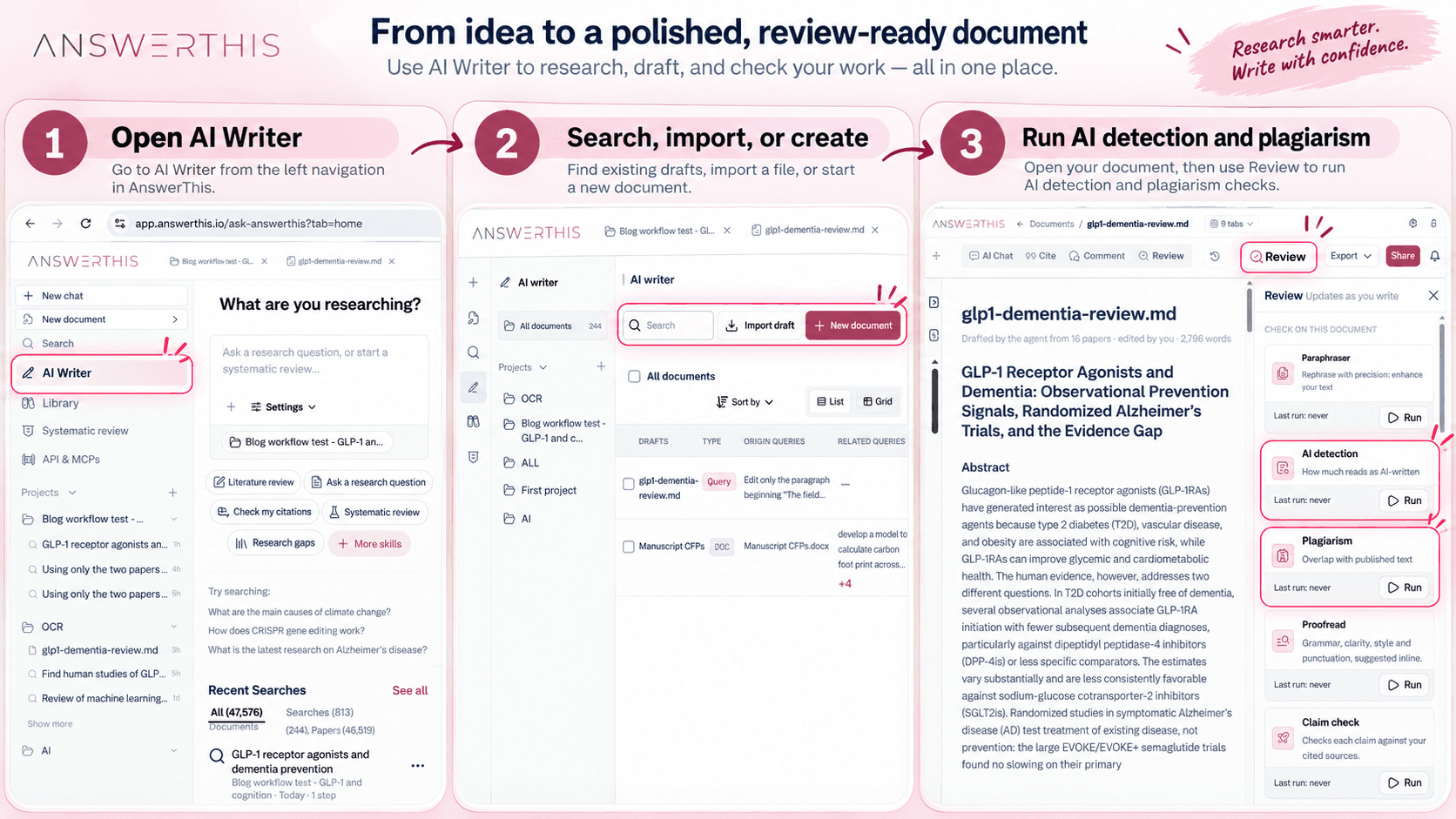
Run the AI detector and the plagiarism check.
For the first check, choose Run AI detection, leave Whole document selected and click Check document. Read the result before returning with Back to Review.
Then choose Run Plagiarism. In the tested setup, Published papers and Web pages were included, while Your Library was not selected. The exclusions for Quoted text, References section and Matches under 8 words were enabled. Click Check for plagiarism after reviewing those settings.
Record the settings with the report. They define what was compared and what was left out. The tested AI and plagiarism reports also counted different amounts of text, so do not assume their word counts or percentages describe identical checks.
Show the results and talk through them.
The AI report displayed 0% human, 0% AI-assisted and 100% AI, with 2,732 words checked and 56 flagged passages. It identified Pangram, model 4.1. These are the labels and results of this particular in-app run, not a verified measure of how every word was produced.

The document itself was labelled as drafted by the agent from 16 papers and edited by the user. The flag is consistent with that known drafting history, but the history is established by the workflow, not proved by the detector.
The plagiarism report displayed 0%, No similarity found, 2,794 words checked, 0 matches and 0 sources. It also stated that quotes, the references section and matches under eight words were left out.

A careful interpretation is: “This check reported no similarity matches with the compared material under these settings.” It is not a certificate that the ideas are original, the citations are correct, or the draft is ready to submit.
These checks support review of your own work. They do not replace source reading, your supervisor's judgment or the submission rules, and they are not a way to get past a detector.
What does an AI detector result mean?
Read an AI detector result as an estimate that needs context. A flag alone does not establish authorship, prohibited AI use or misconduct.
Liang and colleagues' 2023 Patterns study of GPT detector bias found that the detectors tested consistently misclassified non-native English writing samples as AI-generated while accurately identifying native writing samples. The authors cautioned against using GPT detectors in evaluative or educational settings where non-native English speakers could be penalised. That study concerns detectors available then, not an evaluation of every current detector or the tested in-app model.
For a separate public-page check, the AnswerThis free AI detector uses Winston AI and returns a Human Score with sentence-level estimates. That score does not measure the percentage of words written by AI and cannot prove authorship. The public page is distinct from the Pangram-labelled in-app report demonstrated above.
Do not treat different providers' labels as interchangeable. Preserve the report's wording and explain its limitations rather than converting a score into a factual claim about your authorship.
What should you do about a flagged passage?
Investigate the passage before changing it. The right response depends on whether the problem is unsupported content, borrowed wording, missing attribution or an AI estimate that does not match the drafting history.
If a passage closely follows a source, compare both texts. Use a properly attributed quotation when the exact wording is necessary and permitted, or write your own explanation from your understanding and cite the source. Swapping words while retaining borrowed phrasing is not a substitute for doing that work.
If a claim is unsupported, correct or remove it. Adding a citation only helps when the cited evidence actually supports the claim. Neither citation nor quotation is a method for fixing an AI score.
If the detector flags wording you wrote yourself, keep the earlier drafts and notes showing how you developed the argument. Do not rewrite accurate work merely to pursue a different score, and do not assume that keeping drafts guarantees a particular institutional decision.
The tested AI panel offered Rewrite with paraphraser and I wrote this. This walkthrough did not activate either control. Do not mark an agent-generated passage as personally written, and do not treat a paraphraser as a way to conceal AI involvement.
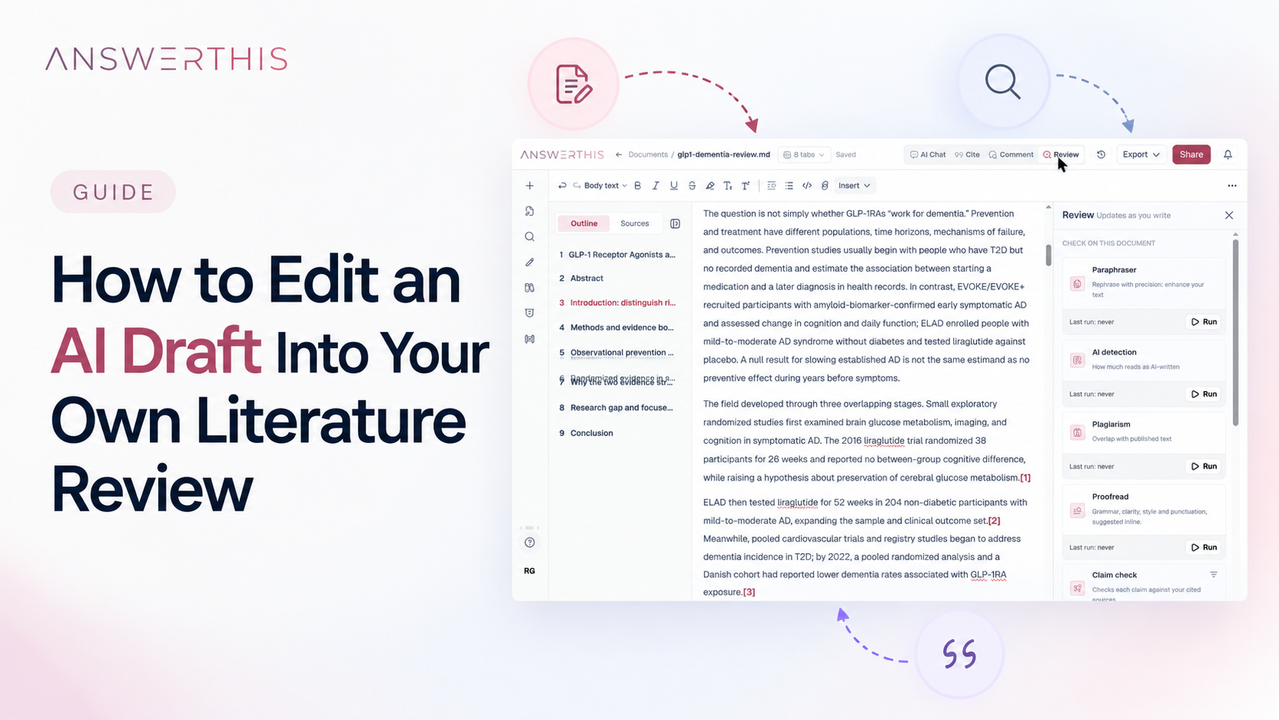
For help revising meaning rather than chasing scores, see Turning an AI draft into your own draft.
What should you disclose about AI use?
Describe what you actually used AI to do and follow the rules for the specific submission. Coursework and journal submissions do not share one universal disclosure requirement.
For journals, COPE's position statement on authorship and AI tools says AI tools cannot be authors because they cannot take responsibility for submitted work. Authors using AI in manuscript writing, graphics or data collection and analysis must disclose which tool they used and how they used it in Materials and Methods or a similar section. Authors remain responsible for all manuscript content, including AI-produced parts.
Check the target journal's instructions for its required wording and placement. For coursework, follow your university's and assignment's own rules, and ask your supervisor if the permitted use is unclear. A detector result does not tell you whether the use was allowed.
Keep a factual record of the tool, task, affected material and checks you performed. Do not claim you verified every source unless you actually did. Disclosure should describe your process accurately, not make it sound more limited than it was.
What else belongs in a pre-submission review?
Review the argument and the manuscript requirements after checking individual flags. A draft can have no reported similarity matches and still misrepresent evidence, omit limitations or fail to answer its research question.
Read the manuscript without the score panel open. Check whether each section contributes to the question, whether the conclusions match the evidence and whether the references identify the sources actually used. Confirm the required format, attachments and disclosure before handing it in.
The guide to pre-submission review steps covers evidence, structure, citations and journal requirements. Check every AI suggestion against the original sources and keep final judgment with the author.
FAQs
Should I upload an unpublished manuscript to any checker I find?
Check permission and the service's data-handling terms before uploading unpublished, confidential or identifying material. Confirm any restrictions from your institution, collaborators or journal. If you cannot establish that sharing the text is appropriate, do not upload it merely to obtain a score. Ask your supervisor about an acceptable review route.
Can I use a detector report as my AI disclosure?
A detector report is not a description of how you used AI. Your disclosure should identify the tool and the actual tasks it performed, following the relevant submission instructions. Keep the report as review material if useful, but do not substitute its estimate for an accurate account of your process.
What should I do if I change the draft after running the checks?
Keep track of which version each report describes. Review new wording and citations after editing, and decide whether a further check is useful under your submission requirements. An earlier report does not automatically describe a later draft. Preserve both the checked version and the final version so their relationship is clear.
Does quoting a passage remove the need for a citation?
Quotation marks identify borrowed wording, but you still need to attribute the source using the required citation style. Check that the quotation is accurate and that its context supports your use of it. Follow any submission requirements for quotation formatting rather than relying on a similarity check's treatment of quoted text.
What if I cannot explain a paragraph in the draft?
Return to the sources and work out the argument before submitting the paragraph. Remove or revise claims you cannot support, and ask your supervisor for help where needed. A clean similarity report or a reassuring detector score does not replace understanding the material you are presenting as your work.
Explore AnswerThis to review your draft alongside its sources and check results. Submit only after you have checked the evidence, corrected attribution and followed the applicable AI disclosure rules.