
To organize research papers into a useful library, keep one collection per project, save relevant papers as you find them, and record comparable notes. Ask the collection the same five questions about findings, methods, disagreements, limitations and future research. Keep each answer connected to the paper and passage supporting it.
TL;DR
Create a scoped collection for each project and distinguish saved papers from checked sources.
Compare findings, methods, disagreements, limitations and future-research questions.
Record consistent fields and supporting passages in a synthesis matrix.
Ask AnswerThis questions across selected Library papers, then verify cited passages before using the answers.
A folder stores papers. A working library helps you explain how those papers relate. AnswerThis lets you ask those questions across your selected papers while you remain responsible for checking the answers against the sources.
How should you organize research papers for one project?
Create one project collection with a clear scope, then save relevant papers into it as you search. Define what belongs before the folder becomes a collection of everything you might eventually read.
Write a short scope note covering your topic, main question and boundaries. For example, a clinical project might distinguish preventing a condition from treating people who already have it. Papers about both can be relevant, but they should not be treated as answering the same question.
Name the collection for the project rather than your reading status. “Dissertation: medication exposure and cognition” tells you more than “Interesting papers.”
If you use AnswerThis Library, save papers from search results into a folder for that project. The library also supports PDF uploads and imports from Zotero or Mendeley, with folders or boards for chapters, assignments or topics.
Save a paper when you find it, but do not confuse saving with approving its evidence. In your working notes, distinguish papers awaiting assessment from papers you have read and checked.
What five questions should you ask your paper library?
Ask about findings, methods, disagreements, limitations and future research. These are standard reading and comparison questions, not a method invented by an AI platform.
The formal version of consistent extraction appears in the Cochrane Handbook’s Chapter 5 on collecting data. Li, Higgins and Deeks describe structured collection of methods, participants and setting, interventions, outcomes, results and other information, including authors’ conclusions.
That guidance concerns systematic reviews. The five questions below are a practical reading framework, not a Cochrane checklist or a substitute for a systematic-review protocol.

1. What are the main findings?
Record what each study found, in whom and for which outcome. Preserve the difference between a reported association, an intervention effect and an interpretation offered in the discussion.
Avoid notes such as “supports the treatment.” Write enough detail to explain what the finding actually supports. Keep the relevant source passage beside your note so you can return to it.
2. What methods did the studies use?
Record the design, population, setting, comparator and outcome measurements. A comparator is the group or condition against which the study makes its comparison.
These details help you decide whether findings belong in the same discussion. A study of routine clinical records and a randomized trial can contribute to the same topic without answering the same question.
3. Where do the papers disagree?
Identify the precise point of disagreement before trying to explain it. Check whether the papers examined comparable populations, outcomes, measurements and follow-up periods.
Use this prompt when you compare research papers:
Identify apparent disagreements in these papers. For each one, distinguish a conflicting finding from a difference in the question, population, method or outcome studied. Cite the relevant papers.
Treat a proposed explanation as something to investigate. Do not assume that a difference in methods caused the disagreement simply because both are present.
4. What are the limitations?
Separate limitations the authors state from concerns you identify through your own appraisal. Keep the authors’ wording and your interpretation in different notes.
For a closer check of one source, you can extract a paper’s limitations from text you paste or a paper you upload. The tool returns author-stated limitations with exact quotations and locations. It does not retrieve articles, and a missing limitations section is not proof that a study has none.
Read each limitation in context. A short observation period matters differently for an immediate response than for a question about long-term outcomes.
5. What is left for future research?
Record unresolved questions and distinguish the authors’ suggestions from your own. Look for missing populations, uncertain measurements, unanswered comparisons or findings that need further investigation.
This question can help you identify research gaps, but the answer is a starting point. An unanswered question in your folder is not automatically an unanswered question in the wider literature.
Before presenting a gap as novel, search beyond the collection. Check whether later papers or research using different terminology already address it.
How do you build a synthesis matrix manually?
Create a spreadsheet with one row per study and consistent columns for the information you need. A synthesis matrix is a structured comparison that helps you move from individual paper notes to relationships across sources.
Johns Hopkins University Sheridan Libraries’ guidance on using a synthesis matrix explains that the matrix records sources’ main points and how they relate. Arranging sources by theme or variable helps you see those relationships.
Use this starter template. The prompts are instructions for your notes, not findings from real studies.
Study identifier
What to record: A reference that lets you reopen the paper
Population and setting
What to record: Who or what was studied, and where
Methods and comparator
What to record: How the study was conducted and what was compared
Outcomes and findings
What to record: What was measured and what the study reported
Agreements or disagreements
What to record: Which other findings are comparable, and how they differ
Limitations
What to record: Author-stated constraints, with your appraisal recorded separately
Future research
What to record: Authors’ proposals and your unresolved questions, clearly distinguished
Supporting passage
What to record: The quotation or note, with its page or section location
Fill in each row while reading the paper. If something is unavailable, write “not reported in the text checked” rather than guessing.
Then read across the rows. Your task is not to count which conclusion appears most often, but to explain what the different studies allow you to conclude.
How do you build and question a project library with AnswerThis?
Save a project-specific set of papers, select that folder as your source collection, and ask a focused question. AnswerThis lets you ask questions using only your saved papers, generating answers, summaries or literature reviews from the papers you save or select.
1. Run a search on your project topic, open its sources and save the papers you want to your Library, in a new folder for this project.
Click New chat, type your topic into the home-screen search box and click Search. Open Sources in the completed answer and assess the papers before saving them. For a project collection, open Library, click New project, enter a Project Title, select a Project Category and click Create Project. Return to the search, click Save beside a paper, choose the destination project and click Save paper. Check that the intended papers appear in that project’s Papers tab.

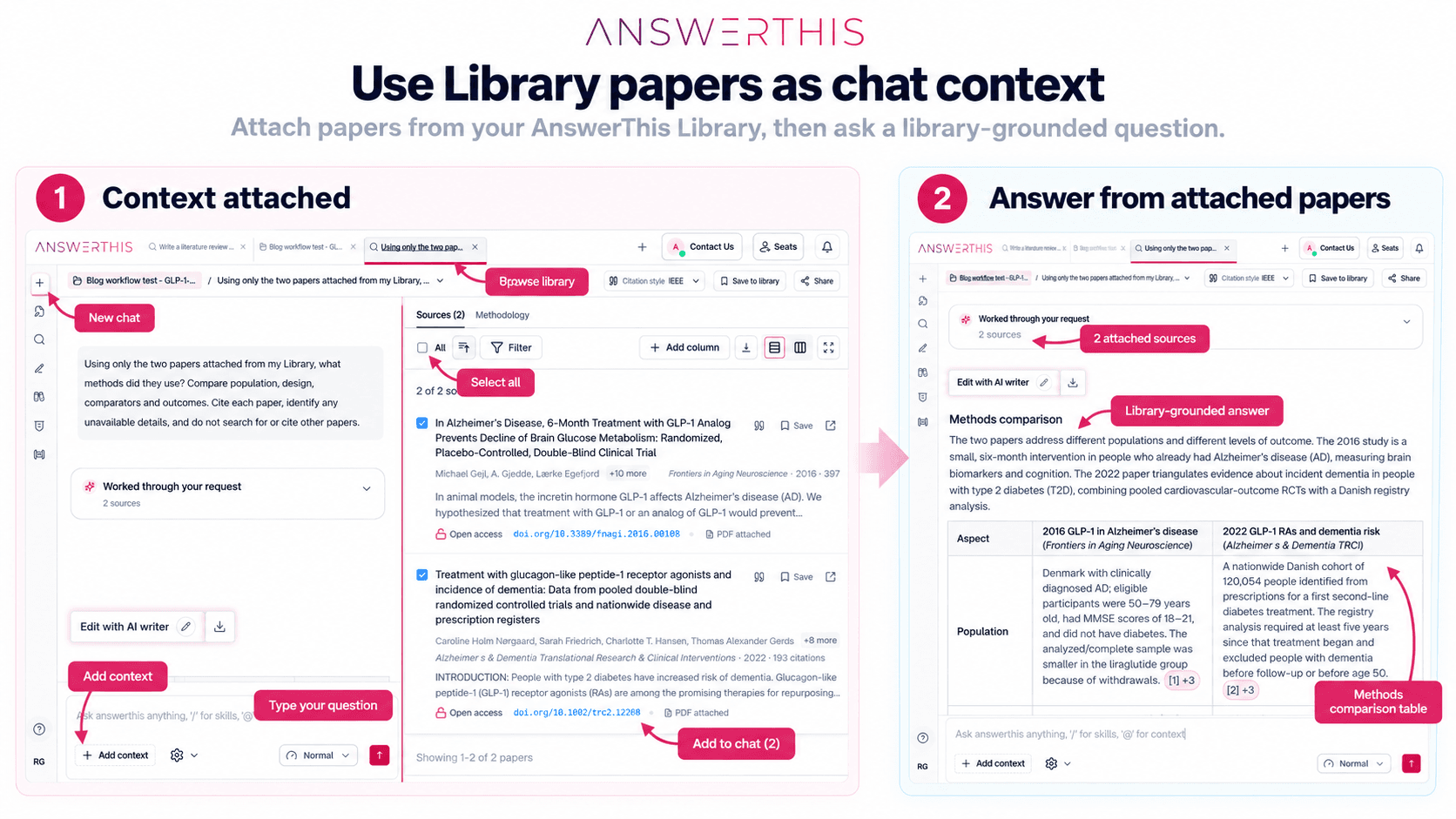
2. Click New chat, then Add context and Browse library. Select the papers from your project.
In the Library picker, open your project and use its Select all papers checkbox, or select individual papers. Click Add to chat with the selected paper count. Check the attached collection before sending your question. Choosing the destination project alone is not the same as attaching its papers as context.
3. Ask one of the five questions and send it.
Begin with one comparison task rather than a request to write your entire review. For example: “Using only the papers attached from my Library, what methods did they use? Compare their populations, study designs, comparators and outcome measurements. Cite each paper, identify unavailable details, and do not search for or cite other papers.” Click Search. Check the resulting sources against the collection you attached.
4. Click a citation in the answer to open the paper behind it.
Confirm that the cited paper belongs to your selected collection. In the tested answer, a grouped citation opened a list of cited passages. Clicking Open passage opened the saved paper in the PDF viewer, where the quoted methods text could be checked against the original. Read the passage in context and check whether it supports the answer’s description, including any qualifications. Do not treat the presence of a citation as confirmation by itself.
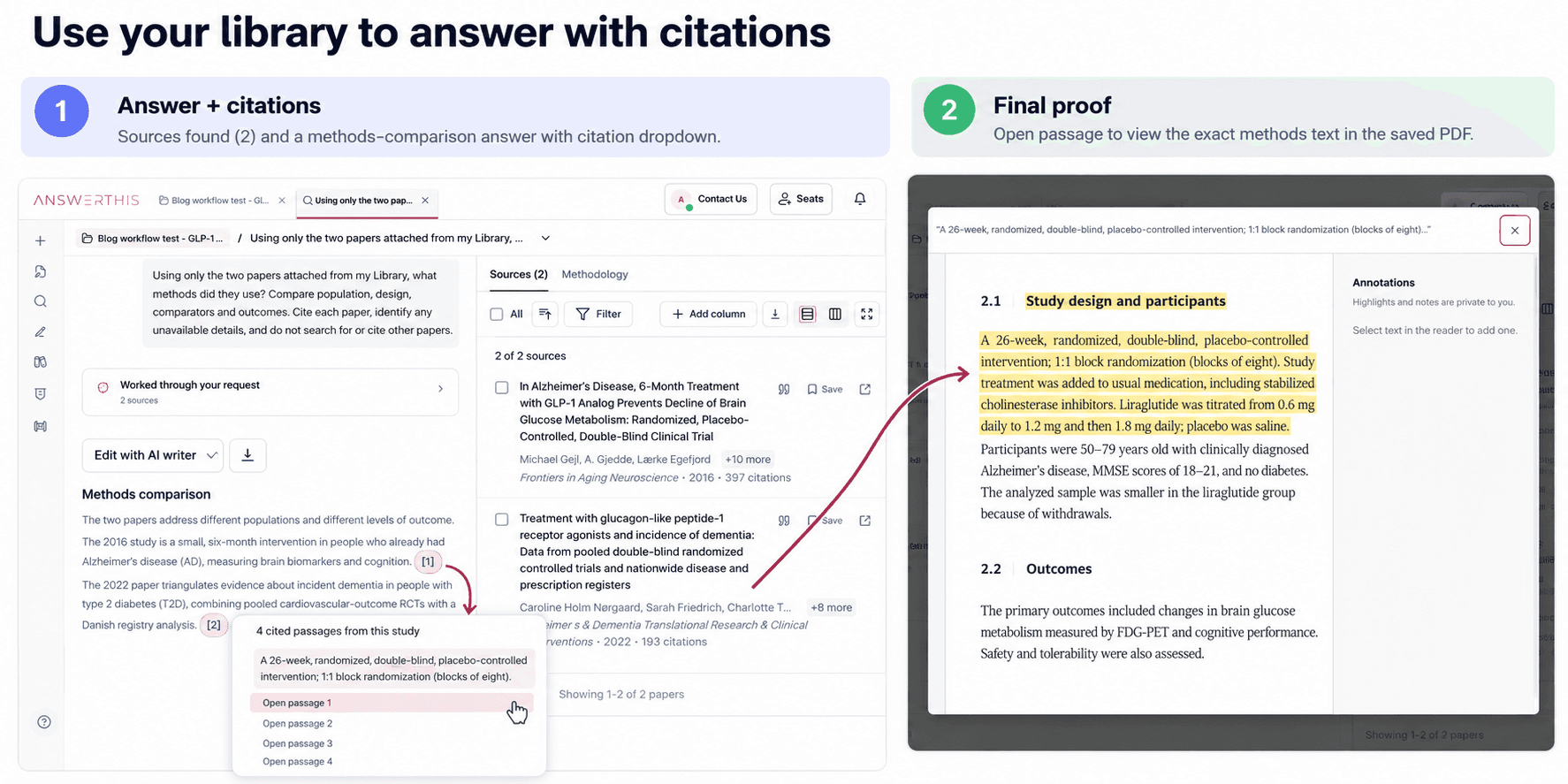
The five questions are standard good practice, not something AnswerThis invented. AnswerThis lets you ask them across your selected papers, but you still read the sources, check the answers and decide what the comparison means.
How do you turn library answers into literature review themes?
Group the papers around questions they jointly address, rather than around the order you found them. Literature review themes should explain relationships in the evidence, not simply divide your reading list into folders.
Start with the questions your field is debating. For a clinical topic, useful groupings might concern a population, an intervention or a measured outcome.
Within each theme, note what kind of evidence each study provides. Critical appraisal means examining how the design, measurements and limitations affect the conclusions you can draw.
Consider this illustrative example. Study A examines an association in routine records, while Study B tests an intervention in a randomized trial. Before calling their findings contradictory, check whether the participants, comparison and outcome match.
Your synthesis matrix supports that comparison. Your explanation of the relationship is what turns the notes into a literature review.
For the broader writing task, see What a good literature review actually looks like.
FAQs
How many papers should I save before asking questions?
Start when you have a relevant set you can assess, rather than waiting for an arbitrary paper count. An early comparison can show you which methods, populations or outcomes you have collected and which you still need to investigate. Follow your assignment or review protocol where it specifies the required scope.
Should a paper used in two projects belong in both collections?
Include the paper in each project’s working collection when it genuinely addresses both questions. Write project-specific notes because the relevant findings or limitations may differ. Keep the reference consistent so you can recognize that both entries concern the same source rather than treating them as separate pieces of evidence.
What should I do with a paper I can access only as an abstract?
Mark the paper as abstract-only and record exactly what you could inspect. Use the abstract only for claims it supports, and do not fill missing methods or limitations from assumptions. Seek the full text through your library before making detailed comparisons that depend on information absent from the abstract.
Does asking questions across a folder make the review systematic?
A folder-based comparison does not, by itself, establish a systematic review. The review still needs methods appropriate to its purpose, including a defined question, a planned search and selection process, and an explicit approach to appraisal and synthesis. Use the five questions as reading prompts, not as a claim of methodological completeness.
Explore AnswerThis to save papers into a project library and ask a focused question across the collection. Open a cited paper and check the supporting passage before adding the answer to your notes.