
To write an abstract, summarize the purpose, approach, main findings and implications of the completed work, then revise against the submission requirements. A common length is 150–250 words, but the journal, conference or institution determines the permitted length and format. The abstract should give readers the central answer, not merely announce that the paper will discuss it.
AnswerThis’s free abstract generator turns research notes into a five-section draft using Background, Objective, Methods, Results and Conclusion, and flags missing results. Adapt that starting point to your discipline’s format and check it against the manuscript; the tool does not guarantee a journal-specific word limit.

TL;DR
Draft from stable findings or a completed argument, not from what you hoped to discover.
Use the required format; a connected paragraph can have structure without visible headings.
Report the central result or interpretation, with appropriate numbers and uncertainty where relevant.
Check study-specific reporting guidance and count the final version using the submission system’s rules.
What is an abstract, and how long should it be?
An abstract is a concise, self-contained account of a larger work. It helps readers assess the work’s relevance and contribution before opening the paper. The University of North Carolina Writing Center’s guidance on abstracts distinguishes informative summaries from descriptive accounts and explains why their components vary by discipline.
An introduction develops context and rationale; a conclusion interprets the completed argument. An informative abstract summarizes the whole trajectory, including the answer. It is not a teaser that withholds the contribution.
Although 150–250 words is a useful planning range, it is not a universal requirement. A thesis may allow more space, and a conference may impose a shorter limit or separate fields. Check whether headings, keywords, registration details or other declarations count. The submission portal’s calculation can differ from your word processor’s, especially for hyphenated terms and symbols.
Structured vs one-paragraph abstracts
Choose the required format before polishing sentences; an argument-centered paper may need no empirical methods section.

Structured
Typical organization: Separate fields such as Objective, Methods, Results and Conclusion.
When to use it: When instructions specify headings or the relevant reporting guidance recommends them.
Unstructured
Typical organization: One connected paragraph moving from question to approach, findings and implication.
When to use it: When the destination requests a paragraph rather than labeled sections.
Discipline-specific
Typical organization: Problem or debate, material, interpretive approach, argument and contribution.
When to use it: When the work develops a textual, historical or conceptual interpretation.
A flexible scaffold is background, objective, approach, findings or argument, and implication. These are functions, not compulsory headings. Humanities work can explain its material, interpretation and contribution without experimental terminology.
How to write an abstract in seven steps
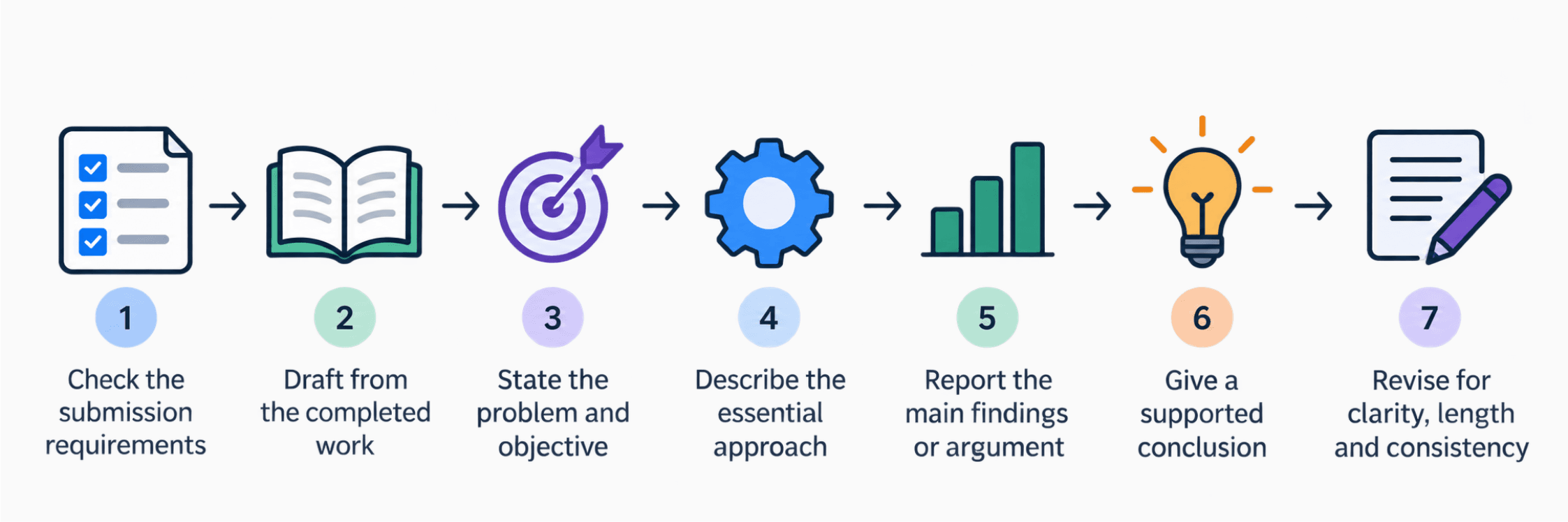
1. Check the submission requirements
Record the limit, headings, study-type guidance and required registration or funding information. Check the submission category: reviews, protocols and completed trials can have different requirements.
2. Draft from the completed work
Write the final abstract after the findings and argument are stable. An early working version can help plan the paper, but revise it when the study changes. The guide to how to write a research paper places abstract preparation within the broader drafting and revision process.
3. State the problem and objective briefly
Give enough context to explain the question, then state the objective. Prioritize the particular uncertainty over a history of the discipline.
4. Describe the essential approach
Select design, population or material, setting, comparison and analysis details that affect interpretation. For interpretive work, name the texts or archive and analytical approach.
5. Report the main findings or argument
Use actual results. Quantitative abstracts should include meaningful estimates and uncertainty where appropriate, not just a significance label. Qualitative abstracts should explain substantive themes or interpretations. Humanities abstracts should state the argument rather than promise an interesting discussion.
6. Give a supported conclusion
State what the findings warrant, including consequential limitations. Do not convert association into causation, introduce new results or generalize beyond the material examined.
7. Revise for clarity, length and consistency
Start with one or two sentences per component, then adapt. Remove repetition, explain essential abbreviations and check claims against the manuscript. Usually omit citations unless instructions allow or require them. Recount after editing.
Six annotated abstract examples
These are original teaching examples. All numerical results, study details and findings are invented solely to demonstrate writing structure and do not describe real studies. Every abstract is labeled so its status remains visible if copied separately.
Counting rule: The calculated counts below cover only the abstract prose, excluding its title, format label, section headings and annotations. Whitespace-separated terms count as words, including numbers; a hyphenated term counts as one. Use the destination’s own counting rules when submitting.
1. Quantitative study: internet access and engagement
Illustrative example. Unstructured abstract. Word count: 151.
Reliable internet access may shape participation in online courses, but access and engagement are distinct concepts. This study examined their association among postgraduate students at one university in Malaysia. A cross-sectional survey collected reports of connection interruptions and engagement during the preceding month. Complete responses from 240 students were analyzed using linear regression, adjusting for course load and employment hours. Engagement was measured on a scale from 0 to 100. Each additional reported interruption per week was associated with a 2-point lower engagement score, with a 95% confidence interval from 1 to 3 points lower. The model estimated an association rather than the effect of improving connectivity. Selection into the survey and reliance on self-report limit interpretation. The findings identify connectivity as a relevant consideration when examining participation in this setting, without establishing that internet problems caused disengagement. Future work should compare reports with connection records and examine changes over time.
Question and approach
What this example does: Specifies an association, setting, survey period and adjusted analysis.
Main result
What this example does: Reports the score scale, estimate and confidence interval in points.
Interpretation
What this example does: Identifies selection and self-report limitations without claiming causation.
The estimate and interval communicate magnitude and uncertainty without a p-value. Adjustment alone does not establish causation.
2. Qualitative study: arranging vaccination appointments
This example explains experiences without turning interviews into prevalence estimates.
Illustrative example. Unstructured abstract. Word count: 151.
Appointment systems can create difficulties that are not visible in attendance records. This study explored how parents whose children missed routine vaccinations described arranging appointments at a community clinic in Kenya. Eighteen parents were purposively selected to include different travel arrangements and work schedules. Interviews explored attempts to book, attend and rearrange appointments. Reflexive thematic analysis developed three connected themes: negotiating uncertain clinic times, coordinating care with paid work, and interpreting missed visits as a risk of criticism. Participants described repeated planning rather than a simple decision against vaccination. Some accounts also identified helpful staff explanations and informal support from relatives. These findings represent interpretations of this interview material, not estimates of how common each experience is among clinic users. Recruitment through the clinic may have excluded families who had disengaged entirely. Appointment communication and responses to missed visits warrant examination alongside individual attitudes when services investigate barriers to timely vaccination.
Selection and collection
What this example does: Identifies purposive recruitment, variation sought and interview focus.
Analysis and findings
What this example does: Names reflexive thematic analysis and explains substantive interpretations.
Boundaries
What this example does: Notes who recruitment might miss and avoids population-frequency claims.
The themes convey substantive interpretations without claiming saturation.
3. Systematic review: scheduled study breaks
A synthesis abstract must explain how evidence was found and evaluated, not simply summarize a topic. The official PRISMA 2020 for Abstracts checklist has 12 items and updates the 2013 abstract guidance. It is distinct from the full-report checklist.
Illustrative example. Structured abstract. Word count: 160.
Title: Scheduled study breaks and student fatigue: a systematic review
Objective: To assess whether scheduled study breaks improve fatigue or concentration among adult university students compared with uninterrupted study.
Methods: MEDLINE, PsycINFO and ERIC were searched from inception to 1 June 2025. Randomized trials comparing scheduled breaks with uninterrupted study were eligible; nonrandomized studies and studies of schoolchildren were excluded. Two reviewers independently assessed risk of bias using RoB 2. Results were grouped by outcome and summarized narratively because interventions and measures differed substantially.
Results: Six trials involving 480 students were included. Four trials involving 320 students assessed fatigue; three reported lower fatigue with breaks, while one found no clear difference. Two trials involving 160 students assessed concentration and found no clear difference. Four trials had high risk of bias and two raised some concerns. Small samples, inconsistent measures and short follow-up limited interpretation. No pooled estimate was calculated.
Conclusion: Scheduled breaks may reduce reported fatigue, but the evidence does not establish improved concentration. Larger trials using comparable outcomes and longer follow-up are needed.
Search and eligibility
What this example does: Gives databases, their shared final search date, eligible design and exclusions.
Appraisal and synthesis
What this example does: Identifies RoB 2 and explains narrative synthesis rather than meta-analysis.
Included evidence
What this example does: Reports six trials and 480 participants, with outcome-specific counts.
Limitations and omissions
What this example does: Identifies evidence limitations; funding and registration fields are intentionally omitted.
This is not presented as fully PRISMA-compliant. A real submission must address funding and registration accurately, including absence where applicable, rather than invent identifiers. Its direction-based summary also lacks study-level magnitudes and precision; those should be reported when available and space permits. A systematic review need not contain a meta-analysis.
4. Randomized clinical trial: allergy symptoms
Trial abstracts need enough information to interpret both benefit and harm. CONSORT for Abstracts, published in 2008, specifies abstract-level items including allocation, blinding, analyzed numbers, estimates, harms, registration and funding. The EQUATOR listing for CONSORT 2025 identifies the current full-report guideline and still lists the abstract-specific guidance separately. A full-report update should not automatically be treated as a replacement abstract checklist; check relevant extensions and submission instructions.
Illustrative example. Structured abstract. Word count: 167.
Title: Cetirizine for seasonal allergic rhinitis: a randomized trial
Objective: To compare cetirizine with placebo for nasal symptoms in adults with seasonal allergic rhinitis.
Methods: A parallel-group superiority trial at two outpatient clinics in India randomized 160 adults with symptomatic seasonal allergic rhinitis equally to cetirizine 10 mg daily or matching placebo for 14 days. An independent service generated the allocation sequence and concealed assignments. Participants, clinicians and outcome assessors were blinded. The primary outcome was the nasal symptom score at day 14, ranging from 0 to 12, with higher scores indicating worse symptoms.
Results: Recruitment and follow-up were complete. All 80 participants in each group were analyzed as assigned. Mean scores were 3.0 with cetirizine and 4.0 with placebo, with a standard deviation of 2.0 in each group. The mean difference was −1.0 points, with a 95% confidence interval from −1.6 to −0.4. Drowsiness occurred in 8/80 participants versus 4/80; no serious adverse events were observed.
Conclusion: Cetirizine reduced average symptom scores over 14 days, with more reported drowsiness. Clinical importance and applicability beyond this short follow-up require consideration.
Design and participants
What this example does: Specifies parallel groups, superiority aim, eligibility and setting.
Allocation and masking
What this example does: Reports sequence generation, concealment and who was blinded.
Outcome and results
What this example does: Gives the primary outcome, timing, group means, analyzed numbers and interval.
Harms and omissions
What this example does: Reports drowsiness and observed serious events; omits real registration and funding information.
The group difference is 3.0 minus 4.0, or −1.0; the interval is consistent with the sample sizes and standard deviations after rounding. This teaching example is not fully guideline-compliant: a real abstract needs actual registry information, funding details and any additional required items. A detectable difference alone does not establish clinical importance, and observing no serious events does not establish safety.
5. Humanities paper: memory and responsibility
An interpretive abstract needs an argument and contribution, not an artificial experiment or numerical result.
Illustrative example. Unstructured abstract. Word count: 153.
This paper examines how remembered conversation shapes the narrator’s presentation of responsibility in Kazuo Ishiguro’s The Remains of the Day. It asks how shifts between reported dialogue and retrospective commentary organize the relationship between professional duty and personal judgment. Through close reading of selected exchanges between Stevens and other characters, the analysis compares moments when the narrator reproduces speech with moments when he explains or qualifies it. The paper argues that these changes in narrative distance make responsibility difficult to assign without making it disappear. Stevens’s explanations invite readers to notice how an account can acknowledge an event while limiting its implications for the speaker. This interpretation treats memory as a practice of positioning rather than merely an unreliable record. By connecting dialogue with retrospective qualification, the paper contributes a focused account of how narrative form sustains the novel’s ethical uncertainty. It does not claim to resolve every ambiguity in the narrator’s conduct.
Material and question
What this example does: Identifies the novel, narrative feature and interpretive issue.
Approach and argument
What this example does: Names close reading and states the paper’s proposed interpretation.
Contribution
What this example does: Connects narrative form to responsibility while preserving ambiguity.
The abstract explains an interpretive move rather than listing passages or presenting its argument as undisputed fact.
6. Conference submission: comparing classifiers
For this fictional scenario, a completed-study computing conference requires Purpose, Approach, Findings and Contribution headings and allows 200 words including headings. These are teaching-scenario instructions, not a claim about a real conference.
Illustrative example. Structured abstract. Word count: 161 excluding headings; 165 including the four required headings.
Purpose: This study examined whether two support-ticket classifiers differed in their ability to identify requests needing urgent review.
Approach: Classifiers A and B processed the same held-out collection of 500 manually labeled tickets from a university computing service in the United Kingdom. The collection contained 100 urgent and 400 nonurgent tickets. Neither classifier was trained on these evaluation records. Performance was described using precision and recall for the urgent category.
Findings: Classifier A identified 80 urgent tickets and incorrectly flagged 40 nonurgent tickets, giving 80% recall and 66.7% precision. Classifier B identified 70 urgent tickets and incorrectly flagged 20 nonurgent tickets, giving 70% recall and 77.8% precision. These descriptive results show a tradeoff between missed urgent requests and unnecessary reviews rather than a universally better classifier.
Contribution: The comparison supports choosing an operating approach according to review capacity and the consequences of missed requests. Evaluation at one service limits transferability; deployment decisions require further testing with representative incoming tickets and monitoring of changing request patterns.
Scenario and format
What this example does: Meets the fictional 200-word limit even when headings count.
Evaluation
What this example does: Uses the same held-out collection and defines its class totals.
Results and implication
What this example does: Shows the precision–recall tradeoff without claiming universal superiority.
Recall is 80/100 or 70/100; precision is 80/120 or 70/90, rounded to one decimal place. Other conferences permit proposals or work in progress only where their instructions allow.
Abstract checklist before submission
Use the following checks against the actual manuscript, not against an earlier plan:
Confirm the word limit, required headings and which elements count.
State a clear purpose, question or interpretive problem.
Include the essential design, material or analytical approach.
Report the main findings or central argument.
Check denominators, units, estimates and uncertainty where relevant.
Keep the conclusion proportionate to the evidence.
Reconcile every number and term with the manuscript.
Address the relevant study-type reporting items.
Handle abbreviations and citations according to the instructions.
AnswerThis’s reporting checklist checker reviews supplied manuscript text against a selected, editioned guideline and returns item-level findings, supporting quotations and missing details for author review. Use its Excerpt setting for an abstract. It does not certify compliance or check every journal requirement; a full-report checklist is not interchangeable with the official abstract-specific checklist.
Common abstract mistakes
Too much background. Keep only the context required to understand the question. Recover space for the approach and contribution before cutting essential results.
No result or central argument. State what the completed work found or argues. “Results will be discussed” leaves readers unable to assess its contribution.
Vague claims. Replace “important improvements occurred” with the relevant estimate or substantive interpretation. Explain what changed rather than praising the study.
Conclusions exceed the evidence. Preserve the study’s limitations and design. Do not turn a local survey into a universal policy recommendation.
Numbers conflict with the paper. Recheck sample totals, follow-up times, terminology and rounding against the final manuscript, including revised tables.
Instructions are ignored. Adapt headings and length before submitting. Missing findings make a completed-study abstract incomplete, but a legitimate proposal or work-in-progress submission should instead state its actual stage and planned work.
FAQs
How do I start an abstract?
Start with the specific problem and purpose, using only enough background to make the question understandable. A direct opening such as “This study examined…” can work when the context is already clear. Draft the rest before polishing the first sentence so the opening reflects what the completed paper actually addresses. Explore AnswerThis’s free abstract generator.
How long should a research-paper abstract be?
A common range is 150–250 words, but the submission instructions determine the permitted length. Journals, conferences and institutions can require different limits and formats. Check whether headings, keywords, registration information or other fields count, then verify the final edited text in the submission system rather than assuming every word counter agrees.
Can I include citations in an abstract?
Abstracts usually omit citations so they remain self-contained and conserve space. However, instructions may allow or require a reference, particularly where a named work is central to the contribution. Follow the destination’s policy and required format. Do not use citations to replace a clear account of your own question, approach and argument.
What is the difference between an abstract and an introduction?
An abstract summarizes the work’s purpose, approach, main findings or argument, and implications. An introduction develops the background, rationale and question in greater depth. Readers should normally understand the main contribution from an informative abstract; an introduction usually prepares them for the investigation rather than supplying the same compressed account of its outcome.
Can I write an abstract before finishing the paper?
Yes, as a working planning document or when a proposal category requires it. Keep planned methods and unavailable results clearly distinguished from completed work. For a completed-study submission, revise after the findings and argument stabilize. Never fill missing results with expected outcomes or retain claims that the finished manuscript no longer supports.
Draft from the manuscript, check the main claims and results against the final paper, then revise against the submission requirements. Count once more after the last change.