

To write a research paper, first understand the assignment, narrow a researchable question, gather credible evidence, organise the argument, draft, and revise. Each stage should answer a practical question: what am I trying to show, what evidence supports it, and how will the reader follow the reasoning? AnswerThis AI Writer can help turn organised research notes and an outline into a working draft that you can then verify, revise, and support with appropriate citations.
TL;DR
Start by translating the assignment brief into a focused question, a realistic scope, and a clear plan for evidence.
Use credible sources to develop an argument, then organise claims and evidence in an outline before drafting.
Draft the reasoning first, then revise for clarity, source attribution, formatting, and alignment with the brief.
Use AnswerThis to organise research and develop a working draft, while retaining responsibility for evidence and conclusions.
Plan Your Research Paper
Understand the Assignment
Start by reading the assignment brief closely. Note the required length, deadline, audience, citation style, source expectations, and any limits on topic or method before you begin searching for information.
Turn those requirements into a short working checklist and keep it visible while researching. This prevents a well-researched paper from missing the actual task the assignment asks you to complete.
AnswerThis can keep your question, source notes, and draft materials in one workspace, which makes it easier to connect each research decision back to the assignment requirements.
Choose a Focused, Researchable Topic
Choose a topic that is focused enough to investigate within the assignment’s scope but broad enough to support with credible evidence. A useful topic also gives you a genuine question to explore, rather than a conclusion you have already decided.
Test the scope before committing. If a search returns an overwhelming number of unrelated sources, narrow the topic by population, time period, place, method, or outcome. If reliable sources are scarce, broaden one of those limits.
Use AnswerThis to explore related research and refine a broad topic into a question you can investigate.

Turn the Topic Into a Research Question
A research question gives the paper a purpose. It should be specific enough to guide the search for evidence and open enough to require analysis rather than a one-word answer.
For example, replace a broad question such as “What are the effects of climate change?” with a bounded question such as “How have heatwaves affected urban public-health planning in India since 2020?” The second question identifies the issue, context, location, and time frame.
A strong question should also reveal what evidence you need to collect and what gap, comparison, or relationship the paper will examine.
Research and Organise Evidence
Conduct Initial Research
Initial research gives you a working map of the topic before you make detailed claims. Read abstracts, introductions, conclusions, and reference lists to identify key terms, influential sources, competing viewpoints, and unanswered questions.
Use AnswerThis to compare relevant literature and organise early findings, then open the original sources to check context, methods, and limitations before relying on them in your paper.
For a short research-to-draft walkthrough, watch the webinar.
Find and Evaluate Sources
Gather sources that are directly relevant to your question and appropriate for the assignment. Prioritise peer-reviewed research, academic books, credible reports, and primary sources when they fit the topic, then assess each source for authority, relevance, date, and method.
Use AnswerThis to keep useful papers, notes, and source details organised as you research. It can support discovery and comparison, but you should still evaluate each source’s credibility and relevance yourself.
If your reading list is stored as PDFs in Google Drive, the Google Drive PDF workflow explains how to move files into a controlled research workflow before you rely on them in your notes or draft.

Organise Research Into an Argument
Once you have enough evidence, group your research into a few main points that answer the research question. Arrange those points so each one builds on the previous section instead of repeating the same idea.
Create an outline before drafting. Give each section a clear job, such as introducing the question, presenting evidence, analysing what it means, or qualifying a limitation. This structure keeps the paper coherent and makes gaps easier to spot.
Build an Evidence-Based Outline
Your outline does not need full prose. Include the thesis or central answer, major claims, evidence for each claim, and the order in which readers need that information. Revise the outline when the research changes your direction.
Draft the Research Paper
A first draft turns the outline into connected reasoning. Focus on explaining the evidence and developing the argument before worrying about polished wording. Revision is where you improve style, precision, and flow.
Most research papers use a standard research paper outline. The exact structure can vary by discipline, but every section should help the reader understand the question, evidence, and answer.
A Standard Research Paper Outline
Use your assignment brief as the final authority, but many academic research papers follow this sequence. Some disciplines combine or omit sections, especially the abstract, methodology, results, and discussion.
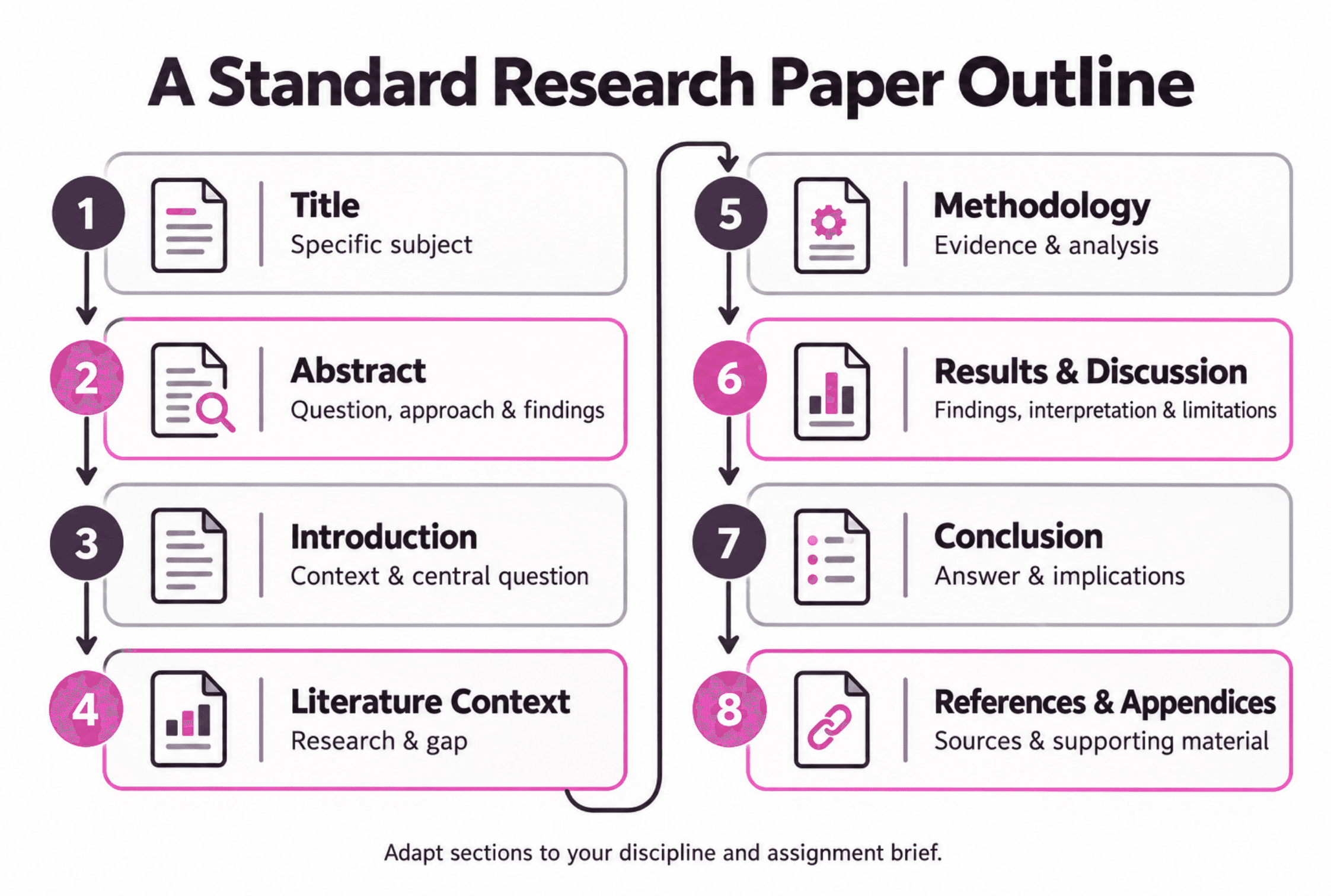
Title: states the paper’s specific subject clearly.
Abstract: briefly states the question, approach, main finding, and significance when the assignment requires one.
Introduction: gives context, identifies the question or thesis, and explains why the topic matters.
Literature context: explains the relevant research and the gap, debate, or evidence the paper addresses.
Methodology: explains how evidence was selected, collected, or analysed when the paper reports original research.
Results and discussion: presents the evidence, interprets what it shows, and addresses relevant limitations.
Conclusion: answers the central question and explains the paper’s main implication.
References and appendices: document the sources and include supporting material when required.
AnswerThis can help you move from organised research to a structured draft by keeping source notes and early writing connected. Review every claim and citation before treating the draft as complete.
Cite Sources and Revise the Draft
Cite Sources Accurately
Academic integrity requires you to distinguish your own ideas from material drawn from other sources. Cite direct quotations, paraphrases, data, and distinctive arguments according to the citation style required by the assignment.
Keep a complete record of each source from the start of the project, including the details needed for in-text citations and the reference list. This makes it easier to check attribution while drafting and revising.
If the brief does not specify a format, use the citation style guide by discipline to choose a style that fits the subject and assignment before you format the final reference list.
AnswerThis can help you keep research notes and source details organised, reducing the risk of losing citation information while you write. It does not replace careful source checking or the citation rules of your institution.
Revise the Argument Before Editing Sentences
Revision improves the paper after the first draft is complete. Review the argument before line editing: check that the question is answered, claims are supported, paragraphs follow a logical order, and transitions show how ideas connect.
Read the draft aloud or review it in a different format to catch unclear phrasing, missing links in reasoning, and repetition. Then edit for sentence-level clarity, citation accuracy, and consistent terminology.
AnswerThis can help you organise revisions and review your draft alongside saved sources. Treat its suggestions as prompts to evaluate, not automatic changes to accept.
Run Final Checks Before Submission
Before submitting, review the paper against the assignment brief. Confirm that the research question is answered, the thesis remains consistent, sources are cited correctly, formatting matches the required style, and the final draft has been proofread.
Use your final review to check that every major claim has appropriate support and that your reference list matches the citations in the text.
If you have used AI-assisted research or drafting, review the guide to checking AI citations and retracted papers before submitting. It provides a focused final check for citations that need closer verification.
Where AnswerThis Fits in the Workflow
AnswerThis can be a useful fit when you want to keep source discovery, research notes, early outlines, and draft development connected. Its practical role is to help you move between those stages while keeping the evidence behind your ideas visible for review.
Use it to compare literature, organise saved papers, and develop a structured working draft. You remain responsible for defining the argument, verifying the original sources, and meeting the standards of your assignment.
Explore the AI Writer when you want to turn an outline and research notes into a more developed working draft.
Key Takeaways
Create a strong research question
Learn about requirements before you start
Select a suitable and manageable topic
Refer to credible sources
Plan your paper and develop an outline
Structure it into introduction, body, and conclusion
Revise and edit
Use AnswerThis throughout the process
Final Thoughts
A strong research paper is built through deliberate steps: understand the task, ask a focused question, use credible evidence, organise the argument, draft, and revise. Following that workflow makes the work more manageable and the final paper more persuasive.
FAQs
What are the main steps for writing a research paper?
Start by understanding the assignment, then choose a focused topic and turn it into a research question. Conduct initial research, evaluate relevant sources, organise the evidence into an outline, draft the paper, cite sources accurately, revise the argument, and complete final checks before submission.
How do I choose a research paper topic?
Choose a topic that fits the assignment, has enough credible evidence available, and can be narrowed into a question you can answer within the required length and deadline. Test the scope with an initial search. If the results are too broad, narrow by population, place, period, method, or outcome.
How do I know whether a source is credible?
Check who produced the source, when it was published, what evidence or method supports its claims, and how directly it answers your research question. Peer-reviewed research, academic books, credible reports, and primary sources can all be useful when they fit the assignment. Read the original source rather than relying only on summaries.
What should a research paper outline include?
A standard outline usually includes a title, an introduction with a question or thesis, main sections that develop claims with evidence, and a conclusion. Depending on the discipline and assignment, it may also include an abstract, literature context, methodology, results, discussion, references, and appendices.
How can AnswerThis help write a research paper?
AnswerThis can help you compare relevant literature, organise saved papers and source notes, and turn an outline into a working draft. Use it to support the workflow, then verify the original sources, check every citation, and make the final decisions about the argument and wording yourself.


