
.png)
Evidence-based practice combines the best available research evidence with clinical expertise and the patient’s values and circumstances. Its five steps are ask, acquire, appraise, apply, and evaluate: frame a question, find evidence, judge its trustworthiness, consider its relevance to care, and assess the process and outcomes. AnswerThis supports the research stages by helping users structure PICOT questions, draft search syntax, locate indexed guideline publications, and prepare evidence-linked risk-of-bias appraisal drafts.
TL;DR
Evidence-based practice integrates research evidence, clinical expertise, and patient values; it is not a research-only decision rule.
The five steps are ask, acquire, appraise, apply, and evaluate.
PICOT adds a time frame to Population, Intervention, Comparison and Outcome.
Combine MeSH headings with title/abstract terms, then inspect the PubMed search you actually ran.
AnswerThis supports question drafting, evidence discovery and draft appraisal; clinicians retain responsibility for care decisions.
What is evidence-based practice?
Evidence-based practice means integrating research evidence, clinical expertise and patient values. Sackett and colleagues defined evidence-based medicine as the “conscientious, explicit, and judicious use of current best evidence in making decisions about the care of individual patients.” The broader practice applies these principles across health professions, not only medicine.
Evidence-based practice is not simply finding a paper that agrees with a preferred intervention. It involves asking whether the evidence is valid, clinically important and applicable, then discussing options in the context of the person’s priorities and available services.
A guideline, trial or evidence summary informs that process; none replaces the clinician’s assessment. The methods below apply to doctors, nurses, pharmacists and clinical researchers, although implementation must follow the relevant professional scope and local policies.
What are the five steps of evidence-based practice?
Dawes and colleagues’ Sicily statement on evidence-based practice, published in 2005 in BMC Medical Education (doi: 10.1186/1472-6920-5-1), describes turning uncertainty into an answerable question, retrieving evidence, critically appraising it, applying it and evaluating performance. The familiar labels below summarize those steps; assess is also used for the final step.
1. Ask
Your task: Translate uncertainty into an answerable question
Research aid or working record: PICOT Question Generator; a component map
Required human judgement: Decide whether the question and outcomes fit the clinical or research need
2. Acquire
Your task: Locate relevant research and current guidance
Research aid or working record: PubMed Search String Builder and Clinical Guideline Finder
Required human judgement: Test the search and verify guideline scope and status
3. Appraise
Your task: Assess validity, importance and applicability
Research aid or working record: Risk of Bias Assessment Tool; full reports and protocols
Required human judgement: Confirm evidence interpretations and design-appropriate judgements
4. Apply
Your task: Integrate evidence with expertise and patient priorities
Research aid or working record: A clinician-owned discussion and implementation record
Required human judgement: Make decisions within professional scope and local governance
5. Evaluate
Your task: Review performance, outcomes and unresolved uncertainty
Research aid or working record: An audit or evaluation log
Required human judgement: Interpret findings and decide what needs revisiting
No verified AnswerThis tool in this toolkit makes treatment decisions or monitors patient outcomes. Its role is question formulation, evidence discovery and draft appraisal; the last two steps remain clinician- and organization-led.
Step 1: Ask a focused PICOT question
What does PICOT stand for?
PICOT means Population, Intervention, Comparison, Outcome and Time. A PICO question uses the first four components; a PICOT question adds an explicit time frame. Identify the patient group or problem, the action being investigated, the relevant alternative, a measurable outcome and, when needed, the observation period.
A practical template is: “In [population], how does [intervention], compared with [comparison], affect [outcome] over [time]?” This is a question about evidence, not a claim that the intervention works.
AnswerThis PICOT question generator requires Population, Intervention and Outcome; Comparison and Time are optional. It composes one question and a P/I/C/O/T mapping from your supplied text without using an AI provider. If a comparator is unknown, leave it unspecified rather than inventing one; a question without C is not a fully specified PICO comparison.

PICOT question examples by specialty
These are hypothetical research questions, not recommendations, study findings or validated protocols. Their time frames illustrate question structure only.
Cardiology nursing
P: Population: Adults discharged after a heart failure admission
I and C: Comparison: Nurse-led telephone follow-up within 72 hours versus usual discharge follow-up
O and T: Measurement: All-cause readmission proportion within 30 days of discharge
Worked question: In this population, how does early nurse-led telephone follow-up compare with usual follow-up for 30-day all-cause readmission?
Perioperative care
P: Population: Adults recovering from elective surgery
I and C: Comparison: Structured education versus usual education
O and T: Measurement: Self-reported pain intensity during the first 48 postoperative hours
Worked question: How does structured education compare with usual education for postoperative pain intensity over 48 hours?
Primary care
P: Population: Adults with hypertension
I and C: Comparison: Structured exercise program versus usual activity advice
O and T: Measurement: Change in measured systolic blood pressure at 12 weeks
Worked question: How does a structured exercise program compare with usual activity advice for systolic blood-pressure change at 12 weeks?
Rehabilitation
P: Population: Adults receiving outpatient stroke rehabilitation
I and C: Comparison: Additional supervised practice versus the usual rehabilitation schedule
O and T: Measurement: Change on a prespecified mobility measure at 8 weeks
Worked question: How does additional supervised practice compare with the usual schedule for mobility change at 8 weeks?
Before using any example in a project, a qualified team must define eligibility, intervention details, outcome measurement, feasibility and any ethics requirements.
Not every clinical question is an intervention comparison. Questions about prognosis, diagnostic accuracy, experiences, or service barriers can need a different framing and evidence design. Do not force qualitative questions into a treatment-effect template.
Step 2: Acquire evidence with a PubMed search and clinical practice guidelines
How do I search PubMed with MeSH terms?
MeSH terms (Medical Subject Headings) come from NLM’s controlled, hierarchical vocabulary. PubMed’s [mh] tag searches MeSH headings, while [tiab] searches title/abstract terms. Combining both helps cover indexed records and relevant papers without applicable MeSH indexing.
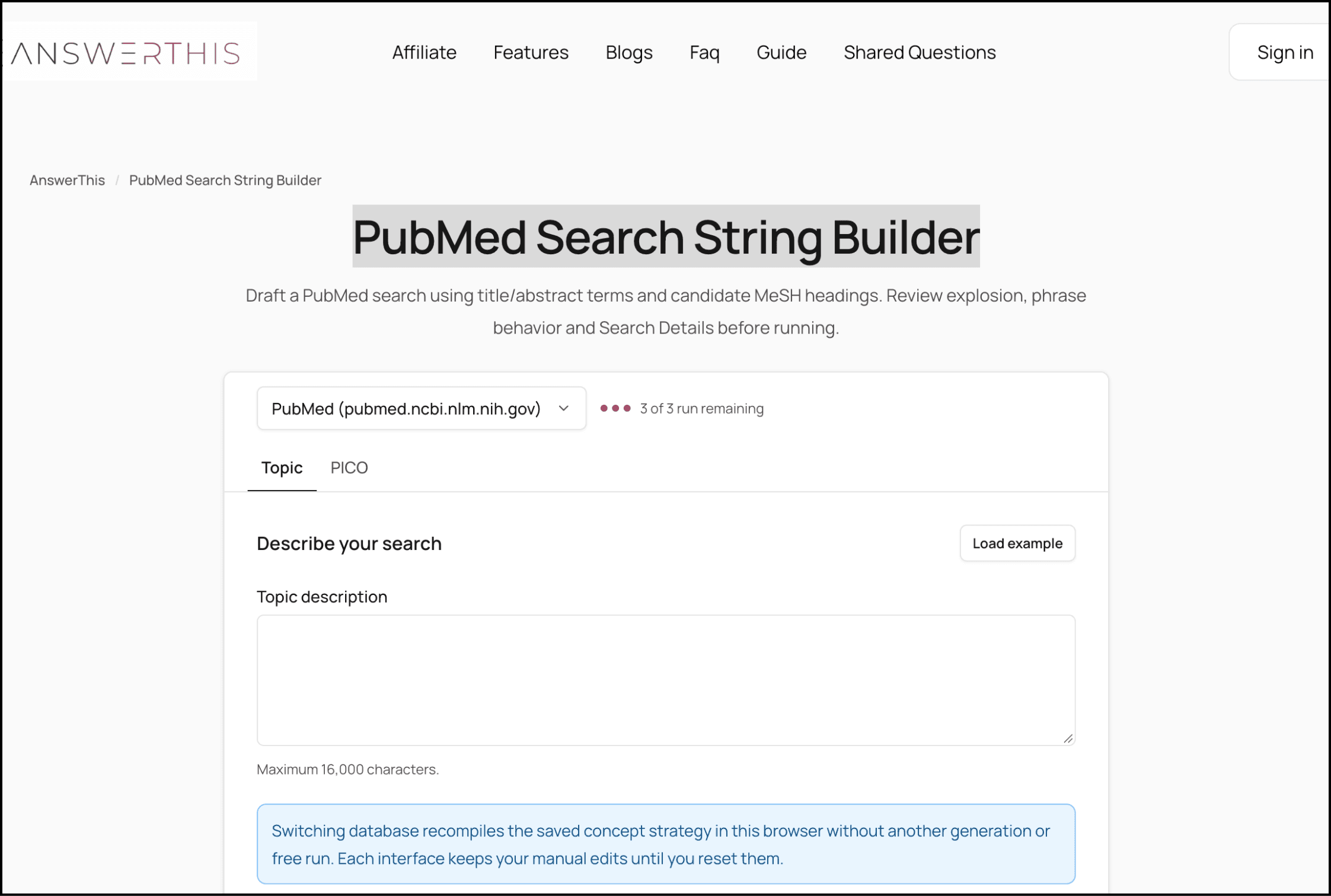
Use AnswerThis PubMed Search String Builder, following the PubMed User Guide:
Identify the essential concepts. Begin with the condition or population and intervention or exposure. Do not automatically require every PICOT component in the query.
Confirm candidate MeSH headings. Read the heading’s scope and narrower terms. A heading normally includes narrower headings; [mh:noexp] requests no explosion.
Add free-text synonyms. Group alternative terms for one concept with OR, then join necessary concept groups with AND.
Run and inspect the strategy in PubMed. Use Advanced and Search Details to examine translation, phrase warnings, and filters. Test whether known relevant records are retrieved.
Save the executed search. Record the database, interface, date, exact query, limits, and result count. Revise missing concepts rather than narrowing the search reflexively.
For the hypothetical hypertension question, a starting query to test, not a validated search, is:
MeSH-only searches can miss unindexed records. Adding the comparator, outcome and follow-up as mandatory blocks can also exclude eligible studies when those details are absent from abstracts. Use eligibility screening to check details that cannot be searched reliably, and ask a librarian or information specialist to review consequential searches.
The search builder drafts a query; it does not run the search or certify recall, precision or methodological adequacy. Its input goes to the generation service and OpenAI, with candidate MeSH terms sent to NLM. Copy the draft, test it in PubMed, and preserve the final executed version.
Where can doctors and nurses find clinical practice guidelines?
Start with the official issuing organization and the jurisdiction relevant to your setting. The AnswerThis Clinical Guideline Finder locates up to ten PubMed records indexed as Guideline or Practice Guideline and provides separate links to official portals. Those portal links are not integrated searches within the tool.
WHO
Where to look: WHO guidelines portal
What to verify: Global clinical or public-health scope, target population and local applicability
NICE
Where to look: Published guidance
What to verify: Guidance type, population, version and relevant health-system context
USPSTF
Where to look: Recommendation search
What to verify: Preventive-service scope, eligible population, recommendation status and grade
SIGN
Where to look: Guideline directory
What to verify: Scottish context and whether the document is current, archived or superseded
AHRQ
Where to look: Evidence resources and official portal links in the finder
What to verify: Distinguish an evidence report or systematic review from a practice guideline
PubMed is not a complete register of current recommendations. An empty finder result does not mean no guideline exists. An indexed publication can also remain available after the guidance has been replaced or withdrawn.
On the publisher’s page, record the issuer, guideline identifier, target population, jurisdiction, publication version and replacement or withdrawal notices. A retrieval date is not proof of currency. Do not treat a journal name or author affiliation as a verified guideline issuer.

Step 3: Use critical appraisal to judge the evidence
Critical appraisal examines a study’s methods, results and relevance to the question before its findings inform practice. A hierarchy of evidence helps identify suitable designs, but it does not replace assessment of an individual study.
What is a randomized controlled trial?
A randomized controlled trial (RCT) assigns participants (or groups in a cluster trial) to intervention and comparator conditions using a process involving chance. Randomization aims to prevent prognostic factors from determining assignment; allocation concealment protects the sequence before assignment, whereas blinding concerns knowledge afterward.
The words “randomized trial” do not establish that its results are unbiased. Read how the sequence was generated and concealed, who was analyzed, what outcomes were missing and whether reporting followed a prespecified plan.
What are the levels of evidence?
This section summarizes the 2011 Oxford CEBM treatment-benefit hierarchy, not a universal ranking for every clinical question. The Oxford table uses different pathways for diagnosis, prognosis, prevalence and harms.
Pathway 1
Treatment-benefit evidence in the Oxford framework: Systematic review of randomized trials, or an N-of-1 trial
How to use it: Inspect review methods, constituent evidence and applicability; a high-level label is not enough
Pathway 2
Treatment-benefit evidence in the Oxford framework: Randomized trial, or observational study with a dramatic effect
How to use it: Check randomization and result-specific limitations
Pathway 3
Treatment-benefit evidence in the Oxford framework: Non-randomized controlled cohort or follow-up study
How to use it: Examine confounding and comparison-group selection
Pathway 4
Treatment-benefit evidence in the Oxford framework: Case series, case-control studies or historically controlled studies
How to use it: Identify selection problems and limits on causal inference
Pathway 5
Treatment-benefit evidence in the Oxford framework: Mechanism-based reasoning
How to use it: Distinguish biological plausibility from demonstrated clinical benefit
Study quality, imprecision, indirectness and inconsistency affect interpretation. A systematic review of weak or poorly matched studies is not automatically more useful than stronger evidence below it. Qualitative evidence can answer questions about patient experience that this treatment-benefit hierarchy was not designed to rank.
Keep three judgements separate: the study design, risk of bias in a particular result, and certainty across a body of evidence. GRADE assesses certainty using more than study design or one trial’s risk-of-bias result; it is not a synonym for the Oxford level or a treatment recommendation.
How do I assess risk of bias in a randomized trial?
Use RoB 2 for the appropriate randomized-trial design. Before answering its signalling questions, specify the outcome, time point and effect of interest: assignment to intervention or adherence to intervention. An assessment of one result does not automatically cover every outcome in the trial.
The Cochrane Handbook’s RoB 2 chapter describes five domains:
Bias arising from the randomization process
Questions to investigate: Was the sequence random and concealed? Do baseline differences suggest a problem?
Useful supporting material: Methods, allocation description and baseline table
Bias due to deviations from intended interventions
Questions to investigate: Which effect is being assessed, and were relevant deviations and analyses handled appropriately?
Useful supporting material: Protocol, intervention delivery and analysis methods
Bias due to missing outcome data
Questions to investigate: Are missing values related to the outcome, and could they distort the result?
Useful supporting material: Participant flow, missingness reasons and sensitivity analyses
Bias in measurement of the outcome
Questions to investigate: Were measurements appropriate and comparable? Could knowledge of assignment influence assessment?
Useful supporting material: Outcome definitions, assessor procedures and blinding details
Bias in selection of the reported result
Questions to investigate: Was this result selected from multiple measures or analyses based on what was found?
Useful supporting material: Registration, protocol and prespecified analysis plan
Record source passages, signalling answers and reasons. RoB 2 proposes Low risk, Some concerns or High risk judgements; reviewers verify them and explain overrides. These categories are not a numeric quality score.

The AnswerThis Risk of Bias Assessment Tool supports evidence-linked draft answers and editable outputs. Its RoB 2 implementation is the 22 August 2019 individually randomized parallel-group version, not the cluster or crossover variants. It also names other design-specific instruments, but edition and scope must be checked before selection.
Matching a quotation confirms its provenance, not that it supports the interpretation. Supply the full relevant report and supporting protocol or registration material where available, then follow your review’s appraisal and disagreement-resolution process. The tool sends extracted study text to its backend and OpenAI; it says studies are not saved to a database. Confirm organizational permissions before submitting even de-identified material, and export the assessment before leaving.
Steps 4 and 5: Apply and evaluate
Apply evidence with clinical expertise and patient priorities
Compare the evidence population, setting and intervention with the real decision context. Consider the magnitude and uncertainty of benefits and harms, patient preferences, accessibility, feasibility and local requirements. Discuss options through the appropriate clinical process; an evidence summary is not a care plan.
For a service-level change, identify who can authorize it, how staff will be supported and what governance or ethics review is needed. Research, audit and improvement work can have different local requirements; classify the project before collecting new data.
Evaluate the process and its consequences
Decide in advance what would show that the process is working and when it will be reviewed. Include a relevant outcome, a process measure and a balancing measure for potential adverse consequences or extra burden. Define the eligible group and denominator, not just a count of events.
For the hypothetical discharge-follow-up project, a team might monitor documented delivery of the follow-up process, its prespecified readmission measure and staff workload. These are proposed evaluation fields, not evidence that the intervention reduces readmissions. A before-and-after change alone does not prove causation; consider case mix, secular trends and other simultaneous changes.
Use a clinician-owned record:
Question and evidence
What to preserve: PICOT components, executed search and relevant source identifiers
Appraisal
What to preserve: Outcome-specific bias assessment, limitations and reviewer reasoning
Applicability
What to preserve: Population match, patient priorities and contextual constraints
Evaluation
What to preserve: Measures, denominator, review point, responsible team and decision to revisit
Why evidence-based practice matters: closing unanswered questions
In a 2014 systematic review, Del Fiol, Workman and Gorman included 72 studies of clinicians’ questions during patient care. In the 11 studies using short post-visit interviews, there were 7,012 questions: clinicians raised an average 0.57 questions per patient, pursued 51% of questions and found answers to 78% of those pursued. The main reported barriers were lack of time and doubt that a useful answer existed.
These are historical estimates from literature searched through May 26, 2011, not measurements of clinicians in 2026 or of AnswerThis users. The 78% applies to pursued questions, not every question; do not change the denominator when interpreting the finding.
A practical response is to maintain a de-identified question log, prioritize consequential uncertainty, look for current guidance or relevant syntheses, and assign a follow-up owner when a question cannot be resolved immediately. Review unresolved questions with colleagues or an information specialist. The toolkit can organize parts of that research workflow, but no verified product study here establishes reduced unanswered questions or improved patient outcomes.
What is free to try in the clinical toolkit?
PICOT Question Generator
Current browser allowance: 3 successful runs per browser
Useful output to save: Question and P/I/C/O/T mapping
PubMed Search String Builder
Current browser allowance: 3 successful runs per browser, shared across the search builders
Useful output to save: Editable strategy and executed-search log
Clinical Guideline Finder
Current browser allowance: 1 successful search per browser
Useful output to save: Up to ten indexed records and their identifiers
Risk of Bias Assessment Tool
Current browser allowance: 1 successful study per browser
Useful output to save: Reviewer-confirmed assessment; SVG, PNG, CSV or JSON exports
These tools are free to try, not unlimited. Copy or download outputs before leaving: signup opens the app and does not transfer drafts or unlock more runs on these pages. The PICOT page uses tab session storage; other tools have their own handling, so do not assume one privacy description applies to all four.
FAQs
Is evidence-based practice the same as evidence-based medicine?
They share the integration of research evidence, expertise and patient values. Evidence-based practice is the broader cross-professional term; evidence-based medicine applies that approach within medicine. Neither means treating published research as the sole basis for care.
Is an empty guideline search proof that no guidance exists?
No. PubMed indexing can lag, and some recommendations appear only on an issuing agency’s website. Check the relevant official portal and document the sources searched before reporting an evidence gap.
Is good reporting the same as low risk of bias?
No. Clear reporting describes what was done; it does not establish that the design, conduct or analysis avoided bias. Missing reporting requires investigation, but it is not automatically proof of misconduct or flawed methods.
Can I enter patient information into these tools?
Do not enter identifying patient details or confidential records. Use public or de-identified research material and confirm your organization’s permissions for the relevant processing service. De-identification is not, by itself, authorization to upload a document.
How can AnswerThis support a clinical research workflow?
AnswerThis can organize supplied PICOT components, draft search syntax, find indexed guideline publications and prepare evidence-linked appraisal drafts. Use those outputs as research working material, then verify sources and decisions through professional review. The toolkit does not provide treatment recommendations or replace a clinician’s judgement.
Start with one answerable research question
Write a de-identified question, preserve the search and source trail, and plan who will review the evidence and evaluate its use. Explore AnswerThis to continue researching that question; save the public tools’ outputs first so your working record stays available.


