
A research proposal is a focused plan that explains what you will study, why the question matters, and how you can answer it within a realistic scope. A strong proposal connects a precise problem, a feasible method, and a credible contribution so that a supervisor, committee, or funder can judge the project. The AnswerThis Research Proposal template can help turn an early topic and evidence notes into a structured first draft that you can test against your requirements.
TL;DR
A strong proposal makes a focused, evidence-aware case for a research project that can realistically be completed.
Define the problem, explain why it matters, and turn that reasoning into objectives that guide the rest of the proposal.
Show that the literature context, methodology, timeline, and available resources fit the question you are asking.
Review the draft as a connected argument, not as a set of separate sections completed in isolation.
What a Research Proposal Actually Does
A research proposal is both a plan and a persuasive argument. It tells the reader what you intend to investigate, why the issue deserves attention, how the study will be carried out, and what a successful outcome would contribute. The proposal does not need to prove the final result. It needs to show that the question is worth asking and that the study can answer it responsibly.
Whether the proposal is for a thesis, dissertation, grant, ethics review, or internal project approval, the reader needs to see a clear link between the problem, the objectives, and the proposed method. A topic can be interesting and still make a weak proposal if the scope is unclear, the evidence base is thin, or the approach cannot deliver the stated objectives.
Before drafting sections, make sure the proposal can answer three connected questions:
What problem are you addressing?
Why is it important?
How will you approach the problem?
When these questions align, the rest of the proposal becomes easier to evaluate and write. They provide a practical check for every later decision, from the literature you include to the method, timeline, and expected contribution you describe.
Key Components of a Research Proposal
Most proposals share the same core components, although institutions may use different labels or request additional material. Each component should serve a distinct purpose while supporting the same central argument: the question matters, the project is feasible, and the proposed approach can produce a useful answer.
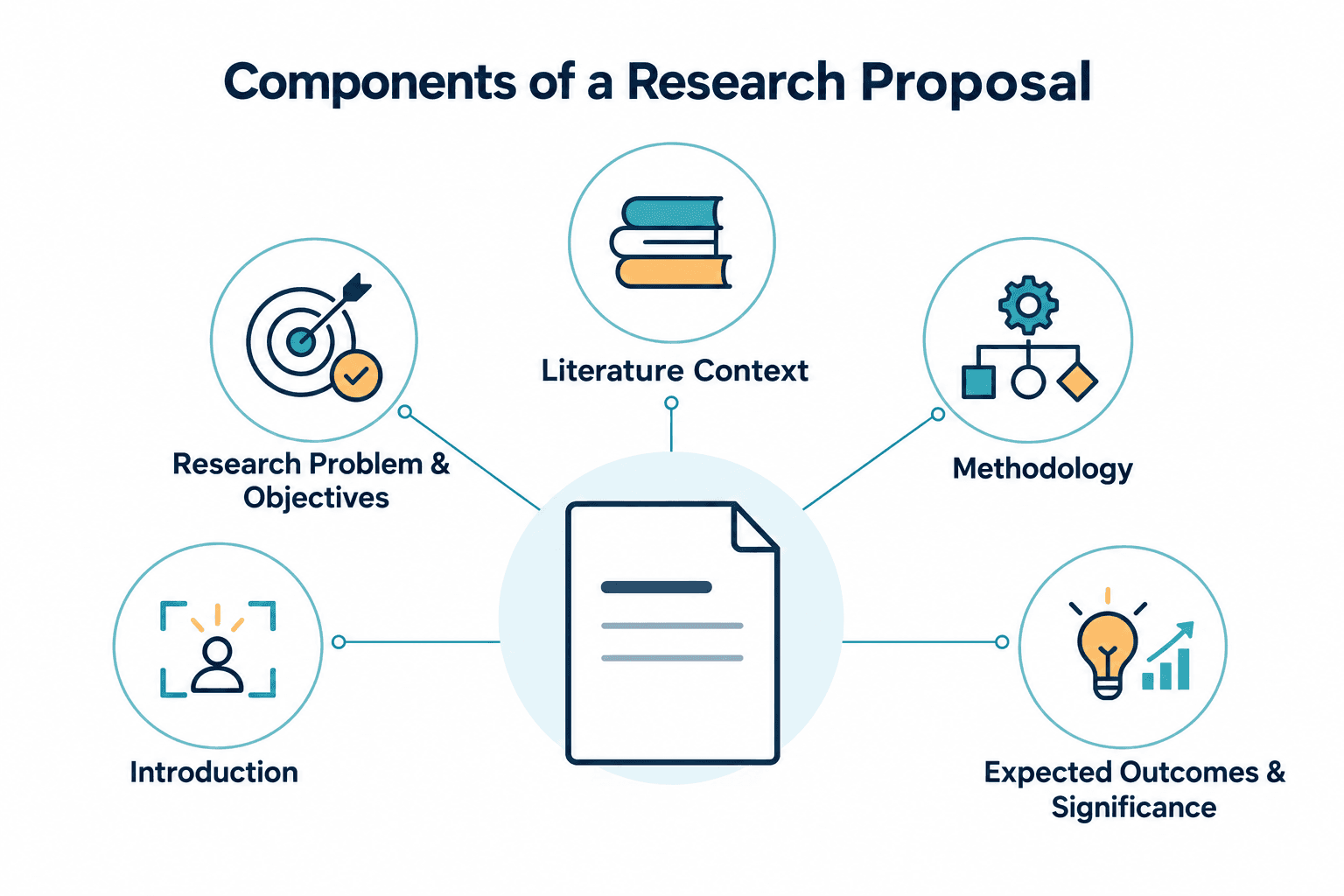
Five components carry that argument: the introduction, the research problem and objectives, the literature context, the methodology, and the expected outcomes. The title page, abstract, timeline, budget, and references frame and support them.
Title Page
The title page is the first impression of your proposal. It should feature a concise and descriptive title that accurately reflects the main focus of your study. Alongside the title, include your name, institutional affiliation, and contact information. This information provides context and establishes your identity as the researcher.
Abstract
The abstract offers a brief summary of your research proposal, typically around 250 words. It should succinctly present the research problem, objectives, methodology, and anticipated outcomes. The abstract serves as a quick overview, allowing readers to grasp the essence of your study without delving into the full proposal.
Introduction
The introduction sets the stage for your research by providing background information and context. It should clearly state the research problem or question your study aims to address. Additionally, outline the objectives and aims of your research, explaining what you hope to achieve. Highlight the significance of your study, demonstrating its potential impact and relevance within your field.
Research Problem and Objectives
State the research problem in concrete terms. Explain the issue, gap, or uncertainty the study will address, rather than restating a broad subject area. The problem statement gives the proposal its direction and should lead naturally to the research question.
Objectives translate the question into work the study will actually carry out. They should be specific enough to guide decisions about evidence and method, and realistic enough to complete within the project’s limits. If an objective cannot be connected to a method or a final output, it may be too vague for the proposal.
Literature Review
The literature review surveys existing research related to your topic, identifying key theories, findings, and gaps in the current knowledge. This section showcases your understanding of the subject and situates your research within the broader academic discourse. By critically analyzing previous studies, you can highlight how your research will contribute to advancing knowledge and addressing unresolved questions.
Research Methodology
The methodology section details the approach and methods you will use to conduct your research. This includes the research design (qualitative, quantitative, or mixed-methods), data collection techniques (such as surveys, interviews, or experiments), sampling strategies, and data analysis procedures. Providing a clear and comprehensive methodology ensures that your research is replicable and scientifically sound. Additionally, address any ethical considerations related to your study, outlining how you will handle sensitive data and obtain necessary approvals.

Expected Results
In this section, outline the potential findings of your research. While you cannot predict exact outcomes, discuss the possible results and their implications for your field. Explain how your study will contribute to existing knowledge and what new insights it may provide. This demonstrates your ability to foresee the impact of your research and its relevance to ongoing scholarly conversations.
Timeline
Provide a realistic schedule for completing each stage of your research project. A detailed timeline helps demonstrate the feasibility of your study and ensures that you can manage your time effectively. Break down your project into manageable phases, assigning specific deadlines to each task to keep your research on track.
Budget
If applicable, include a detailed budget that outlines the financial resources required for your research. This should cover expenses such as materials, equipment, travel, and personnel. A well-structured budget demonstrates your ability to plan and manage resources efficiently, making your proposal more credible to funding bodies or academic committees.
References
The references section lists all the sources cited in your proposal. Ensure that you use an appropriate academic citation style, such as APA, MLA, or Chicago, and include all relevant bibliographic information for each source. Proper citation not only gives credit to original authors but also strengthens the credibility of your proposal by showcasing the breadth of your research.

Preparations Before Writing Your Proposal
Preparation turns a topic into a proposal that can be defended. Before you draft, define the decision you need the proposal to support, such as approval of a thesis plan, funding for a pilot study, or permission to access participants. That purpose affects the level of detail, evidence, and feasibility information your reader will expect.
Start by narrowing the topic. Broad interests such as online education, social media, or public health are not yet researchable plans. Specify the setting, population, phenomenon, and practical boundary that make the study manageable. A narrower topic is not automatically better, but it should be precise enough to guide the literature search and the method.
Next, conduct a preliminary literature review. You do not need a complete review at this stage, but you do need enough background to understand how the topic has been studied, which concepts need defining, and where your proposed work might add value.
Then formulate a research question that is clear, specific, and feasible. A useful question identifies what you want to understand, explain, compare, or evaluate. It should also be narrow enough that the available time, evidence, participants, and methods can plausibly answer it.
Examples of Research Proposals (What Good Ones Look Like)
Knowing the standard sections is useful, but the quality of a proposal depends on how specifically those sections work together. The following examples show how a broad topic becomes a question that identifies a context, a population, and a workable approach.
For an education project, this statement is too broad to guide a convincing proposal:
“This study will focus on online education.”
A stronger version identifies what will be studied and how:
“This study examines how asynchronous online learning relates to student engagement among university students in remote areas, using surveys and course-performance data.”
The stronger version gives the reader a population, setting, focus, and plausible source of evidence. It is still a proposal, not a finished result, but it offers enough detail to assess whether the study is coherent and feasible.
The same principle applies to a business topic. This statement is too open-ended:
“This research will explore social media marketing.”
A more useful proposal statement might be:
“This study examines the relationship between short-form video content and purchase behavior among Gen Z consumers, using a mixed-methods design that combines behavioral data with participant responses.”
Specificity does not mean adding detail for its own sake. It means including the details that let a reader understand the proposed scope, evidence, and method. Use the same test on your own draft: can a reader tell what will be studied, why it matters, and how the question will be answered?
For a structured starting point, use the Research Proposal template
Tips for Writing an Effective Research Proposal
Creating a successful research proposal involves meticulous planning and attention to detail. Here are some essential tips to enhance the quality of your proposal:
Be Clear and Concise: Use straightforward language to convey your ideas. Avoid unnecessary jargon and ensure that each section is well-organized and easy to follow. Clarity helps reviewers understand your research intentions without getting bogged down by complex terminology.
Define Your Research Question: A well-defined research question provides a clear focus for your study. Spend time refining your question to ensure it is specific, manageable, and researchable. A precise question guides your methodology and keeps your research on track.
Demonstrate Feasibility: Ensure that your research objectives are achievable within the proposed timeframe and resources. Address potential challenges and outline strategies to overcome them. Feasibility increases the likelihood of your proposal being accepted and supported.
Highlight Significance: Emphasize the importance of your study and its potential impact. Explain how your research addresses existing gaps and contributes to advancing knowledge in your field. Demonstrating significance convinces reviewers of the value of your work.
Provide Detailed Methodology: Offer a comprehensive description of your research methods, ensuring that your approach is logical and suitable for addressing your research question. A thorough methodology section demonstrates your ability to conduct the research effectively.
Proofread Carefully: Review your proposal for grammatical errors and ensure that it is well-written and professionally presented. Consider seeking feedback from peers or mentors to improve clarity and coherence. A polished proposal reflects your attention to detail and commitment to quality.
Common Challenges and How to Overcome Them
Defining a Researchable Question: One of the primary challenges is formulating a research question that is both significant and feasible. A poorly defined question can lead to ambiguous results and may not contribute meaningfully to the field. Spend ample time refining your question, seeking feedback from advisors to ensure it is clear and researchable.
Literature Overload: Navigating the vast amount of existing research can be overwhelming. It is essential to focus on the most relevant studies and critically analyze them to identify gaps that your research will address. Develop a systematic approach to literature review, prioritizing sources that directly relate to your research question.
Methodological Uncertainty: Choosing the appropriate research methods can be challenging. Researchers must ensure that their chosen methodology is suitable for answering their research question and consider seeking advice from experts if uncertain. Conduct preliminary studies or pilot tests to validate your methodological choices.
Time Management: Developing a research proposal requires careful planning and time management. Creating a detailed timeline and adhering to it can help mitigate the risk of last-minute rushes and ensure a thorough and thoughtful proposal. Break down tasks into smaller, manageable steps and set realistic deadlines for each.

Refining and Improving the Draft Proposal
A first draft is a working model of the project, not a final statement. Review it with the same questions a supervisor or reviewer might ask: Is the problem clear? Do the objectives follow from it? Does the method answer the question? Is the scope realistic?
Read the proposal as a continuous argument, not one section at a time. A strong draft makes the relationship between the problem, literature, objectives, and methodology visible without forcing the reader to infer the connections. Remove details that do not support the central question, and add explanation where a decision would otherwise seem unexplained.
Then check the transitions between sections. The end of one section should prepare the reader for the next. For example, the literature context should make the proposed objectives feel necessary, and those objectives should make the methodology feel like a justified response rather than a separate description.
If you use a drafting tool, use it to test clarity and organization rather than to substitute for subject knowledge. Compare any suggested revision with your sources, institutional requirements, and intended method before incorporating it into the proposal.
The Role of Tools Like AnswerThis in Crafting Your Proposal
Leveraging tools like AnswerThis can greatly enhance the process of writing your research proposal. AnswerThis is an AI-powered research assistant designed to streamline various aspects of the research process, making it easier for scientists to harness the full potential of AI technologies.
Literature Search Assistance: AnswerThis can help you find relevant literature quickly and efficiently. By utilizing advanced search algorithms, it can identify key studies and sources that are directly related to your research question, saving you valuable time in the initial stages of your proposal.
Data Organization: Use AnswerThis to organize your sources and notes in one place. The tool allows you to categorize and store information systematically, ensuring that you can easily access and reference your materials as you develop your proposal.
Collaboration Features: Collaborate with peers or advisors through shared documents and feedback options. AnswerThis facilitates seamless collaboration, enabling multiple stakeholders to contribute to and refine your proposal, enhancing its overall quality and comprehensiveness.
Writing Support: Access templates and guidelines to structure your proposal effectively. AnswerThis provides customizable templates that adhere to academic standards, helping you maintain consistency and professionalism throughout your document.
Feedback and Revision: Utilize features that help you refine your proposal based on suggestions and best practices. AnswerThis can offer constructive feedback on your writing, highlighting areas for improvement and ensuring that your proposal meets the required standards.

Final Thoughts
Writing a research proposal is the initial step in turning an idea or hypothesis into a full-blown research project. By carefully planning each section and utilizing resources and tools like AnswerThis, you can create a compelling proposal that effectively communicates your research plan and its significance. Remember to stay focused, be clear, and demonstrate the originality and feasibility of your study.
Related resources
Frequently Asked Questions
What should a research proposal include?
A strong research proposal typically includes a focused research question, background or literature review, objectives, methodology, expected contribution, timeline, budget where relevant, and complete references.
How do I create a research question for a proposal?
Choose a question that is specific, important, feasible within your available time and resources, and answerable through an appropriate research method. Refine it until it gives the proposal a clear scope.
How detailed should the methodology section be?
Explain the research design, data sources or participants, collection methods, analysis approach, sampling strategy where relevant, and ethical considerations. The reader should be able to understand why the approach can answer your question.
What common mistakes weaken a research proposal?
Common problems include a vague question, an unfocused literature review, unrealistic timelines, methods that do not match the question, and unsupported claims about significance. Careful planning and revision help address these issues.
How can AnswerThis help write a research proposal?
AnswerThis can help you find and organize relevant literature, compare sources, structure early notes, and build a more efficient path from research question to proposal draft. Always verify sources and keep final research decisions under your control.