Slovin's Formula: How to Compute Sample Size, With Examples and Limits

Dr. Rajni Garg
Executive Lead, Research & Content Strategy
7 min read

Slovin's formula is a quick way to compute the sample size for a survey when you know the size of the population and the margin of error you will accept. The formula is n = N / (1 + Ne²).
This guide explains each letter, shows how to compute the formula in four steps, and works through three examples. It also explains what the formula assumes and when you should use a different method.
TL;DR
The formula is n = N / (1 + Ne²), where N is the population and e is the margin of error as a decimal.
A population of 1,000 at a 5% margin of error gives a sample of 286.
The formula fits a simple random survey that estimates a proportion.
It does not fit studies that compare groups or test a hypothesis.
What is Slovin's formula?
Slovin's formula gives the number of people you need to survey from a known population. It has three letters.
n is the sample size. This is the number you are computing.
N is the population size. This is the total number of people in the group you are studying.
e is the margin of error, written as a decimal. A 5% margin of error is 0.05.
The simplified formula for proportions is credited to Yamane (1967). In the Philippines, it is known as Slovin's formula.

How do you compute Slovin's formula in 4 steps?
Find N. Get the exact size of your population, such as the number of enrolled students.
Choose e. Decide your margin of error and write it as a decimal. Many student surveys use 0.05.
Compute the bottom part. Square e, multiply by N, then add 1.
Divide and round up. Divide N by the result. Always round up, because you cannot survey part of a person.

Worked example: a population of 1,000 at a 5% margin of error
N = 1,000.
e = 0.05.
0.05 squared is 0.0025. Then 1,000 × 0.0025 = 2.5, and 2.5 + 1 = 3.5.
1,000 ÷ 3.5 = 285.7. Round up to 286.
You need 286 respondents.
Three examples side by side
Population (N) | Margin of error (e) | 1 + Ne² | N ÷ (1 + Ne²) | Sample size (n) |
|---|---|---|---|---|
1,000 | 0.05 | 3.5 | 285.7 | 286 |
500 | 0.05 | 2.25 | 222.2 | 223 |
5,000 | 0.03 | 5.5 | 909.1 | 910 |
A smaller margin of error gives a larger sample. Moving from 5% to 3% makes a big difference.
What does Slovin's formula assume, and when does it fit?
The formula has two assumptions built in: a 95% confidence level, and a proportion of 0.5, which is the most cautious choice.
Because of this, the formula fits one kind of study well. It fits a survey that takes a simple random sample and estimates a proportion. For example, it fits a survey that asks what percent of students own a laptop.
When should you not use it, and what should you use?
Slovin's formula is often used for studies it was not made for (Tejada and Punzalan, 2012). Use a different method in these four cases.
You are comparing groups or testing a hypothesis. Use a power analysis. Our guide on how to calculate sample size explains it.
You are estimating a mean, such as an average score. Use a sample size formula for means.
You are sampling whole groups, such as sections or barangays. This is cluster sampling, and it needs a larger sample.
You need a confidence level other than 95%. Use a formula that lets you set it.
How do you use Slovin's formula with stratified sampling?
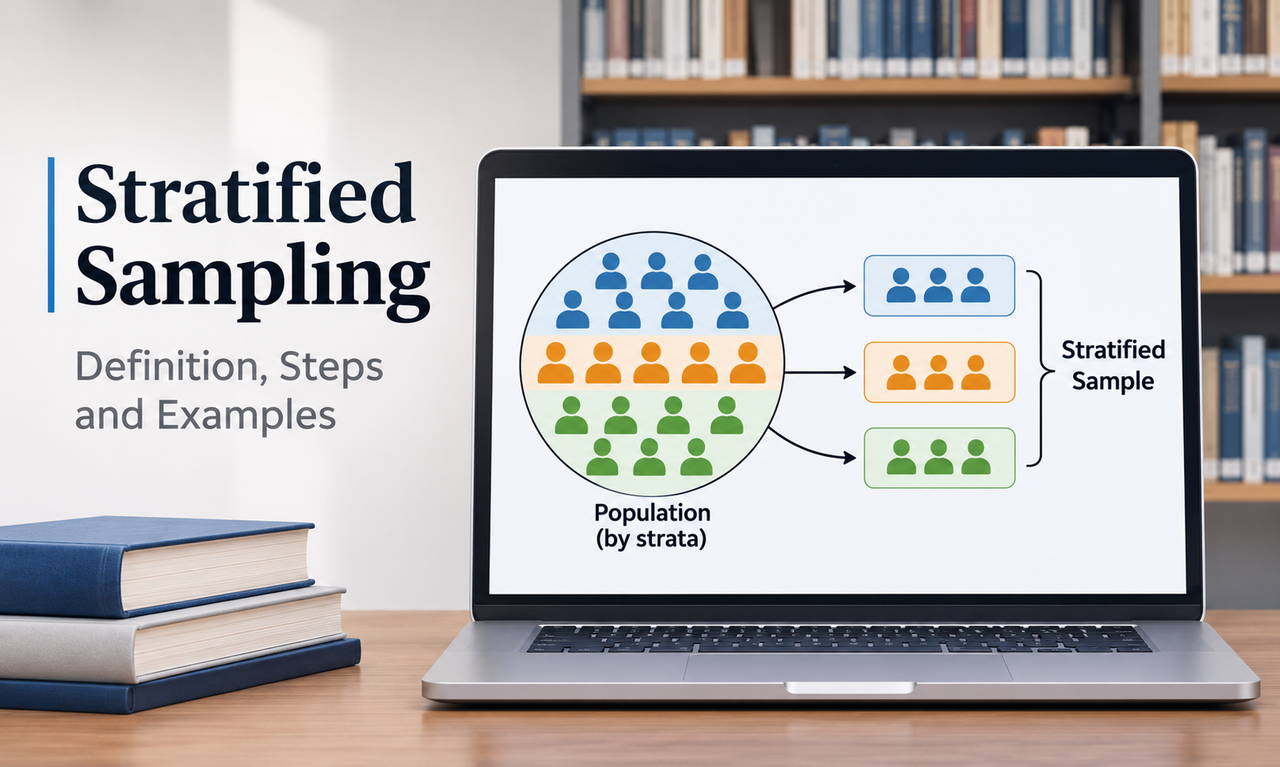
First compute n for the whole population. Then split n across the groups in the same proportion as the population.
Here is an example. A school has 1,000 senior high school students: 400 in Grade 11 and 600 in Grade 12. Slovin's formula at a 5% margin of error gives n = 286.
Grade 11: 286 × 400 ÷ 1,000 = 114.4, so 114 students.
Grade 12: 286 × 600 ÷ 1,000 = 171.6, so 172 students.
Check that the parts add up to n. Here, 114 + 172 = 286.
How do you report it in Chapter 3?
State the population, the formula, the margin of error and the result. Here is a sample paragraph.
The population of the study was 1,000 Grade 11 and Grade 12 students enrolled in [name of school] in School Year 2026 to 2027. The sample size was computed with Slovin's formula at a 5% margin of error, which gave 286 respondents. The respondents were selected by stratified random sampling, with 114 from Grade 11 and 172 from Grade 12.
Tools for the next step
If your study compares groups, the AnswerThis sample size calculator is the right tool. It is free with no limit on runs. It gives power-based sample sizes per group for means and proportions, using a normal approximation. For a survey that uses Slovin's formula, compute by hand with the steps above.

After you collect your data, the free research calculators include a confidence interval calculator for a proportion. You can use it to check the margin of error you actually achieved.
FAQs
What margin of error should I use in Slovin's formula?
Many student surveys use 5%, written as 0.05. A smaller margin of error needs a larger sample. Follow your adviser or your school's manual.
Do I round the answer up or down?
Round up. A result of 285.7 becomes 286.
Is Slovin's formula the same as Yamane's formula?
Yes, it is the same simplified formula. Some sources credit it to Yamane (1967).
Can I use Slovin's formula for a small population?
You can, but for a very small population it is often simpler to survey everyone.
Can I use Slovin's formula for a study that compares two groups?
No. A study that compares groups needs a power analysis, which takes the expected difference between the groups into account.