
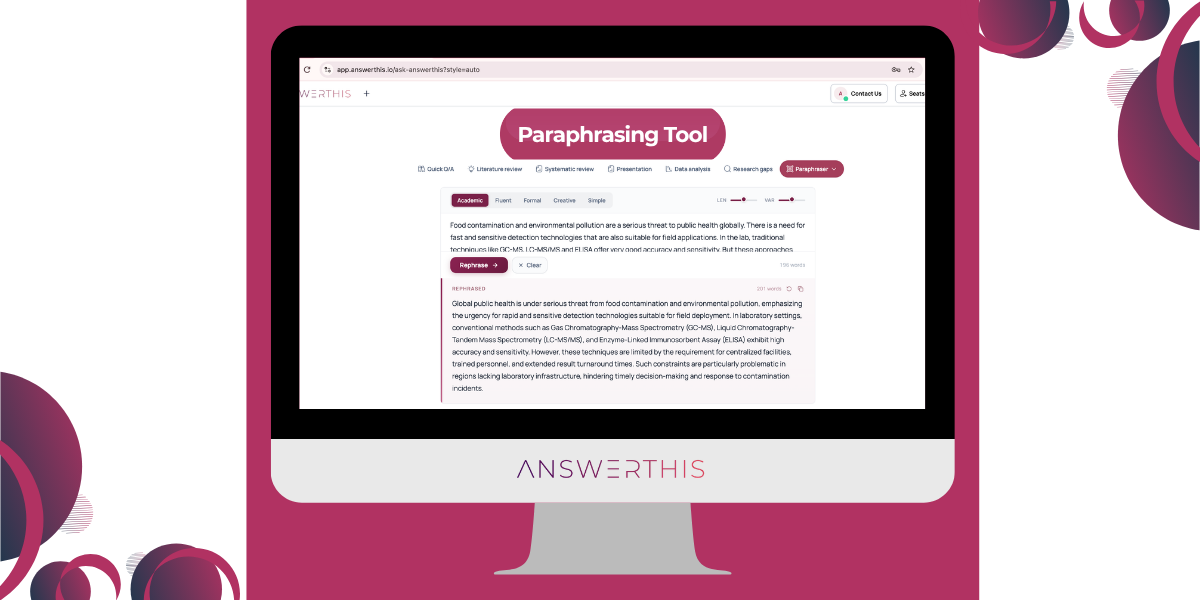
Best AI Paraphrasing Tools 2026: Ranked & Compared
AnswerThis is the pick for academic writers who need rewritten drafts grounded in citations from 250M+ verified sources, not just reworded sentences. AnswerThis supports each stage of the work, from relevant source discovery through synthesis and structured drafting. The sections ahead clarify what to prioritize and how to take the next step.
TL;DR
QuillBot remains the best overall AI paraphrasing tool for everyday rewriting across multiple tones and modes in 2026.
AnswerThis is the pick for academic writers who need rewritten drafts grounded in citations from 250M+ verified sources, not just reworded sentences.
Wordtune wins on natural-sounding rewrites and tone shifting for marketing and business copy.
Grammarly pairs paraphrasing with grammar and clarity checks in one pass.
Why this matters
Most paraphrasing tools solve a wording problem: same meaning, different sentence. That’s fine for a blog post or an email. It’s not fine for a thesis chapter, a literature review, or a grant proposal, where a reworded sentence that drops its source citation turns into an unsupported claim or, worse, an accidental plagiarism flag.
That’s the split this list is built around. If you need a sentence reworded, several tools handle that reliably in 2026. If you need a draft rewritten while every claim stays tied to a verifiable paper, that’s a narrower category. And it’s why AnswerThis shows up on this list even though it isn’t a pure paraphraser.
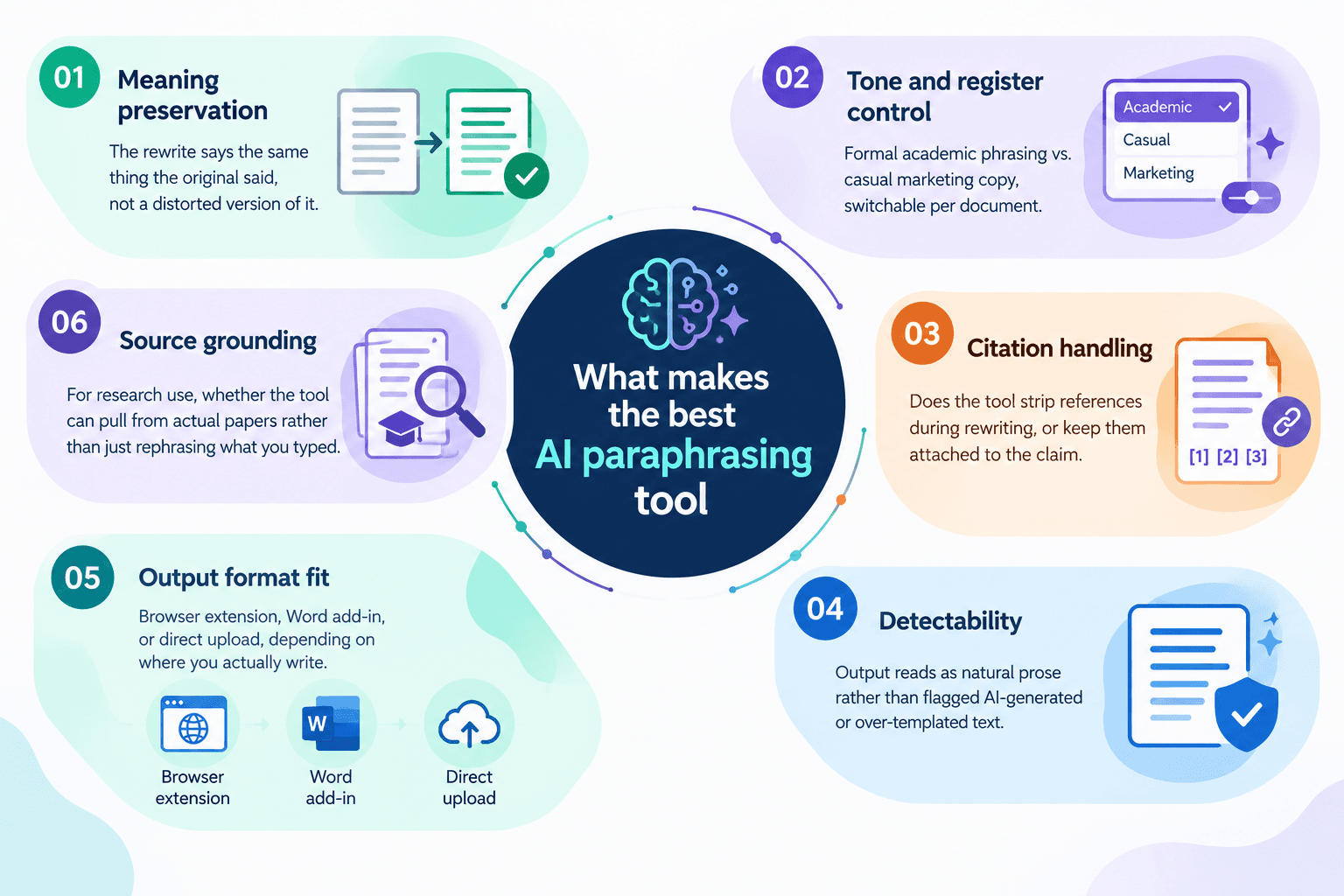
What makes the best AI paraphrasing tool
Meaning preservation: the rewrite says the same thing the original said, not a distorted version of it
Tone and register control: formal academic phrasing vs. casual marketing copy, switchable per document
Citation handling : does the tool strip references during rewriting, or keep them attached to the claim
Detectability: output reads as natural prose rather than flagged AI-generated or over-templated text
Output format fit: browser extension, Word add-in, or direct upload, depending on where you actually write
Source grounding: for research use, whether the tool can pull from actual papers rather than just rephrasing what you typed
You can try AnswerThis’ paraphrasing tool for free by clicking here!
AI paraphrasing tools at a glance
QuillBot
Best for: General everyday paraphrasing
Standout feature: Multiple rewrite modes (Standard, Fluency, Formal, Creative)
Key limitation: Doesn’t verify or attach source citations
AnswerThis
Best for: Academic rewrites with citation grounding
Standout feature: Citation-backed answers from 250M+ verified papers, trials, and PDFs
Key limitation: Not built for casual or marketing rewriting
Wordtune
Best for: Tone and flow rewriting
Standout feature: Rewrite suggestions that read naturally rather than templated
Key limitation: Shorter free usage limits than general rewriters
Grammarly
Best for: Paraphrasing plus grammar cleanup
Standout feature: Combines rewording with grammar, clarity, and tone checks in one pass
Key limitation: Paraphrasing is a secondary feature, not the core product
Trinka
Best for: STEM and academic grammar-focused rewriting
Standout feature: Discipline-specific phrasing corrections for scientific writing
Key limitation: Narrower focus than general-purpose paraphrasers
Paraphraser.io
Best for: Quick, no-frills rewrites
Standout feature: Simple interface, fast single-paragraph rewrites
Key limitation: Limited tone control and mode variety
1. QuillBot: AI paraphrasing tool for everyday rewriting
QuillBot rewrites sentences and paragraphs across several modes: Standard, Fluency, Formal, Simple, Creative, and more. It lets you adjust synonym intensity with a slider. It works as a standalone editor, a browser extension, and a Word add-in, which covers most everyday writing workflows in 2026.
QuillBot pros:
Multiple rewrite modes cover formal, casual, and creative registers
Works inline in Google Docs and Word through extensions
Handles paragraph-length input, not just single sentences
QuillBot pros: (continued)
Synonym slider gives granular control over how much the text changes
QuillBot cons:
Doesn’t cite or verify sources; it only rewords what you give it
Heavy rewriting can occasionally shift nuance in technical sentences
Best for: general blog, email, and business writing that needs faster drafting. Verdict: Buy if your rewriting needs are wording and tone, not citation accuracy.
2. AnswerThis: best for academic rewrites that need citation grounding
AnswerThis isn’t a traditional paraphraser, it’s a research assistant that takes an uploaded question or draft and returns a comprehensive, citation-backed answer pulled from over 250 million verified papers, trials, and PDFs. For a student or academic rewriting a literature review section, that means the output isn’t just reworded text. It is the text tied to actual sources, including support for PRISMA and Cochrane-compliant systematic review structures.
Know more about Cochrane reviews
Know more about PRISMA guidelines
AnswerThis pros:
Rewrites and expands drafts while attaching citations from verified sources
Built for literature reviews and systematic review formats used in academic publishing
Draws from 250M+ papers, trials, and PDFs rather than just rephrasing input text
AnswerThis cons:
Overkill if you just need a sentence or paragraph reworded for tone
Not designed for marketing, casual, or creative rewriting use cases
Best for: thesis chapters, literature reviews, and systematic reviews where every rewritten claim needs a source. Verdict: Buy if your paraphrasing problem is actually a citation problem in disguise.
Need rewrites backed by real citations?
Turn a draft into a citation-backed literature review section.
3. Wordtune: for natural-sounding tone rewrites
Wordtune focuses on rewriting sentences so they read like something a person actually wrote, rather than a template swapping synonyms. It offers tone shifts, more formal, more casual, shorter, longer and works well for business and marketing copy where voice matters as much as meaning.
Wordtune pros:
Rewrites tend to read more naturally than synonym-swap tools
Tone sliders for formal/casual and length adjustments
Browser extension covers Gmail, LinkedIn, and most web text fields
Wordtune cons:
Free tier usage caps are tighter than some competitors
Less suited to long-form academic paragraphs than shorter marketing copy
Best for: marketers and business writers polishing tone across emails, posts, and web copy. Verdict: Buy for tone work, Skip if you need bulk long-form rewriting.
4. Grammarly: for paraphrasing combined with grammar cleanup
Grammarly’s rewrite suggestions sit inside its broader grammar and clarity checker, so paraphrasing happens as part of a full editing pass rather than as a standalone task. That’s useful if you want one tool handling grammar, tone, and rewording together instead of switching between apps.
Grammarly pros:
Combines paraphrasing with grammar, spelling, and clarity checks
Works across browser, desktop, and mobile
Tone detector flags mismatches before you rewrite
Grammarly cons:
Paraphrasing suggestions are narrower in scope than dedicated rewriting tools
Deeper rewrite features sit behind the paid tier
Best for: writers who want grammar checking and paraphrasing in a single workflow. Verdict: Buy if you’d otherwise run two separate tools anyway.
5. Trinka: for STEM and academic grammar-focused rewriting
Trinka targets scientific and technical writing specifically, correcting phrasing issues common in STEM manuscripts, passive voice overuse, wordiness, and field-specific terminology consistency alongside its paraphrasing suggestions.
Trinka pros:
Built around academic and scientific writing conventions
Flags subject-specific terminology inconsistencies
Journal submission readiness checks in some plans
Trinka cons:
Narrower use case than general paraphrasers, not built for casual writing
Doesn’t pull external citations the way a research-grounded tool does
Best for: STEM researchers polishing manuscript language before submission. Verdict: Hold unless your writing is specifically scientific or technical.
6. Paraphraser.io: budget-friendly quick rewrite tool
Paraphraser.io keeps things simple: paste a paragraph, pick a mode, get a rewrite. It’s not built for long documents or nuanced tone control, but it handles quick single-paragraph jobs without much setup.
Paraphraser.io pros:
Fast, low-friction interface for single-paragraph rewrites
No steep learning curve
Paraphraser.io cons:
Limited tone and mode variety compared to QuillBot or Wordtune
Not suited to long-form academic or business documents
Best for: quick, occasional rewrites where speed matters more than nuance. Verdict: Wait, fine for light use, but you’ll outgrow it fast with regular writing needs.
How this list was ranked
Each tool was measured against the same six criteria: meaning preservation, tone control, citation handling, detectability, output format fit, and source grounding. Tools built for general rewriting scored highest on tone and format flexibility; AnswerThis scored highest on citation handling and source grounding specifically because that’s the job it’s built for, not a paraphraser retrofitted with citations.
Which AI paraphrasing tool should you choose in 2026?
For everyday rewriting across emails, blogs, and business copy, QuillBot is the safe default: multiple modes, wide integration, no learning curve. For marketing tone work specifically, Wordtune edges ahead on natural phrasing.
For academic drafts, literature reviews, thesis chapters, systematic reviews, the calculation changes. A rewritten sentence without a citation is a liability, not a convenience. AnswerThis is the better fit when the actual problem is turning a draft into something grounded in 250M+ verified sources rather than just reworded text. Pick based on what you’re rewriting, not just how you want it to sound. See this webinar on how to use AnswerThis to accelerate your research workflow.
FAQ
How does AnswerThis help with paraphrasing research?
AnswerThis is not only a traditional word-swapping paraphraser. It helps you work from research-backed sources and develop an accurate explanation before rewriting the ideas in your own voice.
When should I use AnswerThis instead of a standard paraphrasing tool?
Use AnswerThis when you need to understand, verify, and synthesize research before drafting. Use a paraphrasing tool only after you understand the source and have a clear reason to revise the wording.
How can I paraphrase without changing the original meaning?
Read the original carefully, identify the central idea, write the point in your own structure and language, then compare the result with the source to check accuracy.
Do paraphrasing tools prevent plagiarism automatically?
No. Even well-rewritten text needs attribution when it is based on someone else’s ideas, findings, or wording. You remain responsible for accurate citation.
How should I review text created with AnswerThis or a paraphrasing tool?
Check the original sources, confirm the meaning remains accurate, preserve important terms, cite borrowed ideas, and revise the final language so it reflects your own reasoning and voice.
One last thing
The detail most people miss in 2026: a paraphraser rewording your literature review doesn’t know which claims in your draft actually have a source behind them. It just rewrites the sentence and moves on. If the sentence was already unsupported, the rewrite is too, just in different words. That’s the actual gap between a rewording tool and a research tool, and it’s worth checking before you paste a chapter into any paraphraser.


