

Best AI essay writer tools in 2026
AnswerThis gives researchers a practical way to organize evidence and move from early insights to a clear draft. Jenni AI is good for students who want citations generated inside the drafting editor as they write. Continue reading for a direct framework that turns this answer into action.
Best overall for citation-backed essay research: AnswerThis.
Best for in-editor academic citations while drafting: Jenni AI.
Best for long-form marketing and blog-style essays: Jasper.
Best for grammar and clarity editing: Grammarly.
Best for paraphrasing and originality checks: QuillBot.
Best for creative and narrative essays: Sudowrite.
TL;DR
AnswerThis is the best AI essay writer pick for research-backed essays, pulling citations from 250M+ verified papers, trials, and PDFs.
Jenni AI wins for students who want citations generated inside the drafting editor as they write.
Jasper and Sudowrite generate essay prose fast but carry zero built-in source verification.
Grammarly and QuillBot are editing tools, not research tools. Pair either one with a citation engine.
Why this matters
Most tools marketed as an “AI essay writer” generate fluent paragraphs with no working connection to real, checkable sources. That’s fine for a blog draft. It’s a serious problem for a thesis chapter, a grad school application essay, or any assignment a professor runs through a citation check in 2026.
The real split in this category isn’t “who writes the best sentences.” It’s who backs those sentences with sources you can actually verify, versus who just fills a page. AnswerThis sits on the research side of that split. It doesn’t draft your essay’s prose; it builds the citation-backed foundation the essay stands on, pulled from a database of over 250 million verified papers, trials, and PDFs.
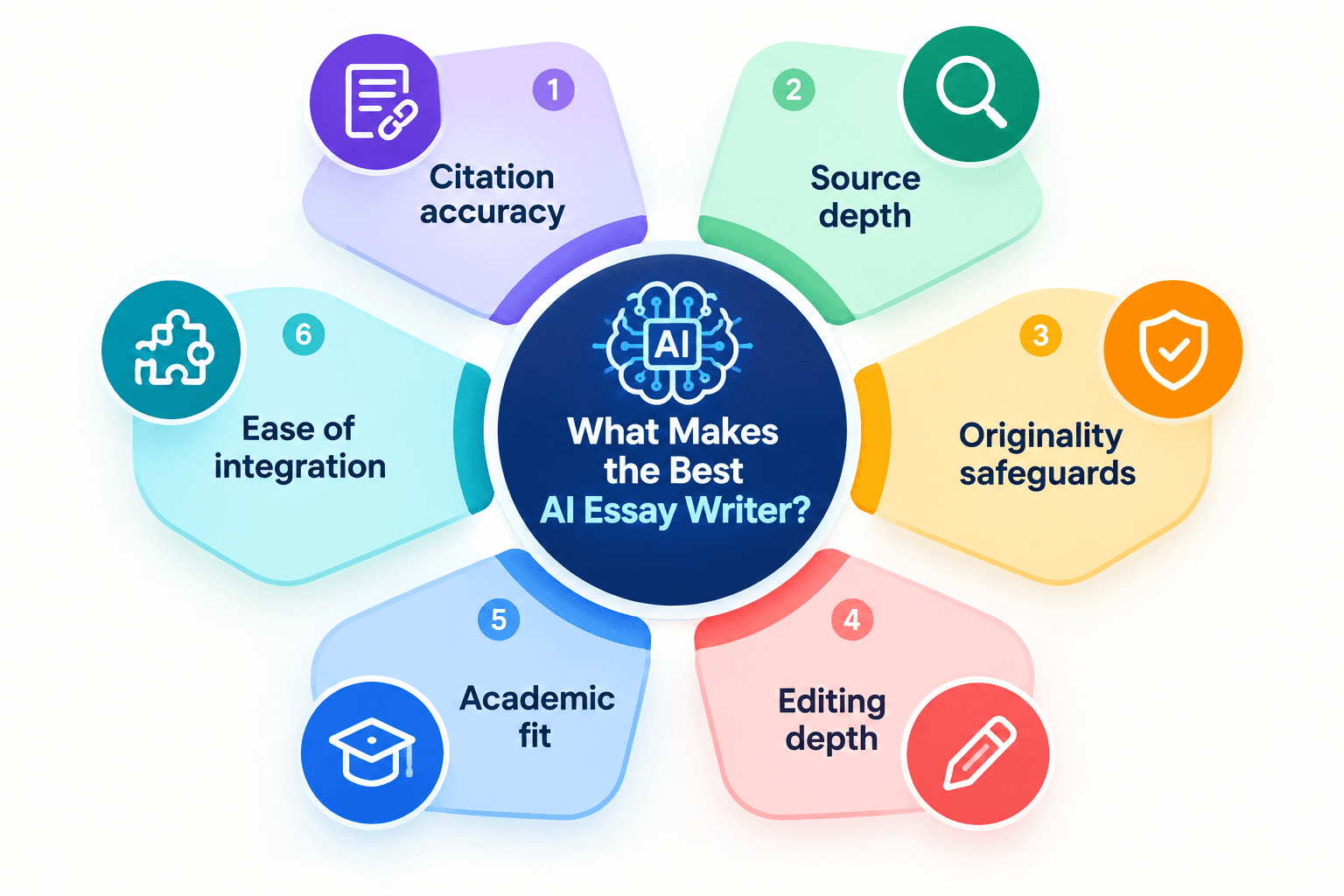
What makes the best AI essay writer
Citation accuracy: does the tool link claims to real, retrievable sources, or does it hallucinate references.
Source depth: how many verified papers, trials, or PDFs the tool actually searches.
Originality safeguards: built-in paraphrase or plagiarism checks versus none at all.
Editing depth: grammar, tone, and clarity correction after a draft exists.
Academic fit: usable for a thesis or lit review, not just a blog post.
Ease of integration: works inside your existing writing workflow (Word, Google Docs, browser).
AI essay writer tools at a glance
AnswerThis
Best for: Citation-backed research
Standout feature: 250M+ verified papers, trials, PDFs
Key limitation: Doesn’t draft essay prose itself
Jenni AI
Best for: In-editor academic citations
Standout feature: Citations generated as you type
Key limitation: Source pool smaller than dedicated research tools
Jasper
Best for: Long-form marketing essays
Standout feature: Fast drafts, brand-voice templates
Key limitation: No academic citation support
Grammarly
Best for: Grammar and clarity editing
Standout feature: Real-time sentence-level correction
Key limitation: Doesn’t generate or research content
QuillBot
Best for: Paraphrasing and originality
Standout feature: Synonym and sentence restructuring
Key limitation: Can strip nuance from technical claims
Sudowrite
Best for: Creative and narrative essays
Standout feature: Story and voice-focused generation
Key limitation: Not built for cited, factual writing
1. AnswerThis: Best AI essay writer for citation-backed research
AnswerThis is an AI research assistant, not a prose generator. You upload a question or a draft, and it returns a comprehensive, citation-backed answer or literature review pulled from over 250 million verified papers, trials, and PDFs. For essays that require real sources, theses, literature reviews, and grad applications with evidence-based claims, this is the layer that keeps you out of trouble.
It also supports PRISMA- and Cochrane-compliant systematic review structures, which matters if your essay or paper needs to meet a formal academic standard rather than just read well.
Know more about PRISMA guidelines
AnswerThis pros:
Citations pulled from verified academic sources, not generated from memory
Handles systematic review structures (PRISMA/Cochrane) for formal academic work
Built specifically for research-heavy writing, not generic content
AnswerThis cons:
May not generate finished essay prose in one go; needs revision.
Overkill for a short, non-cited personal essay or blog post
Verdict: Buy, if your essay lives or dies on real citations, this is the tool that keeps them real.
2. Jenni AI: Best for in-editor academic citations
Jenni AI is built around a writing editor that suggests citations as you draft, aimed squarely at students writing research papers and academic essays. The autocomplete-style drafting combined with in-line citation suggestions makes it a natural fit for someone who wants to write and cite in the same window.
Jenni AI pros:
Citations appear inline while drafting, no separate research step
Familiar document-editor feel for students used to Word or Docs
Jenni AI cons:
Source pool is narrower than a dedicated systematic-review research tool
Best suited to shorter academic essays, not full literature reviews
Verdict: Buy, for students who want citation suggestions without leaving the drafting window.
3. Jasper: Best for long-form marketing essays
Jasper generates long-form content fast using brand-voice templates, and it’s widely used for marketing copy, blog posts, and business content rather than academic writing. It’s not designed around citations or source verification at all.
Jasper pros:
Fast first drafts across many content formats
Templates and tone controls for consistent brand voice
Jasper cons:
No built-in citation or source-checking
Not suited to academic essays that require verifiable evidence
Verdict: Hold, fine for marketing content, wrong tool for a cited essay.
4. Grammarly: Best for editing and clarity
Grammarly checks grammar, tone, and clarity at the sentence level once a draft already exists. It doesn’t research or generate content but polishes what you’ve already written.
Grammarly pros:
Strong real-time grammar and tone correction
Works across browsers, Docs, and word processors
Grammarly cons:
Zero research or citation capability
Won’t catch a factually wrong or unsupported claim
Verdict: Buy, as a final editing pass, not as your primary essay tool.
5. QuillBot: Best for paraphrasing and originality
QuillBot rewrites and restructures sentences, which makes it useful for reducing similarity scores or reworking a rough draft into cleaner phrasing. It’s a rewriting tool, not a research or drafting tool.
QuillBot pros:
Fast paraphrasing across multiple modes
Helps reduce awkward phrasing in a rough draft
QuillBot cons:
Can flatten precise technical or academic language
No citation or source verification built in
Verdict: Hold, a supporting tool, not a standalone essay solution.
6. Sudowrite: Best for creative and narrative essays
Sudowrite is built for fiction and creative narrative writing, with tools tuned for voice, description, and story structure. For a personal or narrative-style essay with no citation requirement, it’s a reasonable fit.
Sudowrite pros:
Strong at narrative voice and descriptive prose
Useful for personal essays without factual sourcing needs
Sudowrite cons:
Not built for factual, cited, or academic essay writing
No research or verification layer at all
Verdict: Skip for academic work. Hold for personal narrative essays only.
How we ranked
Each tool was measured against the six criteria above: citation accuracy, source depth, originality safeguards, editing depth, academic fit, and ease of integration. Tools that generate prose with no sourcing layer rank lower for any essay requiring cited evidence, regardless of how fluent the output reads.
Which AI essay writer should you choose?
If your essay needs real, checkable sources, a thesis chapter, a systematic literature review, or a research-based application essay, start with AnswerThis for the citation-backed research layer, then draft the prose yourself or pair it with Jenni AI for in-editor citation support. If your essay is a marketing post or a creative narrative piece with no sourcing requirement, Jasper or Sudowrite handle the drafting, with Grammarly for the final polish. Nobody writing a cited academic essay in 2026 should skip a dedicated research tool and trust prose-only generators to get sources right. See the webinar on how to get a citation-backed first draft.
Get citation-backed research fast
Upload your question or draft and get answers sourced from 250M+ verified papers.
FAQ
What should I look for in an AI essay writer?
Look for tools that fit your writing stage, support reliable source use, provide clear editing controls, and help you improve a draft instead of simply generating text.
Can AI essay writers help with research-based assignments?
They can support outlining, brainstorming, and early drafting, but research-based assignments still require you to verify sources, develop your own argument, and follow academic rules.
Which AI essay writer is best for citations?
Choose a tool like AnswerThis that makes sources visible and easy to verify. You should always check that every citation is accurate and that the linked source supports the claim in your essay.
How can I use an AI essay writer without plagiarism?
Use AI as a drafting aid, write in your own voice, cite every borrowed idea, and review the final work for unsupported claims or language that is too close to a source.
Do AI essay writers replace editing and proofreading?
No. A final human review is still essential for argument quality, factual accuracy, structure, tone, citation integrity, and the requirements of your assignment.
One last thing
The single biggest mistake in this category isn’t picking the wrong tool, it’s assuming any AI essay writer’s citations are correct without checking them. Run every generated reference through the original source before it goes into a submitted paper, even when the tool claims to pull from verified databases.


