From Evidence and Trial Analysis to Lit Reviews and Clinical Papers.
Stay evidence based, publish with confidence, and save hours every week. Summarize the latest trials, generate AMA citations, and draft literature reviews, all in one platform.

Trusted by over 100,000+ researchers
Trusted by over 200,000+ researchers









Trusted by 200,+ institutions and individuals
Trusted by 200,000+ institutions and individuals
The Choice of Leading Professors, Doctors, and Researchers

I finished a systematic review draft in three days instead of three weeks. The AMA citation tool alone saves me hours every week.

For cardiology, keeping up with trials is overwhelming. AnswerThis surfaces what matters and cites instantly.

I used AnswerThis to draft a protocol for psychiatric emergency triage. It pulled in evidence, structured it, and formatted everything in AMA style. Done in an afternoon.

I used to spend hours formatting references for publications. Now AMA citations are instant. It feels like having a 24/7 research assistant.

Find the Right Trials and Papers in Seconds.
Literature Reviews and Publications
Made Simple.
Cite perfectly in over 2000+ styles.
Tools to help everything from
ideation to publication
250 Million Papers From Top Medical and Established Databases.
Add Your Teams to Collaborate On Projects
Use AI To Add Sources To Your Paper and
Continue Writing
Use AI To Add Sources To Your Paper and
Continue Writing
Stay evidence-based in, draft literature reviews in hours, and publish faster, without sacrificing patient time or time from your actual experiments.
Your All-in-One Research Companion
Take control of your medical research. Use AI to instantly summarize RCTs, meta-analyses, and guidelines, compare treatment outcomes, and extract key insights, all in a single, organized workflow that keeps you moving forward.

Your All-in-One Research Companion
Take control of your medical research. Use AI to instantly summarize RCTs, meta-analyses, and guidelines, compare treatment outcomes, and extract key insights, all in a single, organized workflow that keeps you moving forward.
Perfect + 2,000 Citation Styles
Stop losing nights to reference formatting. Instantly generate flawless AMA, APA, or Chicago citations, so your manuscripts are journal-ready the moment you need them.
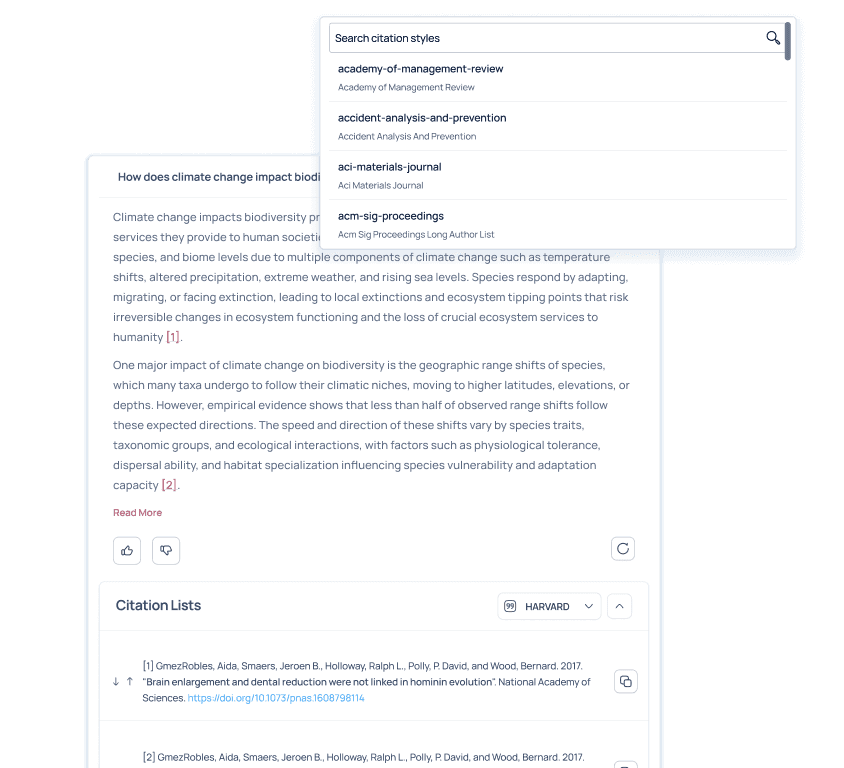
Perfect + 2,000 Citation Styles
Stop losing nights to reference formatting. Instantly generate flawless AMA, APA, or Chicago citations, so your manuscripts are journal-ready the moment you need them.
Keep Evidence at Your Fingertips
Run AI driven analysis across PubMed and the latest trials. Spot clinical gaps, compare therapies, and position your work where it matters most. Perfect for systematic reviews and case reports.

Keep Evidence at Your Fingertips
Run AI driven analysis across PubMed and the latest trials. Spot clinical gaps, compare therapies, and position your work where it matters most. Perfect for systematic reviews and case reports.
Write With Confidence
Every summary and literature review is backed by line-by-line citations linked directly to PubMed. Verify facts instantly, strengthen your credibility, and ensure your publications, protocols, and lectures stand on solid evidence.

Write With Confidence
Every summary and literature review is backed by line-by-line citations linked directly to PubMed. Verify facts instantly, strengthen your credibility, and ensure your publications, protocols, and lectures stand on solid evidence.
Real Results From Real Researchers
AnswerThis doesn’t just find papers, it understands context, identifies connections between ideas, and synthesizes insights from multiple sources, giving you coherent, research-backed answers faster than ever.
AnswerThis doesn’t just find papers, it understands context, identifies connections between ideas, and synthesizes insights from multiple sources, giving you coherent, research-backed answers faster than ever.
Personal Libraries Created
Increase in Research Productivity
Research Papers
Literature Reviews Completed
Real Results From Real Researchers
AnswerThis doesn’t just find papers, it understands context, identifies connections between ideas, and synthesizes insights from multiple sources, giving you coherent, research-backed answers faster than ever.
Personal Libraries Created
Increase in Research Productivity
Research Papers
Literature Reviews Completed
1,534 Searches
Compare BM25 and LLM-based vector embeddings for information retrieval
1,927 Searches
Effectiveness of different concurrency control mechanisms in multi-threaded applications
Compare BM25 and LLM-based vector embeddings for information retrieval
Abstract
This review contrasts BM25, a sparse lexical ranking function rooted in probabilistic IR, with LLM-based (dense) vector embeddings used for semantic retrieval. We summarize modeling differences, empirical trends across standard benchmarks, efficiency/engineering trade-offs, domain/multilingual considerations, and open problems. Evidence across MS MARCO, TREC Deep Learning, and BEIR suggests hybrids—sparse + dense—often yield the best effectiveness–efficiency balance.
1. Background
BM25. A term-matching method from the probabilistic relevance framework; scores documents by TF-IDF-like signals with length normalization (Robertson & Zaragoza, 2009). Advantages include simplicity, interpretability, robustness, and low cost.
Dense/LLM embeddings. Neural encoders (Bi-encoders like DPR; late-interaction like ColBERT; or general LLM/embedding models) map text to high-dimensional vectors; retrieval uses vector similarity via ANN indexes. They capture paraphrase and semantic similarity beyond exact term overlap (Devlin et al., 2019; Karpukhin et al., 2020; Khattab & Zaharia, 2020).
2. Modeling Differences
Signal type: BM25 relies on exact token overlap; dense models use distributed semantics.
Training: BM25 is training-free; dense retrieval typically requires supervised (MS MARCO) or distillation/contrastive pretraining.
Ranking pipeline:
Sparse first-stage (BM25) → Neural re-ranker (cross-encoder) is a common strong baseline (Nogueira & Cho, 2019).
Dense first-stage can replace or complement BM25; late-interaction (ColBERT) preserves some token granularity for accuracy at higher cost.
3. Empirical Findings (high level)
On keyworded or head queries, BM25 remains highly competitive; exact matches matter.
On conversational/semantic queries and mismatch vocab (synonyms, paraphrases), dense retrieval typically outperforms BM25.
Zero-shot/transfer (BEIR): dense retrievers can generalize, but performance varies by domain; hybrids reduce variance (Thakur et al., 2021).
Reranking: Cross-encoders (e.g., monoBERT) over BM25 candidates often surpass pure dense retrieval in effectiveness, at higher latency.
4. Efficiency & Engineering
Indexing & memory:
BM25: inverted indexes are compact; scales easily on CPU.
Dense: vector stores (FAISS, HNSW) require larger memory/compute.
Latency:
BM25 is milliseconds-fast.
Dense first-stage is fast with ANN, but building indexes and updating them is heavier; late-interaction models (ColBERT) cost more at query time.
Interpretability: BM25 scores are explainable (term contributions). Dense scores are opaque; attribution requires auxiliary tooling.
5. Domain, Multilingual, and Robustness
Domain shift: BM25 degrades gracefully; dense models may require domain-adaptive finetuning or unsupervised adaptation.
Multilingual: Multilingual embeddings enable cross-lingual retrieval (query ↔ doc in different languages) with no translation step; BM25 typically needs per-language indexes or MT preprocessing.
Robustness: BM25 is less sensitive to adversarial paraphrase but brittle to vocabulary mismatch; dense is the reverse.
6. Evaluation Practices
Common datasets/benchmarks: MS MARCO (passage/document), TREC Deep Learning, BEIR (zero-shot transfer across 18+ tasks). Metrics: MRR@10, nDCG@10, Recall@k, MAP. For production, report both effectiveness and cost (latency, memory, $$ per 1k queries).
7. When to Use What
Prefer BM25 when: queries are short/keyworded; infrastructure must be lightweight; explainability matters; frequent index updates are needed.
Prefer Dense when: queries are natural-language; semantic recall matters (QA, support search, research); cross-lingual retrieval is required.
Prefer Hybrid when: you need strong out-of-the-box performance across mixed query types and domains—BM25 (or SPLADE) for candidate generation + dense rerank (bi-encoder or cross-encoder).
8. Open Problems & Trends
Cost-effective hybrids: dynamic routing (choose sparse vs dense per query).
Lightweight rerankers: distilled cross-encoders for near-cross-encoder quality at lower latency.
Continual/domain adaptation: self-supervised and synthetic-labeling pipelines to keep embeddings fresh.
Safety & bias: auditing dense retrievers for demographic or topical skew; robust evaluation beyond MS MARCO.
Structured + unstructured fusion: retrieval over tables/graphs + text with unified embeddings.
9. Practical Recipe (production-friendly)
BM25 (or SPLADE) top-1k → 2) bi-encoder dense rerank to top-100 → 3) cross-encoder rerank to top-20 for UI.
Add query rewriting (for abbreviations/typos), caching, and telemetry (query difficulty, fallback to BM25 on ANN miss). For multilingual, use multilingual encoders and per-language BM25 as a backstop.
10. Short Annotated Reading List (starting points)
Robertson & Zaragoza (2009): BM25 and probabilistic IR.
Devlin et al. (2019): BERT—foundation for modern neural rerankers.
Nogueira & Cho (2019): MS MARCO passage re-ranking with BERT (strong two-stage baseline).
Karpukhin et al. (2020): DPR dense passage retrieval (bi-encoder).
Khattab & Zaharia (2020): ColBERT late interaction (accuracy/efficiency trade-off).
Thakur et al. (2021): BEIR—zero-shot IR benchmark across diverse tasks.
If you want, I can tailor this into a 1-page PDF with a comparison table (pros/cons, datasets, metrics) or adapt it to your specific domain (e.g., research papers, customer support, code search).
1,534 Searches
Compare BM25 and LLM-based vector embeddings for information retrieval
1,927 Searches
Effectiveness of different concurrency control mechanisms in multi-threaded applications
Compare BM25 and LLM-based vector embeddings for information retrieval
Abstract
This review contrasts BM25, a sparse lexical ranking function rooted in probabilistic IR, with LLM-based (dense) vector embeddings used for semantic retrieval. We summarize modeling differences, empirical trends across standard benchmarks, efficiency/engineering trade-offs, domain/multilingual considerations, and open problems. Evidence across MS MARCO, TREC Deep Learning, and BEIR suggests hybrids—sparse + dense—often yield the best effectiveness–efficiency balance.
1. Background
BM25. A term-matching method from the probabilistic relevance framework; scores documents by TF-IDF-like signals with length normalization (Robertson & Zaragoza, 2009). Advantages include simplicity, interpretability, robustness, and low cost.
Dense/LLM embeddings. Neural encoders (Bi-encoders like DPR; late-interaction like ColBERT; or general LLM/embedding models) map text to high-dimensional vectors; retrieval uses vector similarity via ANN indexes. They capture paraphrase and semantic similarity beyond exact term overlap (Devlin et al., 2019; Karpukhin et al., 2020; Khattab & Zaharia, 2020).
2. Modeling Differences
Signal type: BM25 relies on exact token overlap; dense models use distributed semantics.
Training: BM25 is training-free; dense retrieval typically requires supervised (MS MARCO) or distillation/contrastive pretraining.
Ranking pipeline:
Sparse first-stage (BM25) → Neural re-ranker (cross-encoder) is a common strong baseline (Nogueira & Cho, 2019).
Dense first-stage can replace or complement BM25; late-interaction (ColBERT) preserves some token granularity for accuracy at higher cost.
3. Empirical Findings (high level)
On keyworded or head queries, BM25 remains highly competitive; exact matches matter.
On conversational/semantic queries and mismatch vocab (synonyms, paraphrases), dense retrieval typically outperforms BM25.
Zero-shot/transfer (BEIR): dense retrievers can generalize, but performance varies by domain; hybrids reduce variance (Thakur et al., 2021).
Reranking: Cross-encoders (e.g., monoBERT) over BM25 candidates often surpass pure dense retrieval in effectiveness, at higher latency.
4. Efficiency & Engineering
Indexing & memory:
BM25: inverted indexes are compact; scales easily on CPU.
Dense: vector stores (FAISS, HNSW) require larger memory/compute.
Latency:
BM25 is milliseconds-fast.
Dense first-stage is fast with ANN, but building indexes and updating them is heavier; late-interaction models (ColBERT) cost more at query time.
Interpretability: BM25 scores are explainable (term contributions). Dense scores are opaque; attribution requires auxiliary tooling.
5. Domain, Multilingual, and Robustness
Domain shift: BM25 degrades gracefully; dense models may require domain-adaptive finetuning or unsupervised adaptation.
Multilingual: Multilingual embeddings enable cross-lingual retrieval (query ↔ doc in different languages) with no translation step; BM25 typically needs per-language indexes or MT preprocessing.
Robustness: BM25 is less sensitive to adversarial paraphrase but brittle to vocabulary mismatch; dense is the reverse.
6. Evaluation Practices
Common datasets/benchmarks: MS MARCO (passage/document), TREC Deep Learning, BEIR (zero-shot transfer across 18+ tasks). Metrics: MRR@10, nDCG@10, Recall@k, MAP. For production, report both effectiveness and cost (latency, memory, $$ per 1k queries).
7. When to Use What
Prefer BM25 when: queries are short/keyworded; infrastructure must be lightweight; explainability matters; frequent index updates are needed.
Prefer Dense when: queries are natural-language; semantic recall matters (QA, support search, research); cross-lingual retrieval is required.
Prefer Hybrid when: you need strong out-of-the-box performance across mixed query types and domains—BM25 (or SPLADE) for candidate generation + dense rerank (bi-encoder or cross-encoder).
8. Open Problems & Trends
Cost-effective hybrids: dynamic routing (choose sparse vs dense per query).
Lightweight rerankers: distilled cross-encoders for near-cross-encoder quality at lower latency.
Continual/domain adaptation: self-supervised and synthetic-labeling pipelines to keep embeddings fresh.
Safety & bias: auditing dense retrievers for demographic or topical skew; robust evaluation beyond MS MARCO.
Structured + unstructured fusion: retrieval over tables/graphs + text with unified embeddings.
9. Practical Recipe (production-friendly)
BM25 (or SPLADE) top-1k → 2) bi-encoder dense rerank to top-100 → 3) cross-encoder rerank to top-20 for UI.
Add query rewriting (for abbreviations/typos), caching, and telemetry (query difficulty, fallback to BM25 on ANN miss). For multilingual, use multilingual encoders and per-language BM25 as a backstop.
10. Short Annotated Reading List (starting points)
Robertson & Zaragoza (2009): BM25 and probabilistic IR.
Devlin et al. (2019): BERT—foundation for modern neural rerankers.
Nogueira & Cho (2019): MS MARCO passage re-ranking with BERT (strong two-stage baseline).
Karpukhin et al. (2020): DPR dense passage retrieval (bi-encoder).
Khattab & Zaharia (2020): ColBERT late interaction (accuracy/efficiency trade-off).
Thakur et al. (2021): BEIR—zero-shot IR benchmark across diverse tasks.
If you want, I can tailor this into a 1-page PDF with a comparison table (pros/cons, datasets, metrics) or adapt it to your specific domain (e.g., research papers, customer support, code search).
AI Summarizes the Evidence for You and Can Even Make Full Literature Reviews
Whether you’re preparing for rounds or a grant, AnswerThis delivers the evidence in minutes.
Every Claim, Backed by 250 M+ Papers
Each review is built with line-by-line citations linked directly to PubMed and leading databases. Verify instantly, strengthen credibility, and ensure your publications and protocols are grounded in trusted research.
Always Up to Date
Search across the most up to date papers and clinical guidelines with advanced filters for recency, impact, and relevance.
Confidential and Secure
Your patients’ privacy and your work are protected. We use enterprise grade encryption, and no clinical notes, queries, or projects are ever shared with third parties.
Smarter Reference Management
Stop wasting nights formatting references. Export formatted citations in 2,000+ styles,
From Protocols to Publications
Draft discharge workflows, hospital protocols, and triage guidelines backed by citations. Or scale up to full systematic or narrative reviews for journals and conferences, all with the same streamlined workflow.
Your Questions Answered.
What is AnswerThis?
AnswerThis is an all-in-one AI research assistant that supports your entire workflow, from finding research gaps and collecting papers to summarizing, analyzing, and drafting citation-backed content for your research paper, dissertation, or thesis.
How can AnswerThis support my clinical research workflow?
How many research papers can I access?
Can I organize my research?
Does AnswerThis help with literature reviews?
Can AnswerThis format citations automatically?
Is AnswerThis suitable for all levels of research?
How does AnswerThis draft research content?
Is my data secure?
Your Questions Answered.
What is AnswerThis?
AnswerThis is an all-in-one AI research assistant that supports your entire workflow, from finding research gaps and collecting papers to summarizing, analyzing, and drafting citation-backed content for your research paper, dissertation, or thesis.
How can AnswerThis support my clinical research workflow?
How many research papers can I access?
Can I organize my research?
Does AnswerThis help with literature reviews?
Can AnswerThis format citations automatically?
Is AnswerThis suitable for all levels of research?
How does AnswerThis draft research content?
Is my data secure?
Don't just take our word for it...
I applaud AnswerThis for its commitment to improving research and academic writing processes
I use many AI tools and encourage everyone to always double-check by thinking of them as advisors. AnswerThis is a great starting point toolset that should be in everyone's toolkit!

David Gibson
UNESCO Chair
Having used AnswerThis for only a few days, I'm thoroughly impressed with its capabilities!
I find this tool invaluable for validating information and streamlining my research process. The ability to quickly generate literature reviews and summaries has been a game-changer for me.

Maartin Strydom
Course Developer in Neuroscience, Psychology, and Positive Psychology
I highly recommend this product to any young or experienced researchers out there
I am medical doctor and researchers experimenting with a variety of AI Tools for more than 2 years. I found AnswerThis as one of the best literature review and search tool available The user interface is very clean and simple to navigate.

Farooq Rathore
Professor and Rehabilitation Medicine Consultant
Streamlined the entire process, providing the needed information and saving significant time and effort.
As a highly satisfied user, I was amazed by AnswerThis AI's speed and accuracy in compiling an updated literature review in minutes, a task that previously took hours or days of extensive searching.

Znabu Hadush Kahsay
Researcher
This tool has been very helpful in my research.
It gives detailed and accurate answers. The literature tool offers deep and well-organized insights. The AI writer also helps make academic writing easier. I highly recommend it for researchers and academics who want precision and efficiency.

Fitri Othman
Ph.D candidates in Construction
I highly recommend it.
I use AnswerThis as part of my daily research flow. I love the article summaries and the ability to export results. It is a great tool for both researchers and students.

Ahmet Çelik
Social Researcher
Pricing That Scales With Your Research
Pricing That Scales With Your Research
Start for free. Upgrade only when you're ready to take your research productivity and quality to the next level!
Start for free. Upgrade only when you're ready to take your research productivity and quality to the next level!
Free Plan
$0/month
Receive 5 credits per month
Access to basic paper summaries
Instantly change citations into 2000+ formats
Search across 250 million+ research papers
Bibliometric analysis
Start Researching
Premium Plan
$35/month
Unlimited searches and references
Line-by-line citations to the exact papers you need
Export papers and extract unique data into tables.
Integrate Mendeley and Zotero Libraries
AI editing tool to add citations, write full papers, and generate research outlines
Make and share libraries and projects with your teams
Continue to payment
Why Wait Longer?
Join 150,000 Researchers And Make Your First Literature Review For Free

Why Wait Longer?
Join 150,000 Researchers And Make Your First Literature Review For Free
Why Wait Longer?
Join 150,000 Researchers And Make Your First Literature Review For Free

© 2025 AnswerThis. All rights reserved
© 2025 AnswerThis. All rights reserved