
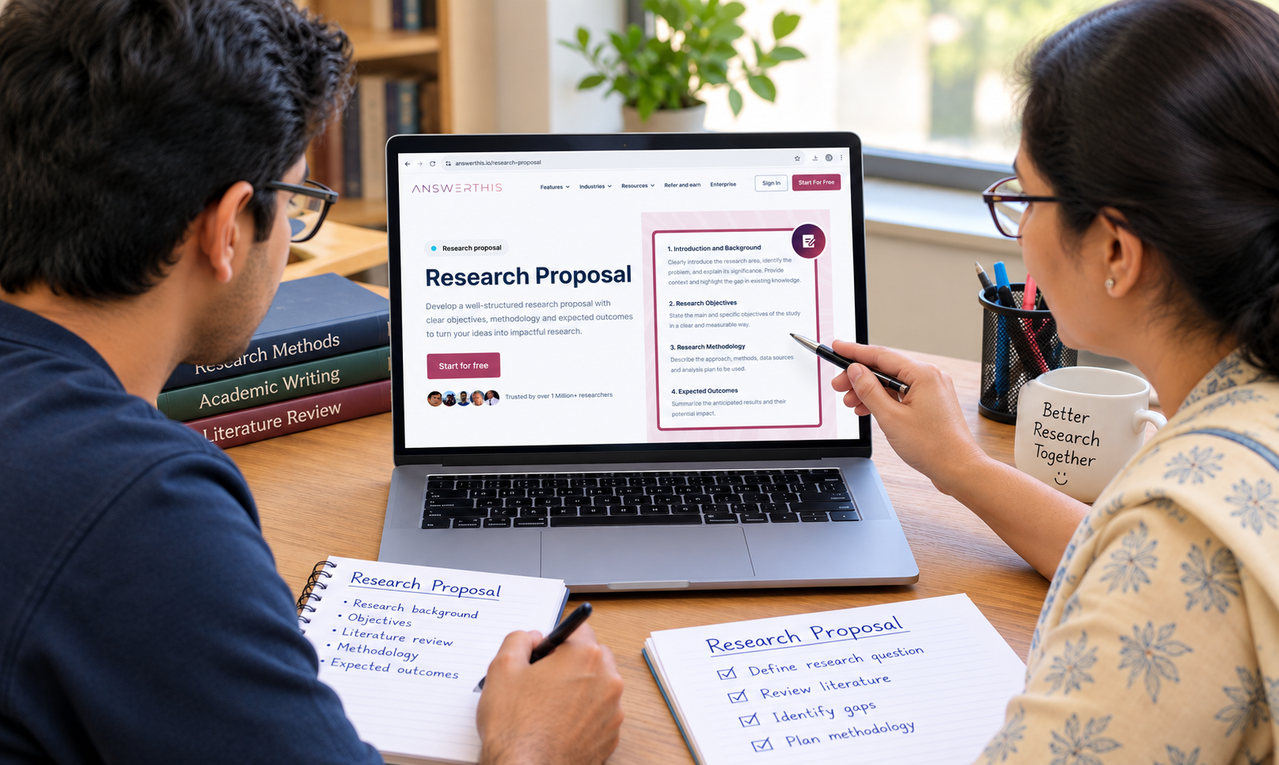
A research proposal is a focused plan that explains what you will study, why the question matters, and how you can answer it within a realistic scope. A strong proposal connects a precise problem, a feasible method, and a credible contribution so that a supervisor, committee, or funder can judge the project. AnswerThis Research Proposal template can help turn an early topic and evidence notes into a structured first draft that you can test against your requirements.
TL;DR
A strong proposal makes a focused, evidence-aware case for a research project that can realistically be completed.
Define the problem, explain why it matters, and turn that reasoning into objectives that guide the rest of the proposal.
Show that the literature context, methodology, timeline, and available resources fit the question you are asking.
Review the draft as a connected argument, not as a set of separate sections completed in isolation.
What a Research Proposal Actually Does
A research proposal is both a plan and a persuasive argument. It tells the reader what you intend to investigate, why the issue deserves attention, how the study will be carried out, and what a successful outcome would contribute. The proposal does not need to prove the final result. It needs to show that the question is worth asking and that the study can answer it responsibly.
Whether the proposal is for a thesis, dissertation, grant, ethics review, or internal project approval, the reader needs to see a clear link between the problem, the objectives, and the proposed method. A topic can be interesting and still make a weak proposal if the scope is unclear, the evidence base is thin, or the approach cannot deliver the stated objectives.
Before drafting sections, make sure the proposal can answer three connected questions:
What problem are you addressing?
Why is it important?
How will you approach the problem?
When these questions align, the rest of the proposal becomes easier to evaluate and write. They provide a practical check for every later decision, from the literature you include to the method, timeline, and expected contribution you describe.
Why Do Good Proposals Matter Early On
A proposal is most valuable when it improves decisions before substantial work begins. It forces you to define what is in scope, what evidence is needed, and what would make the project feasible. That early clarity reduces the risk of building a study around a question that is too broad, too vague, or unsupported by a workable method.
A well-framed proposal also makes the research question testable. Instead of promising to explore a broad topic, it identifies a population, context, concept, or relationship that can be studied within the time and resources available. This gives readers a basis for judging whether the project has a meaningful focus.
Planning early saves time because it exposes gaps before they become expensive. If the question requires data you cannot access, a sample you cannot recruit, or a method you cannot carry out, the proposal is the place to adjust the design. Revising the plan at this stage is more productive than trying to repair the project after research has begun.
A clear proposal also gives collaborators and reviewers a shared reference point. It explains the project’s purpose, boundaries, and decision logic, which makes feedback more specific and helps prevent different readers from assuming different goals.
Preparations Before Writing Your Proposal
Preparation turns a topic into a proposal that can be defended. Before you draft, define the decision you need the proposal to support, such as approval of a thesis plan, funding for a pilot study, or permission to access participants. That purpose affects the level of detail, evidence, and feasibility information your reader will expect.
Start by narrowing the topic. Broad interests such as online education, social media, or public health are not yet researchable plans. Specify the setting, population, phenomenon, and practical boundary that make the study manageable. A narrower topic is not automatically better, but it should be precise enough to guide the literature search and the method.
Next, conduct a preliminary literature review. You do not need a complete review at this stage, but you do need enough background to understand how the topic has been studied, which concepts need defining, and where your proposed work might add value.
Then formulate a research question that is clear, specific, and feasible. A useful question identifies what you want to understand, explain, compare, or evaluate. It should also be narrow enough that the available time, evidence, participants, and methods can plausibly answer it.
At this stage, AnswerThis can be useful for organising early evidence around a topic and testing alternative ways to frame a question. Treat the output as material for refinement. The final question should reflect your own scope, discipline, and practical constraints.
Components of a Research Proposal
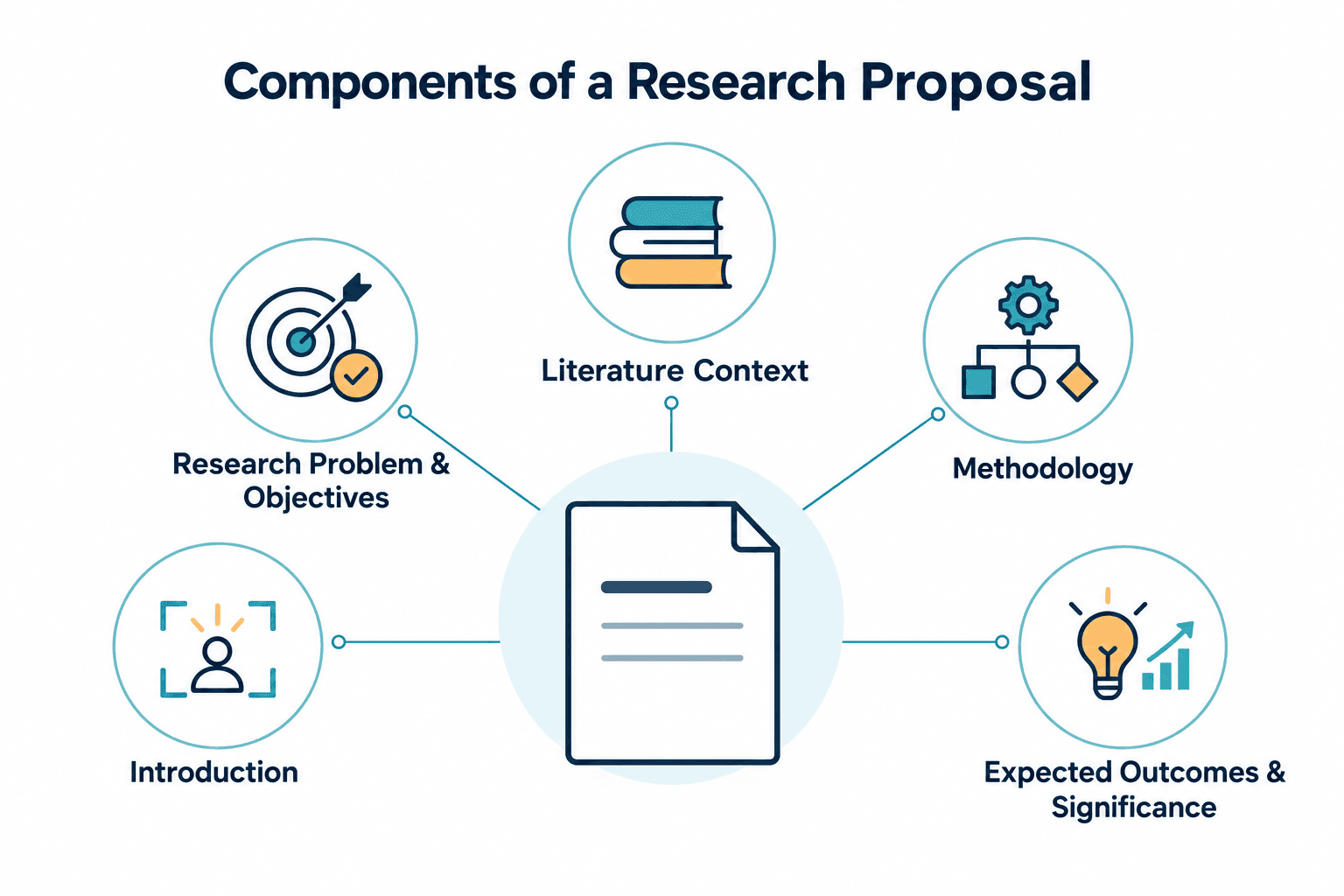
Most proposals share the same core components, although institutions may use different labels or request additional material. Each component should serve a distinct purpose while supporting the same central argument: the question matters, the project is feasible, and the proposed approach can produce a useful answer.
Introduction
The introduction sets the project's context. It should orient the reader to the topic, identify the specific issue the proposal will address, and signal why the question is worth investigating. Avoid trying to summarise an entire field. Use only the context needed to make the problem understandable.
A strong introduction usually moves from the broader setting to a focused problem. By the end of the section, a reader should understand what is not yet known, not yet well explained, or not yet adequately addressed, and why your proposed study is a reasonable response.
Research Problem and Objectives
State the research problem in concrete terms. Explain the issue, gap, or uncertainty the study will address, rather than restating a broad subject area. The problem statement gives the proposal its direction and should lead naturally to the research question.
Objectives translate the question into work the study will actually carry out. They should be specific enough to guide decisions about evidence and method, and realistic enough to complete within the project’s limits. If an objective cannot be connected to a method or a final output, it may be too vague for the proposal.
Literature Context
The literature context shows that the proposal is informed by relevant work rather than built on assumption. Select sources that clarify the problem, show what is already known, and identify the gap or unresolved question your study will address. The goal is not to reproduce a full literature review unless the brief requires one.
Use this section to explain how your project relates to prior research. Where studies agree, show how they support the context. Where they differ or leave a question unresolved, explain why that matters for your proposed work. Keep the claims proportionate to the sources you have reviewed.
Methodology
The methodology section explains how the project will answer its question. It should identify the research design, the sources of evidence or participants, how information will be collected, and how the material will be analysed. The reader does not need every procedural detail, but they should be able to judge whether the approach is suitable and feasible.
Match the method to the question. For example, a question about experiences may call for interviews or qualitative evidence, while a question about patterns across a defined group may require structured data or a survey. Explain the logic of the choice, note practical constraints, and address ethical or access issues where they are relevant.
Expected Outcomes and Significance
Describe the contribution you expect the study to make without presenting it as a guaranteed finding. The contribution may be clearer evidence about a problem, a comparison of existing approaches, an account of a specific population or setting, or a well-defined basis for later work. Explain why that contribution matters to the audience for the proposal.
Examples of Research Proposals (What Good Ones Look Like)
Knowing the standard sections is useful, but the quality of a proposal depends on how specifically those sections work together. The following examples show how a broad topic becomes a question that identifies a context, a population, and a workable approach.
For an education project, this statement is too broad to guide a convincing proposal:
“This study will focus on online education.”
A stronger version identifies what will be studied and how:
“This study examines how asynchronous online learning relates to student engagement among university students in remote areas, using surveys and course-performance data.”
The stronger version gives the reader a population, setting, focus, and plausible source of evidence. It is still a proposal, not a finished result, but it offers enough detail to assess whether the study is coherent and feasible.
The same principle applies to a business topic. This statement is too open-ended:
“This research will explore social media marketing.”
A more useful proposal statement might be:
“This study examines the relationship between short-form video content and purchase behaviour among Gen Z consumers, using a mixed-methods design that combines behavioural data with participant responses.”
Specificity does not mean adding detail for its own sake. It means including the details that let a reader understand the proposed scope, evidence, and method. Use the same test on your own draft: can a reader tell what will be studied, why it matters, and how the question will be answered?
For a structured starting point, use the Research Proposal template
Common Mistakes and Weaknesses in Research Proposals
Most weak proposals fail because the sections do not support the same central claim. The problem may be interesting, but the question can be vague, the method may not fit, or the expected contribution may be asserted without enough context. Look for these issues before asking a reader to evaluate the full draft.

A vague research question creates uncertainty everywhere else. If the question does not identify what is being examined, in which context, and at what level of focus, it is difficult to choose evidence, define objectives, or select a method. Narrow the question until it can guide concrete decisions.
Weak justification is another common problem. Naming a topic is not the same as explaining why a study is needed. Use the literature context to show what is known, what remains uncertain, and why resolving that uncertainty would be useful to the intended audience.
A proposal also weakens when the methodology is disconnected from the objectives. Every major objective should have a credible route to evidence, and the proposal should acknowledge constraints such as time, access, sample size, ethics, or available resources rather than ignoring them.
Finally, do not treat revision as a final proofread. Review the proposal first for logic and alignment, then for clarity. Check whether each section advances the same project, whether key terms are used consistently, and whether a reader could explain the study after reading the proposal once.
Creating a Proposal That Reads Clearly and Persuasively
A persuasive proposal begins with a focused idea and an argument that develops in a logical order. The problem should lead to the research question, the question to the objectives, and the objectives to a method that can realistically produce relevant evidence. When that chain is visible, the proposal is easier to read and easier to assess.
Write each section for a clear purpose. The literature context should establish the need for the project, the methodology should establish feasibility, and the expected contribution should explain why the outcome matters. Avoid repeating the same justification in several sections. Instead, let each section add a new part of the case.
Use research tools to support preparation and drafting, but keep ownership of the argument. Notes, source organisation, and early outlines can help you see connections between ideas. You still need to decide which evidence is relevant, how the sources should be interpreted, and whether the proposal accurately represents the work you intend to do.
Refining and Improving the Draft Proposal
A first draft is a working model of the project, not a final statement. Review it with the same questions a supervisor or reviewer might ask: Is the problem clear? Do the objectives follow from it? Does the method answer the question? Is the scope realistic?
Read the proposal as a continuous argument, not one section at a time. A strong draft makes the relationship between the problem, literature, objectives, and methodology visible without forcing the reader to infer the connections. Remove details that do not support the central question, and add explanation where a decision would otherwise seem unexplained.
Then check the transitions between sections. The end of one section should prepare the reader for the next. For example, the literature context should make the proposed objectives feel necessary, and those objectives should make the methodology feel like a justified response rather than a separate description.
If you use a drafting tool, use it to test clarity and organisation rather than to substitute for subject knowledge. Compare any suggested revision with your sources, institutional requirements, and intended method before incorporating it into the proposal.
Integrating Proposal Writing Into Your Research Process
Proposal writing should be part of the research process rather than a document created after the important decisions have already been made. As your question, sources, and method become clearer, update the proposal so it remains an accurate account of the study you are planning.
With AnswerThis, you can keep early research notes and proposal development connected as you refine the direction of the project. Use that connection to compare evidence and develop an outline, then check the final proposal against the expectations of your programme, funder, or review process.
Keep the working process traceable. Organise the evidence behind the problem statement, record important decisions about scope and method, and make sure the proposal reflects the sources you have actually reviewed. The workflow webinar can provide additional workflow context.
Conclusion
A well-written research proposal gives a project a clear starting point. It makes the problem, question, method, and expected contribution visible before significant time or resources are committed.
The strongest proposals are specific enough to guide action and realistic enough to carry out. They use literature to justify the question, methods to show feasibility, and revision to make the argument easy for a reader to follow.
Clarity and consistency are essential, but so is evidence. Build the proposal around decisions you can explain, sources you can verify, and a scope you can complete.
FAQs
What should a research proposal include?
A strong research proposal explains the research question, objectives, background literature, proposed methods, expected contribution, timeline, and any resources or ethical considerations needed to complete the study.
How do I choose a research question for a proposal?
Choose a question that is specific, important, feasible within the available time and resources, and answerable through an appropriate method. Refine the scope before writing the proposal sections.
How detailed should the methodology section be?
Explain the research design, data sources or participants, collection methods, analysis plan, and ethical considerations. The reader should understand why the method can answer the question and whether the study is feasible.
What mistakes can weaken a research proposal?
Common weaknesses include a vague question, an unfocused literature review, unsupported claims about significance, methods that do not match the question, and an unrealistic timeline or budget.
How can AnswerThis help write a research proposal?
AnswerThis can help you find and organise relevant literature, compare research notes, develop an outline, and create an early draft. Verify sources and make the final methodological and writing decisions yourself.


