

To write a strong thesis statement, turn your research question into a clear, specific, and arguable answer that sets the direction for the whole paper. AnswerThis Thesis Statement Generator can help you turn an early topic or question into a focused starting point that you then test against your sources and refine in your own words.
TL;DR
Turn a focused research question into an answer that is clear, specific, arguable, and supportable with available evidence.
Choose the thesis type that fits the assignment, then use the claim to guide source selection, outlining, and paragraph structure.
Test a draft thesis for scope, evidence, and precision, then revise it as the research develops.
Use AnswerThis to compare relevant sources and organise notes, while keeping final judgment about the argument with the writer.
Understand the Foundations of a Strong Thesis
Understand the Role of a Thesis Statement
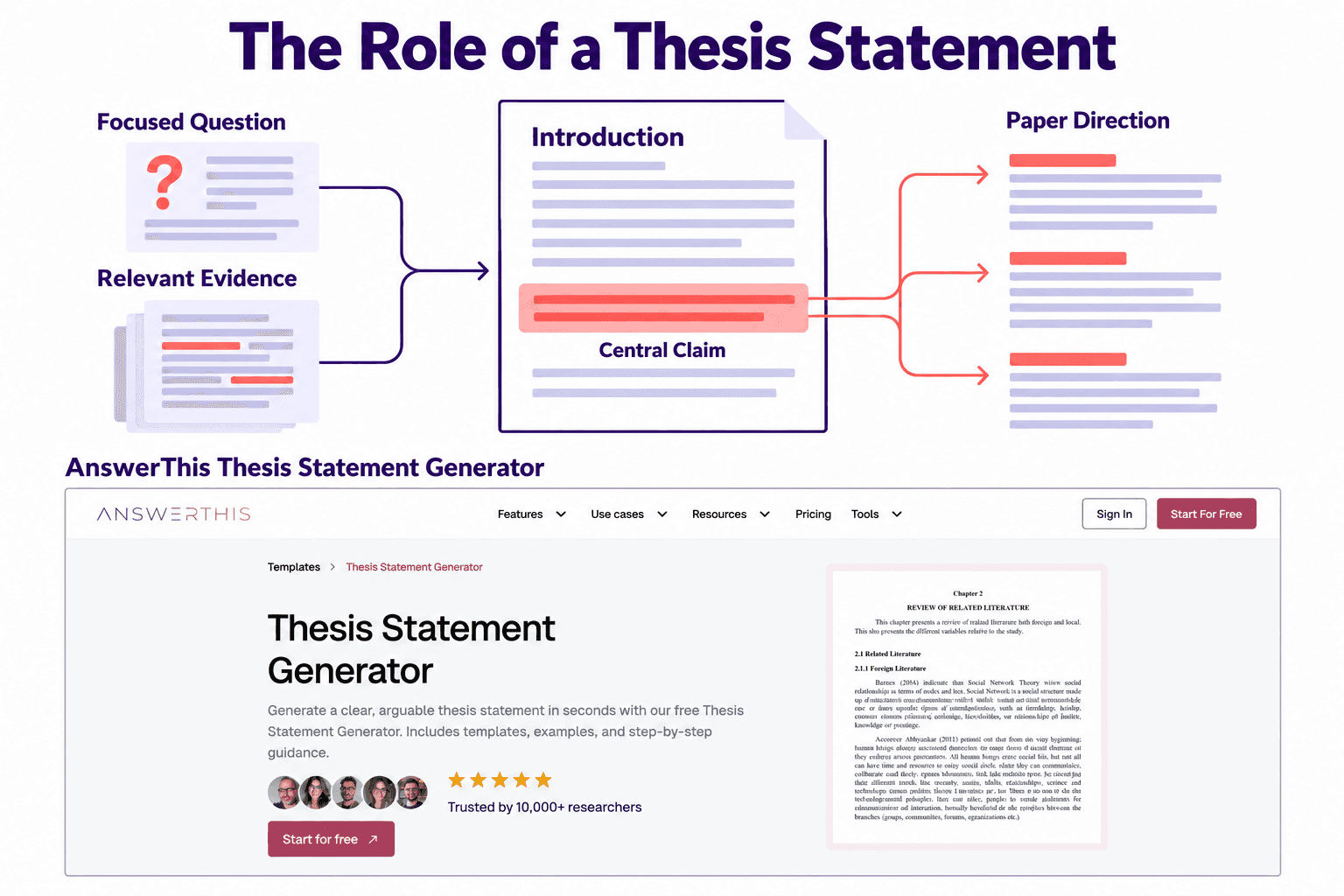
A thesis statement is the paper’s central claim or organising idea. It normally appears near the end of the introduction, where it signals both the paper’s topic and the direction the discussion will take.
It should respond directly to a focused research question.
A workable thesis does more than announce a topic. It makes a claim that can be supported with evidence and gives the reader a clear sense of what the paper will examine.
AnswerThis can help you compare relevant sources, identify recurring patterns, and organise research notes before you write the claim. Use the original papers to check context and decide what your own thesis can reasonably argue.
How the Thesis Guides Your Paper
A thesis statement keeps the research process focused by showing which sources, examples, and concepts are most relevant to the central claim. It also prevents the paper from expanding into loosely related points that do not advance the argument.
Use the thesis as a drafting test. Each paragraph should explain, support, qualify, or apply the claim. If a paragraph does none of these things, revise its role or remove it from the paper.
This focus gives the paper a logical shape: the introduction states the claim, the body develops it with evidence and analysis, and the conclusion returns to what the evidence shows.
Shape a Defensible Claim
Choose a Thesis Type That Fits the Assignment
Choose a thesis type that matches the assignment and the question you need to answer. The clearest thesis is not always argumentative. Its purpose depends on whether the paper must persuade, analyse, or explain.
An argumentative thesis takes a position that readers could reasonably debate. Use it when the paper must defend a recommendation, interpretation, or judgment with evidence and reasoning.
An analytical thesis breaks a subject into parts and explains their relationship, cause, or significance. It is useful for papers that examine how a process works, why an outcome occurred, or how several factors interact.
An expository thesis explains a topic without asking readers to accept a contested position. It works well for papers that clarify a process, concept, or body of information using organised evidence.
Before drafting, compare your research question with the thesis type you plan to use. A question asking “why” or “how” often calls for analysis, while a question asking “what should be done” usually calls for an argument.
Test Whether the Claim Is Strong Enough
A strong thesis statement is clear, specific, arguable, and supportable with the evidence available to you. It should name a manageable topic and make a claim that requires explanation rather than a simple fact anyone would accept.
Avoid claims that are too broad to prove in one paper. Instead, identify the topic, the interpretation or position you will take, and the aspect of the topic your evidence will address.
A quick quality check is useful before drafting. Ask whether the statement answers the research question, whether a reasonable reader could disagree with it, and whether you can identify the evidence needed to support it.
If the thesis fails one of those tests, narrow the claim, clarify the wording, or return to the research. A focused revision at this stage can save substantial rewriting later.

Compare Weak and Strong Claims
The difference between a weak and strong thesis is usually scope. A weak statement offers a general opinion, while a strong statement identifies a specific group, relationship, or effect that the paper can examine.
Weak: “Social media is bad for people.” This statement does not identify who is affected, what effect is being claimed, or what evidence would establish the claim.
Stronger: “A paper examining adolescent social media use could argue that frequent use may be associated with higher anxiety when social comparison is intense and offline support is limited.”
The stronger version identifies a population, makes a qualified and arguable claim, and names the relationships the paper would need to investigate. It also gives the writer a practical roadmap for selecting sources and organising body paragraphs.
Develop and Finalize the Thesis
Develop the Thesis Through Research and Revision
Writing a thesis statement is iterative rather than one-time work. Start with a question, examine the available evidence, draft a provisional answer, and revise the wording as your research becomes more precise.
First, define a research question that is narrow enough to investigate and broad enough to support with credible sources. A focused question helps you avoid gathering evidence that is interesting but irrelevant.
Next, review relevant research for patterns, disagreements, limitations, and gaps. These observations reveal where the evidence is strongest and what claim your paper can responsibly make.
Then draft a simple purpose statement and turn it into a direct, arguable thesis. Add detail only when it clarifies the scope, the relationship you will examine, or the reasoning the paper will develop.
Revise the thesis whenever new evidence changes your understanding of the topic. A revision is a sign that the argument is becoming more accurate, not that the research has failed.
During early research, use the available material to compare findings and record the limits that affect your claim. Keep the original sources beside your notes so the final thesis reflects the evidence rather than a convenient summary.
Use Research Tools Before You Commit to a Claim
Before you settle on a claim, identify the question, the main evidence, and the qualification each source adds. This makes it easier to distinguish a well-supported argument from a statement that merely sounds precise.
Once you have a provisional claim, organise the evidence around the parts of the argument it needs to support. The Research Outline Generator can help you map those claims into a working structure, so you can see whether the thesis is too broad, whether one element lacks evidence, or whether the paper needs a more precise question.
When you are ready to develop the paper, use the AI Writer to turn a structured outline into a working draft. Keep the draft connected to your sources so each claim can be checked and refined during revision.
Run a Final Thesis Check
Before finalising the thesis, check that it answers the research question, makes a claim you can support, and sets a realistic scope for the assignment. A good final test is whether you can explain exactly what evidence each part of the paper will need.
The final thesis should be clear, specific, and focused on one central idea. It should leave room for evidence and analysis rather than trying to cover every part of a broad topic in one sentence.
Keep the wording connected to the research question throughout drafting. This makes the argument easier to follow, helps you evaluate new evidence, and gives the conclusion a clear claim to return to.
Conclusion
A strong thesis statement gives research and writing a clear centre. Start with a focused question, develop an evidence-based answer, and refine the wording until the claim is specific, arguable, and manageable within the paper’s length.
Use the AnswerThis Thesis Statement Generator as a starting point, not a final claim. Test any suggested wording against the evidence, revise it in your own voice, and make sure the final thesis reflects what the paper can actually support.
FAQs
What is the relationship between a research question and a thesis statement?
Your research question identifies what you want to investigate, while your thesis statement gives a focused, arguable answer. A strong thesis keeps the paper connected to the question from research through the final draft.
What makes a thesis statement strong?
A strong thesis statement is clear, specific, arguable, and focused on one main topic. It should give you a workable direction for the evidence, structure, and argument that follow in the paper.
How do I turn a research question into a thesis statement?
Start with a focused research question, review relevant evidence, identify a defensible position, and refine it into a direct claim. You can use a purpose statement first, then make the final thesis more precise as your research develops.
Why should I revise my thesis statement during research?
Research often uncovers new evidence, patterns, and limitations. Revising the thesis helps ensure that it remains accurate, sufficiently focused, and aligned with the strongest argument your evidence can support.
How can AnswerThis help build a thesis statement?
AnswerThis can support the workflow at different stages: use the Thesis Statement Generator for a starting point, the Research Outline Generator to map evidence to claims, and the AI Writer to develop a working draft. In every case, verify the sources and make the final decisions about the argument yourself.


