
AnswerThis
VS

Consensus
AnswerThis vs Consensus: A Full Comparison for Researchers
Consensus is built for quick evidence checks with its Meter. AnswerThis has the whole workspace for research in one deeply verified workflow. This is how the two compare.

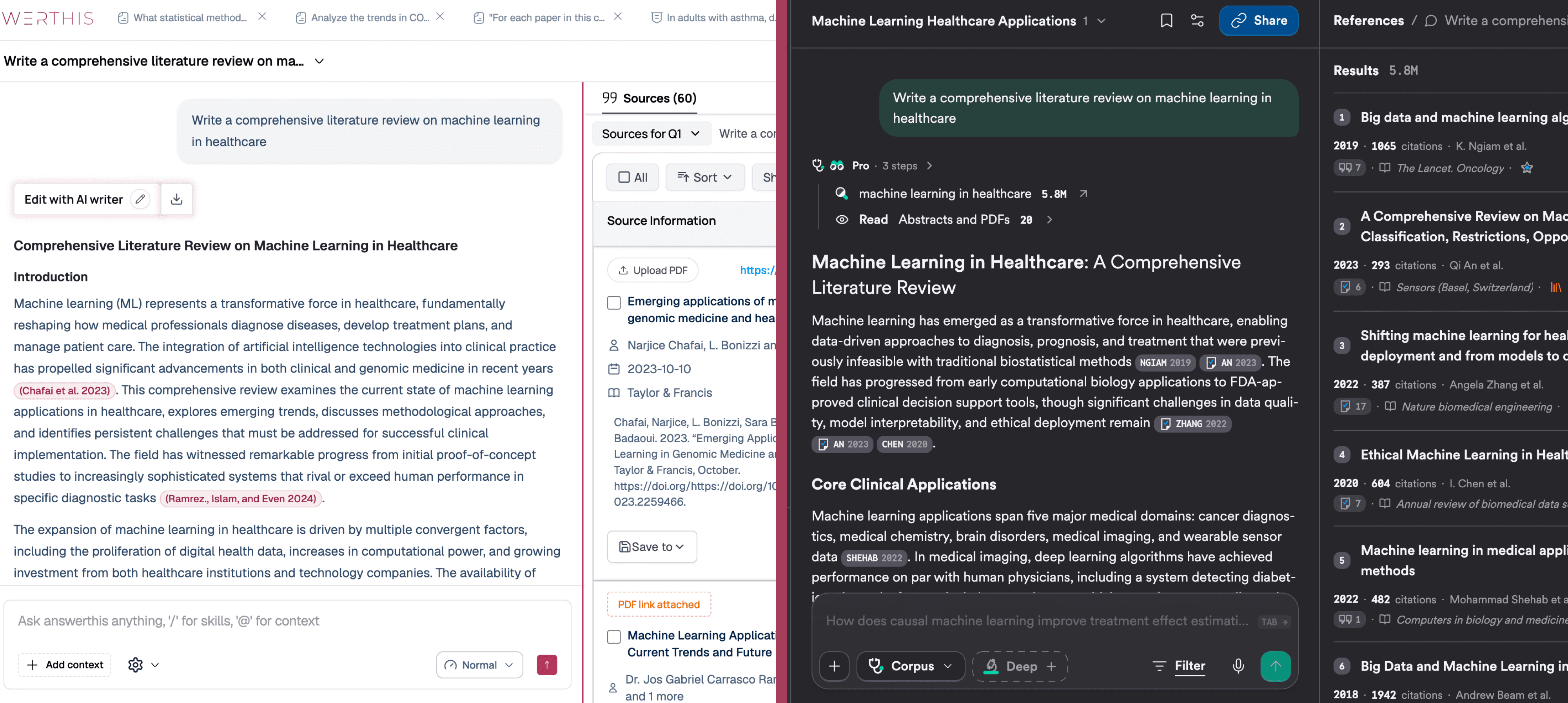
HOW WE VERIFY
Every Answer is Verified Before it Reaches You


AnswerThis
Consensus
Work with your own PDFs
✅
One paper or your whole library.
✅
Upload and search your papers
Systematic review workflow
✅
Agent-led and PRISMA-compliant, every decision logged
⛔
Not a built-in workflow
AI Writer
✅
Draft with one-click citations, plagiarism and AI checks
⛔
No
Free plan
✅
Yes, no card required
✅
Yes
Ask either tool a research question and you get an answer with citations, drawn from the scholarly record rather than the open web


verdict
Our verdict
Consensus and AnswerThis both surface evidence from real papers. They suit different moments in the work.
Choose Consensus if you want to
01
Get a fast yes or no read on a research question
02
See how the top studies lean with the Meter
03
Run quick evidence checks before a deeper dive
04
Keep a light, low-cost evidence search tool
Choose AnswerThis if you want to
01
Get the written review itself, cited line by line.
02
Verify any claim by opening the paper at the exact sentence
03
Work across your own PDFs, extraction tables and library
04
Finish a checked, exportable draft, or a full systematic review
Where A Glance Ends
And A Review Begins
Finding answers is quick. A review has to show where the field agrees, where it splits, and what it leaves open, with a source behind every line. Consensus gives you the first read: how top studies lean on the question you asked. AnswerThis produces the review itself: structured by theme, built from 150+ relevant sources, every line traceable to the paper behind it, ready to refine in the same tab. One tells you where the evidence leans. The other hands you the review.
verdict
Value for money
Compare the value of quick evidence checks versus a complete research workflow.
PLANs
AnswerThis
Consensus
Free
Cited answers and reviews to start, no card required
Search with limited Pro analyses
Entry paid
$14 per month paid annually
Pro, around $10 to $15 per month by billing cycle
Team tier
$30 per month annually
Custom and enterprise plans
Top tier
Max, $250 per month
Custom and enterprise plans
What users say
Reviews from researchers
AnswerThis
★★★★★
5.0 on Product Hunt
AnswerThis has proven to be a reliable and valuable resource in my research work. The platform provides detailed and so far very accurate answers, and its literature tool offers deep, well-curated insights that are truly impressive. The AI writer is also a great asset, helping to streamline academic writing tasks. A highly recommended tool for researchers and academics seeking both precision and efficiency.

MUAIYED BUZAYAN
dental researcher
A purpose serving tool for researchers. It paves the way for deep research in structured way with great features.

Abu Talha
i am student who loves researching
Consensus
★★★☆☆
3.5/5
Congrats on the launch! It's really helpful, I used to try via prompts in chat asking GPT to give answers based on research papers. But I would check the answers by asking for the title of the article and authors to then check that it actually exists via google scholar😅 It's great to be able to simplify this task

Maksim Mamchur
CEO and Product of SubSchool
I appreciate the confidence Consensus' scientific-based answers provide me when researching topics new and old... especially in today's partisan & combative political/news climate

Patrick King
Los Angeles
get started
Give AnswerThis A Research Task
Choose a task and go. AnswerThis handles the searching, reading, citing and drafting with you.
Extract data into tables
Any field across studies, including numbers inside the papers' own tables.
Draft a paper with citations
Write in the AI Writer, cite in one click, check before you submit.
Generate citations in 2,000+ styles
One question in, a structured review out, cited on every line.
FAQ
We have answers to your questions
Is AnswerThis a strong alternative to Consensus?
AnswerThis searches the scholarly literature and cites its answers like Consensus, and adds full PDF reading, the written review with line by line citations, data extraction, the AI Writer and a systematic review pipeline. Consensus remains a strong choice if fast yes or no evidence checks are your main need.
What is the main difference between AnswerThis and Consensus?
Consensus tells you what the evidence says about a question. AnswerThis writes the review itself, a structured, fully cited draft built from 150+ sources, which you refine, check and export from the same workspace.
Do both tools provide citations?
Both do. The difference is what a click gives you. Consensus links to the source paper. AnswerThis opens the PDF at the highlighted sentence, and every claim was checked against that passage before it reached you.
What is the Consensus Meter, and is there an AnswerThis equivalent?
The Meter is the signature Consensus gauge showing how the top papers lean on a yes or no question. AnswerThis does not have a meter. It answers the question in a written, cited review, where you see not just where the field leans but why, source by source.
Is AnswerThis cheaper than Consensus?
The entry prices are close, and Consensus can cost slightly less. AnswerThis covers the search, the review, the extraction, the writing and the checks in one subscription, work that usually spans several tools. Both are free to start.
